

MES Software: Vendors, Features & Costs Compared 2026
MES software compared: vendors, functions per VDI 5600, costs (cloud vs. on-premise) and implementation. Honest market overview 2026.
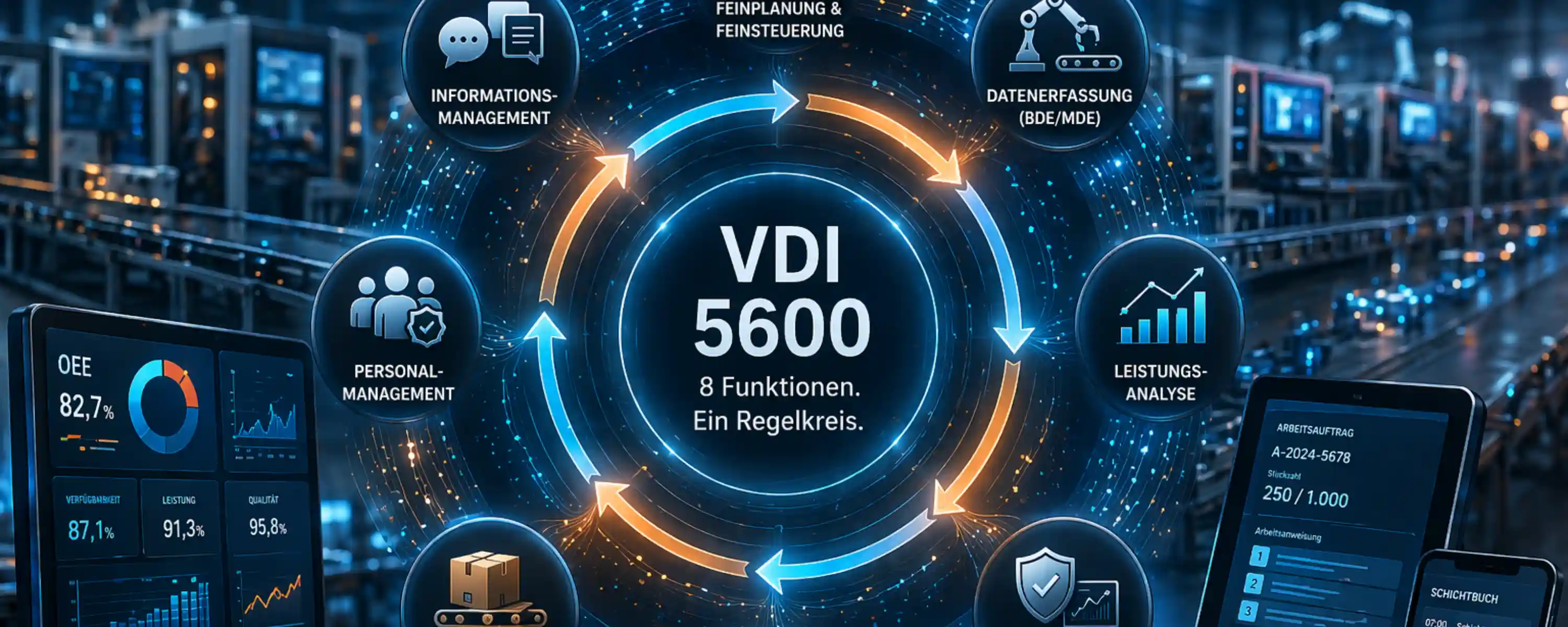
TL;DR: VDI 5600 defines 8 task areas for a Manufacturing Execution System (MES): detailed scheduling & dispatching, data collection (MDC/PDA), performance analysis, quality management, equipment management, material management, personnel management, and information management. Together they form a closed control loop — every deviation in one function affects all others. No company needs all 8 functions on day one. The implementation sequence determines the ROI: data collection and performance analysis first, scheduling and quality follow once the data foundation exists.
Table of contents
The VDI Guideline 5600 by the VDI/VDE Society for Measurement and Automatic Control standardizes the functional scope of Manufacturing Execution Systems. It defines 8 task areas that an MES should cover in manufacturing, and describes their interfaces to ERP (Level 4) and the shop floor (Level 0–2) per ISA-95.
VDI 5600 is the leading MES standard in the German-speaking region. Internationally, ISA-95 (IEC 62264) complements the function definition with a stronger focus on system integration. Both standards describe the same MES at Level 3 of the automation pyramid — VDI 5600 from the function perspective, ISA-95 from the integration perspective.
For the comprehensive MES overview with definition, architectures, costs, and implementation: MES: Definition, Functions & Benefits 2026.
What most VDI 5600 explanations leave out: The guideline describes what an MES should do — not in what order to introduce the functions. In practice, the implementation sequence is the decisive success factor. Companies that start with scheduling before a reliable data foundation exists fail systematically. The implementation matrix below shows the field-proven path.
| # | Task area | Core task | Typical benefit | SYMESTIC module |
|---|---|---|---|---|
| 1 | Detailed scheduling & dispatching | Translate ERP master plan into executable orders, dynamically optimize sequence | 10–30 % less setup time, higher on-time delivery | Fertigungssteuerung, Production Planning |
| 2 | Data collection (PDA/MDC) | Automatically capture machine data (cycle times, downtimes) and production data (orders, personnel) | Data foundation for all other functions, elimination of manual capture | MDE, BDE, OPC-UA Cloud Connector, IoT Gateway |
| 3 | Performance analysis | Calculate OEE, availability, performance, quality in real time and visualize | 5–15 % OEE improvement, losses visible for the first time | Production KPIs, Dashboards, AI Assistant |
| 4 | Quality management | Inline quality monitoring, SPC, inspection planning, traceability | 5–15 % less scrap, complete traceability | Quality module, Process data |
| 5 | Equipment management | Manage machines, tools, gauges; maximize availability | 5–10 % fewer unplanned failures | Maintenance management, Machine alarms |
| 6 | Material management | Material staging, WIP tracking, batch tracking | Shorter lead times, lower WIP, batch traceability | Fertigungssteuerung, ERP interface |
| 7 | Personnel management | Staff assignment, qualification matching, order-based time recording | Right person on right machine, post-calculation | Personnel / Headcount |
| 8 | Information management | Dashboards, digital work instructions, shift log, ERP integration | All levels work from the same data basis | Dashboards, Shopfloor Docs, Shift log, REST-API |
Detailed scheduling translates the ERP's master plan into concrete, executable work orders on the shop floor. While the ERP defines what to produce (product, quantity, deadline), the MES calculates how: sequence, machine, tooling, personnel — in real time.
Sequence optimization: The MES arranges orders to minimize changeovers. Three orders requiring the same tooling are scheduled back-to-back. In practice, this saves 10–30 % of setup time. At Klocke, optimized order sequencing delivered 12 % higher output and 7 additional production hours per week.
Real-time reaction to disruptions: When a machine fails unexpectedly, the MES automatically reschedules affected orders — to an alternative machine or a later shift. ERP only learns about it through delayed feedback. The MES knows in seconds.
Bottleneck detection: Scheduling identifies bottleneck machines in real time. When a machine approaches capacity limits, the MES shows this and suggests actions: shift extension, order relocation, prioritization.
Distinction from ERP: ERP plans in days and weeks. MES plans in hours and minutes. ERP has no awareness of machine states. This distinction is so fundamental that we've dedicated a separate article to it: MES vs. ERP.
Data collection is the foundation for all other MES functions. Without automatic capture of machine data (MDC) and production data (PDA), there is no OEE, no downtime analysis, no order feedback, and no quality documentation.
Machine Data Collection (MDC) captures technical data directly from machines: run times, downtimes, cycle times, piece counts, process parameters (temperature, pressure, torque), energy consumption. Capture happens automatically — via OPC-UA for modern controllers, via IoT gateways with digital signals for brownfield equipment. For details: Machine Data Collection (MDC) explained.
Production Data Acquisition (PDA) extends the scope to organizational data: order assignments, personnel times, setup times per order, start/end times of operations, quality feedback, scrap reasons. PDA links machine data to orders — creating a complete picture of the production process. For details: Production Data Collection explained.
| Capture method | Data types | SYMESTIC connectivity |
|---|---|---|
| Automatic | Machine states, cycle times, piece counts, process parameters | OPC-UA Cloud Connector, MQTT, digital I/O via edge gateways |
| Semi-automatic | Order login, scrap reasons, quality assessments | Shopfloor clients, Smartphone MES App |
| From third-party systems | Production orders, master data, material stocks | REST-API (bidirectional: SAP, Infor, proAlpha, Navision) |
Practical insight from 15,000+ connected machines: Manually captured OEE values typically deviate 8–12 percentage points from automatically measured values. In the first 1–2 weeks after initial automatic capture, the displayed OEE value drops by 15–20 percentage points — not because production gets worse, but because measurement becomes accurate for the first time. This "OEE drop" is the strongest signal that data collection is working: real losses become visible for the first time.
Performance analysis calculates production KPIs like OEE (Overall Equipment Effectiveness), availability, performance, and quality in real time. It is the function that turns raw data into actionable KPIs — the foundation for shopfloor management and strategic improvement programs (CIP, Lean, Six Sigma).
What performance analysis shows:
Neoperl: Performance analysis identified four PLC alarm codes responsible for 80 % of all machine stops. After targeted elimination, technical downtimes dropped by 25 %. At Meleghy Automotive, cross-plant performance analysis delivers comparable OEE data across 6 plants — the foundation for best-practice transfer between sites.
Quality management in the MES ensures that product quality is monitored in real time throughout the production process — not just at the end of the line. For industries with traceability requirements (automotive, food, pharma packaging), this function is not optional but a supplier prerequisite.
Inline quality monitoring & SPC: The MES captures quality-relevant process parameters in real time. Control charts (SPC) monitor process stability, calculate Cp/Cpk automatically, and detect trend deviations before scrap is produced. Neoperl achieved 15 % less scrap through correlation of PLC alarms with quality defects.
Traceability: Every part or batch is documented completely: machine, operator, process parameters, material (batch number), inspection results. When a quality issue arises, the root cause can be traced in minutes. At Meleghy, bidirectional CASQ-it (Böhme & Weihs) integration triggers automatic sampling.
Inspection planning: The MES controls when which inspections are required: first article at order start, sampling during production, 100 % inspection for safety-critical parts.
Equipment management covers all machines, tools, and gauges used in manufacturing. The goal: minimize unplanned failures. Combined with real-time machine data, it becomes the foundation for condition-based and predictive maintenance.
Machine management: Digital representation of every machine — location, condition, operating hours, maintenance history, qualification (which products on which machine). Scheduling uses this data to assign orders only to suitable and available machines.
Tool management: Service lives are monitored, tool changes flagged before quality problems occur. Storage locations and machine assignments managed centrally.
Maintenance interface: The MES provides operating hours, switching cycles, fault history, vibration trends — the data foundation for the transition from calendar-based to condition-based maintenance.
Material management ensures the right material at the right time in the right place. It manages WIP (Work-in-Progress) in real time and enables complete batch tracking.
Personnel management assigns employees to machines and orders — considering qualifications, availability, and shift models. It prevents orders from being scheduled on machines for which no qualified personnel is available.
Information management is the cross-cutting function connecting all other MES capabilities. It ensures the right information reaches the right person at the right time — from the operator at the terminal to the COO on the management dashboard.
Dashboards & reporting: Real-time data from all functions consolidated in configurable, role-based dashboards. At SYMESTIC: no-code editor, unlimited dashboards, unlimited users, smartphone MES app.
Digital work instructions & shift log: Operators receive the current work instruction for the running order on their terminal. Shift handovers are documented digitally — open issues, ongoing actions, special incidents. At Schmiedetechnik Plettenberg, the digital shift log replaced handwritten handover notes entirely.
ERP integration (ISA-95): Information management controls the bidirectional data exchange with ERP. Orders come from ERP, feedback (quantities, times, quality) flows back. At Meleghy via ABAP IDoc to SAP R3. At Schmiedetechnik Plettenberg to InforCOM. At Klocke via file interface to Navision. ISA-95 (IEC 62264) defines this interface as standard.
The 8 VDI 5600 functions are not isolated modules — they form a closed control loop running in real time. Every deviation in one function affects all others.
The loop in one sentence: Scheduling creates orders → Data collection reports progress → Performance analysis evaluates results → Quality management verifies quality → Equipment management ensures availability → Material management delivers materials → Personnel management assigns operators → Information management makes everything visible → Scheduling reacts to deviations.
Concrete example: unplanned machine downtime
A press fails unexpectedly. What happens in the control loop?
This sequence takes seconds to minutes. Without MES, the same process takes hours — because every piece of information is communicated manually, every decision made manually, every adjustment executed manually.
VDI 5600 describes what an MES should do — not in what order to introduce the functions. From 15,000+ machine connections, a clear pattern emerges: companies that start with data collection and performance analysis achieve ROI faster than those starting with scheduling or quality management. The reason: without a reliable data foundation, every subsequent function lacks its base.
| Phase | VDI 5600 functions | Timeline (SYMESTIC) | Expected effect |
|---|---|---|---|
| 1. Foundation | Data collection (PDA/MDC) + Performance analysis + Information management | < 1 month (10 machines) | Real-time transparency, OEE baseline, losses visible for the first time |
| 2. Execution | Scheduling & dispatching + Equipment management | Month 2–4 | Order dispatching, setup optimization, maintenance interface |
| 3. Assurance | Quality management + Material management | Month 3–6 | SPC, traceability, WIP reduction |
| 4. Optimization | Personnel management + advanced analytics (AI, energy monitoring) | From month 6 | Qualification matching, post-calculation, predictive approaches |
The most common mistake: Starting with scheduling before data collection is in place. This leads to orders being planned based on estimates — not on real machine states. The scheduling engine makes decisions on a false basis. Result: the system produces plans nobody trusts, and the team returns to Excel. → Always first: data collection + performance analysis. For the full implementation guide: MES Implementation: From Pilot to Rollout.
SYMESTIC covers all 8 VDI 5600 task areas as a cloud-native, modularly expandable platform. The following table maps each VDI function to the specific SYMESTIC module — with package availability.
| VDI 5600 function | SYMESTIC module | Available from package |
|---|---|---|
| Data collection (MDC/PDA) | MDE, BDE, OPC-UA Cloud Connector | Segments (entry-level) |
| Performance analysis | Production KPIs, AI Assistant, Dashboards | Starter package |
| Information management | Dashboards, Shopfloor Documents, Shift log, Smartphone App | Starter package |
| Scheduling & dispatching | Fertigungssteuerung, Production Planning | Extension module |
| Quality management | Quality module, Process data | Extension module |
| Equipment management | Maintenance management, Machine alarms | Alarms package / Extension |
| Material management | Fertigungssteuerung, ERP interface (REST-API) | Interface package |
| Personnel management | Personnel / Headcount | Extension module |
→ Configure all modules and pricing
What are the core functions of an MES per VDI 5600?
VDI 5600 defines 8 task areas: detailed scheduling & dispatching, data collection (PDA/MDC), performance analysis, quality management, equipment management, material management, personnel management, and information management. Together they form a closed control loop for real-time production management.
What is the difference between MES scheduling and ERP planning?
ERP plans in days and weeks based on orders and capacities. MES scheduling plans in hours and minutes based on real-time machine states, personnel availability, and material supply. The MES reacts to unplanned events in real time. More: MES vs. ERP.
Does an MES need all 8 functions from the start?
No. The typical entry point is data collection (MDC/PDA) + performance analysis (OEE) + information management (dashboards). Scheduling, quality, and material management are activated as needs grow. Cloud-native MES platforms enable this gradual expansion without changing systems. The implementation matrix shows the field-proven sequence.
What is VDI 5600?
VDI 5600 is a guideline by the VDI/VDE Society standardizing the functional scope of Manufacturing Execution Systems. Internationally, ISA-95 (IEC 62264) complements the standard with a focus on system integration.
What is the difference between VDI 5600 and ISA-95?
Both describe the MES at Level 3 of the automation pyramid. VDI 5600 defines the 8 functions (what the MES does). ISA-95 defines the interfaces (how the MES communicates with ERP and shop floor). In practice, they complement each other: VDI 5600 for scope, ISA-95 for integration.
How do the 8 functions work together?
They form a closed control loop: scheduling creates orders → data collection reports progress → performance analysis evaluates results → all other functions react to deviations → scheduling adjusts. The control loop example shows the sequence during an unplanned machine downtime.
The key takeaway: VDI 5600 defines 8 functions — but the implementation sequence determines success or failure. Always first: data collection + performance analysis. Everything else builds on that foundation.
Further reading in the MES cluster:
→ MES: Definition, Functions & Benefits 2026 (Pillar)
→ MES Architectures Compared
→ MES vs. ERP
→ MES Implementation: Pilot to Rollout
→ MES Software: Vendors, Features & Costs
→ MES Costs 2026
→ Production Data Collection
→ Machine Data Collection (MDC)
→ OEE: Definition, Calculation & Practice


MES software compared: vendors, functions per VDI 5600, costs (cloud vs. on-premise) and implementation. Honest market overview 2026.
OEE software captures availability, performance & quality automatically in real time. Vendor comparison, costs & case studies. 30-day free trial.
MES (Manufacturing Execution System): Functions per VDI 5600, architectures, costs and real-world results. With implementation data from 15,000+ machines.