A batch report is the record of how one specific batch was made: which materials went in and in what quantity, which steps ran when and on which equipment, which in-process checks gave which results, what the yield was and what deviated from the plan. Outside pharma, the same term is used for the production report of a batch or lot. In regulated manufacturing it is the evidence that the batch was produced according to the approved master record.
The term itself does not appear in the regulations. US rules speak of batch production and control records, the EU GMP guide of the batch processing record. Both cover the same content, and the EU keeps packaging in a separate batch packaging record.
What US and EU rules require
Under 21 CFR 211.188, a batch production and control record must be prepared for each batch of drug product. It starts from an accurate reproduction of the master production or control record, checked, dated and signed, and documents each significant step. The EU GMP guide sets a similar list for each batch processed (EU GMP Chapter 4, section 4.20).
| Content | 21 CFR 211.188 | EU GMP 4.20 |
|---|
| Product name and batch number | not listed separately; the record is kept per batch | a) |
| Dates and times of significant steps | (b)(1), dates only | b) |
| Major equipment and lines used | (b)(2) | e) |
| Batch identity and weights of each component | (b)(3), (b)(4) | d) |
| In-process and laboratory control results | (b)(5) | f) |
| Actual yield and percentage of theoretical yield | (b)(7) | g) |
| Line clearance, labeling, containers and closures | (b)(6), (b)(8), (b)(9), (b)(13) | separate batch packaging record, 4.21 |
| Sampling performed | (b)(10) | not listed separately |
| People who performed and checked each step | (b)(11) | c) |
| Deviations and investigations | (b)(12), with 211.192 | h) |
| Signature of the person responsible for the processing operations | not listed separately | i) |
| Review and approval before release | quality control unit, 211.192 | outside 4.20: certification by the Qualified Person |
In the US, batch records are kept for at least one year after the batch expiration date (21 CFR 211.180(a)). In the EU, batch documentation is kept for at least one year after the batch expires or five years after certification by the Qualified Person, whichever is longer (section 4.11).
Worked example: yield and reconciliation
The numbers are invented for illustration. A tablet batch is set up for a theoretical 200,000 tablets.
| Item | Tablets | Share |
|---|
| Theoretical quantity | 200,000 | 100.00% |
| Good tablets after compression | 196,400 | 98.20% |
| In-process samples and retained samples | 900 | 0.45% |
| Start-up and setup rejects | 2,100 | 1.05% |
| Unaccounted for | 600 | 0.30% |
Actual yield is 196,400 of a theoretical 200,000, or 98.2 percent. The reconciliation only closes if every line is counted. In this example the master record allows up to 0.5 percent unaccounted loss, so the 0.3 percent is within the limit. Under 21 CFR 211.192, any unexplained discrepancy, including a yield outside the limits set in the master record, must be thoroughly investigated, whether or not the batch has already been distributed. The investigation extends to other batches that may be affected.
Review: every page or by exception
All production and control records are reviewed and approved by the quality control unit before a batch is released (211.192). On paper this means reading every entry. The EU GMP guide allows a shorter route. Where a validated process is continuously monitored and controlled, automatically generated reports may be limited to compliance summaries and exception reports (note to 4.20). Review then concentrates on what departed from normal.
| Format | Strength | Weakness |
|---|
| Paper | simple, available anywhere | illegible or late entries, page-by-page review |
| Spreadsheet | calculations done automatically | easy to change without trace, versions hard to prove |
| Electronic batch record | values taken directly from scales and equipment, checks at entry, review by exception | must be validated, demanding to introduce |
Electronic records must meet 21 CFR Part 11 in the US, which requires time-stamped audit trails (11.10(e)), and Annex 11 of the EU GMP guide, which requires an audit trail based on a risk assessment.
Common gaps in batch reports
- Entries made after the fact. Times are filled in at the end of the shift from memory.
- Missing initials. A step is done but nobody signed it off.
- Deviation without approval. A stoppage or rework appears in the record, the signed authorization does not.
- Incomplete reconciliation. Start-up rejects are not counted and the yield does not add up.
- Component batch numbers. One is missing or mistyped, and traceability breaks.
Batch reports outside pharma
In food, chemicals, plastics or metalworking, a batch report is the production report for one batch or lot. Its content is set by the company, its customers and the rules of its industry. A typical report records:
- order and batch or lot number
- start and end time
- good quantity and scrap
- downtime with its reason
- operators and shift
- inspection results and deviations
The yield and reconciliation logic from the example above applies in the same way.
Line data for the batch report with SYMESTIC
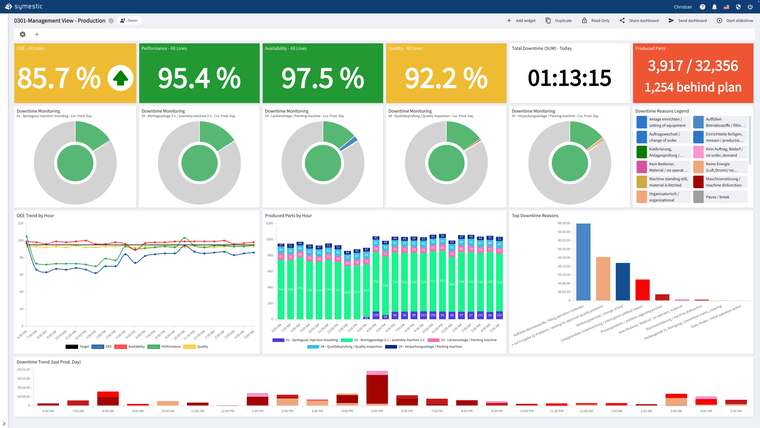
SYMESTIC does not keep a GMP batch record with electronic signatures and an audit trail; that stays with the manufacturer's validated system. SYMESTIC captures the line data that feed into it: quantities, scrap and downtime automatically, order status and current operation live, and paperless documentation at the workstation. Klocke, a GMP pharmaceutical packager, had all lines at its site live, without any change to the PLC.
See the page on production control software for details, or read how a batch number ties records together.
Sources