



MES Software: Vendors, Features & Costs Compared 2026
MES software compared: vendors, functions per VDI 5600, costs (cloud vs. on-premise) and implementation. Honest market overview 2026.

A MES (Manufacturing Execution System) is software that controls, monitors and optimizes manufacturing processes in real time. The system bridges the gap between the ERP system at the planning level and the shop floor with machines, sensors and operators.
The core task: accompanying the transformation of raw materials into finished goods without gaps, while automatically capturing operational, machine and quality data.
The definition of a Manufacturing Execution System is in every textbook. MESA International listed the 11 core functions decades ago. ISA-95 defines where an MES sits in the enterprise architecture. And yet most MES implementations do not deliver the results that were promised in the vendor presentation.
The problem is rarely the software. It is how MES projects are executed. Across more than 25 years of MES implementations and data from over 15,000 connected machines in 18 countries, a recurring pattern emerges:
Companies invest six figures in an MES, then implementation takes 12 to 18 months, and by the time the system goes live, the organization has changed, the project manager has moved on, and the original requirements are outdated.
The consequence: A large proportion of installed MES systems end up being used as expensive data collection machines rather than the operational control instruments they were meant to be. The dashboards exist, but nobody acts on them. Data is gathered, but never distilled into decisions. This article does not just explain what an MES is. It shows what an MES actually changes in practice, which architectures matter today, what an implementation realistically costs, and how companies move from data collection to measurable improvement.
MESA International originally defined 11 core MES functions. The international standard ISA-95 (IEC 62264) positions the MES at Level 3, between ERP (Level 4) and the process control layer (Level 2). In German-speaking markets, VDI 5600 provides the most widely used functional framework. Regardless of which standard a company follows, the functions converge around the same operational needs.
Detailed scheduling translates the master plan from the ERP into concrete work orders. The MES factors in actual machine availability, tooling and personnel, and dynamically adjusts the sequence when conditions change. In practice, this is where an MES creates the largest operational difference compared to spreadsheet-based planning: it reacts to disruptions, material shortages or staff absences in real time.
Data collection is the foundation of every MES function. Without automatic capture of machine data (MDC) and production data (PDC), the data basis for all subsequent functions is missing. Machine data collection delivers cycle times, piece counts and downtime events directly from the equipment. Production data collection adds order, shift and personnel information. The quality of this data determines the quality of every KPI and every decision built on top of it.
Performance analysis calculates production KPIs such as OEE (Overall Equipment Effectiveness), availability, performance and quality in real time. These metrics are the foundation for operational decisions in shopfloor management and for strategic improvement programs. Without an MES, performance analysis relies on manual estimates that systematically deviate from reality. From SYMESTIC implementation data: when companies first switch on automatic data collection, the measured OEE value is on average 8-12 percentage points below what the team had previously estimated.
Quality management monitors process and product quality in real time, documents inspection results and automatically triggers corrective actions when deviations occur. For industries with traceability requirements (automotive, food and beverage), this function is not optional but a prerequisite for supplying OEMs.
Equipment management tracks machines, tools and gauges with the goal of minimizing unplanned failures. Combined with real-time machine data, it becomes the basis for predictive maintenance.
Material management ensures timely supply of materials to production and manages work-in-progress and buffer inventories. The connection to the ERP system synchronizes material stocks between planning and shop floor.
Labor management matches orders to the availability and qualifications of operators. In plants with rotating shift patterns and product-specific skill requirements, this function prevents orders from being scheduled on machines where no qualified operator is available.
Information management ties all the above functions together and delivers the right information to the right person at the right time. In practice this means: the operator sees the current order with work instructions at their machine, the shift leader sees the OEE dashboard for their line, and the plant manager sees the aggregated status of all lines.
The value question cannot be answered with theory. It can only be answered with data. Across hundreds of MES implementations and all industries, five measurable outcome categories emerge consistently.
Transparency is the first and most immediate effect. Within hours of connecting the first machine, companies see actual downtime causes, cycle times and loss patterns for the first time. At Yanfeng International, a global automotive supplier with over 30 sites and more than 500 connected segments, the time spent on KPI reporting dropped by over 90%. The information existed before, but it was scattered across spreadsheets, shift logs and ERP reports. The MES brought it to one place.
Downtime reduction follows once loss causes become visible. At Meleghy Automotive, an international automotive supplier with plants in Germany, Spain, the Czech Republic and Hungary, downtime decreased by 10% within six months. No machines were repaired. The loss causes had simply become visible for the first time, and teams could respond precisely instead of searching blindly. At Brita, an internationally leading consumer goods manufacturer with highly automated assembly lines, downtime reduction was 5%, accompanied by a 7% increase in output.
Efficiency gains result from the combination of less downtime, shorter changeover times and better utilization. The typical productivity improvement in the first 12 weeks is 2-5%. That sounds modest, but for a plant with 50 machines running three shifts, a 2% productivity increase translates to a six-figure annual value.
Cost reduction is the direct consequence of transparency and efficiency. The CAPEX saving compared to traditional on-premise MES systems is over 95% with cloud-native solutions. This saving refers not just to the software, but to the entire project environment: no server infrastructure, no local IT support, no months of customization work.
Scalability shows when a company rolls out from a pilot in one plant to multiple sites. At Meleghy Automotive, the rollout from the pilot in Wilnsdorf to all core processes at every international site took six months. After a one-day enablement workshop, the plants executed the rollout independently. That is an implementation pace that is not achievable with traditional on-premise MES projects.
The architecture of an MES determines not just the technical infrastructure, but also implementation speed, ongoing costs and long-term innovation capability.
On-premise MES is installed locally in the company's data center. This architecture offers maximum data sovereignty and deep customization. The price: six-figure upfront investments, implementation timelines of 12 to 24 months, ongoing costs for server infrastructure, maintenance and upgrades. On-premise is suited for companies with strict regulatory requirements (e.g. validated pharmaceutical processes) or sites without stable internet connectivity. Established vendors in this segment such as MPDV (Hydra X), Siemens (Opcenter), SAP (Digital Manufacturing) and Rockwell Automation (Plex) offer comprehensive functional coverage but require correspondingly complex implementation projects.
Cloud-hosted MES (lift and shift) moves existing MES software into cloud infrastructure. This reduces internal IT effort but does not change the underlying architecture. The software often remains monolithic, licensing and maintenance costs persist, and scalability is limited. SAP Digital Manufacturing Cloud and Siemens Opcenter partially fall into this category: they offer the integration strength of their ERP ecosystems but still require complex implementation projects.
Cloud-native MES is built from the ground up for the cloud: microservice architecture, open APIs, automatic scaling, automatic updates. Implementation time is typically days to weeks rather than months. Entry is via a SaaS model with no upfront investment. The constraint: cloud-native MES requires a stable internet connection and is not currently suited for fully validated pharmaceutical processes. SYMESTIC is built as a cloud-native MES platform on Microsoft Azure, covering ISA-95 Level 3 core functions: order management, real-time data collection, performance analysis, quality tracking.
See in a demo how SYMESTIC connects machines, captures data and makes production transparent.
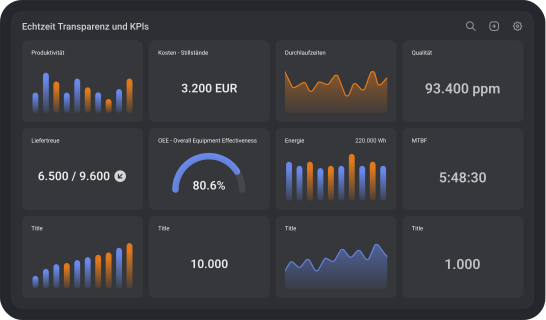

The complete comparison of all three architectures: MES Architectures Compared
Deep dive: Cloud MES: Benefits, Costs and Implementation
An MES without ERP integration delivers shop floor transparency but no end-to-end value chain. An ERP without an MES plans in theory but has no contact with reality on the shop floor. Only together do they deliver full value.
The ERP system (Enterprise Resource Planning) manages the business level: which products to manufacture in what quantities by when. The MES translates those targets into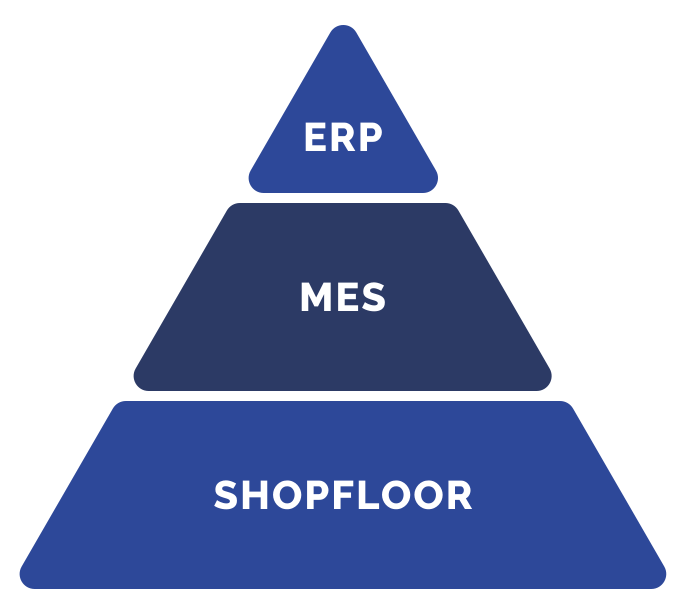 operational reality: which machine runs with which tool in which sequence, and who operates it. Feedback from the MES (quantities produced, downtime, quality data) flows back into the ERP, improving planning, costing and delivery date commitments.
A concrete example: The ERP specifies that 10,000 parts must be produced by Friday. The MES checks in real time which machines are available, what the current speed is and where bottlenecks are forming. It controls the sequence dynamically and reports back whether the deadline is realistic or whether adjustments are needed. At Meleghy Automotive, a bidirectional SAP R3 integration via ABAP IDoc was used to assign machine cycles directly to production orders, while the feedback loop into the ERP provided end-to-end transparency.
The international standard ISA-95 (IEC 62264) defines the interface between MES (Level 3) and ERP (Level 4) as a central element of modern production IT. Only through this integration do continuous data flows and a reliable foundation for Industry 4.0 emerge.
In practice, these terms are frequently used imprecisely. For a successful system selection, the distinctions matter.
ERP manages the business level: planning, procurement, finance, HR, supply chain. ERP decides what gets produced. MES decides how it gets produced. The two systems operate on different time scales: ERP plans in days and weeks, MES controls in minutes and seconds.
SCADA (Supervisory Control and Data Acquisition) is a pure monitoring and control system for machines and equipment. It captures process values such as temperatures, pressures and runtimes. An MES goes further: it connects this machine data with orders, materials, personnel and quality targets. SCADA delivers signals. MES turns them into actionable information.
MOM (Manufacturing Operations Management) is the umbrella term covering all operational systems in manufacturing: MES, quality management, maintenance, laboratory information systems. MES is the core system within MOM that connects the other functions. MOM is the big picture. MES is the heart of it.
The cost of an MES depends less on the feature set than on the architecture and implementation model.
On-premise MES typically requires six-figure upfront investments: license fees, server infrastructure, implementation project with external consultants, training, customization. Annual maintenance fees of 15-20% of the license value come on top. The total cost of ownership over five years for a mid-sized manufacturer with 50-100 machines often reaches mid to high six figures.
Cloud-native MES works on a SaaS model: monthly or annual fees per machine or segment, with no upfront investment. Implementation happens in days to weeks rather than months. Maintenance, updates and infrastructure are included. At Yanfeng International, this meant a CAPEX saving of over 95% compared to the previous on-premise approach. Configure a monthly price here.
The critical cost factor is not the software itself but the implementation project. In traditional MES deployments, implementation costs regularly exceed license costs by a factor of 2-3x. Cloud-native platforms largely eliminate this factor because they rely on standard configuration rather than custom development.
Successful MES implementations follow a clear pattern. Across hundreds of deployments, three phases emerge consistently.
Phase 1: Pilot and first transparency (weeks 1-4). The start is deliberately small: one plant, one line, 5-10 machines. The goal is not a full MES rollout but the first proof that automatic data collection works and delivers immediately actionable insights. At Meleghy Automotive, the pilot started at the Wilnsdorf plant with Schuler presses. The first machines were connected live during the onboarding training itself. A large-screen monitor directly at the line showed cycle times, piece counts and downtime events in real time. Process stability improved visibly on the first day.
Phase 2: Optimization and scaling (months 2-6). The losses that have become visible are prioritized and systematically eliminated. Simultaneously, the rollout to additional lines and plants begins. What matters in this phase is not the software but the organizational embedding: daily dashboards in shopfloor management, weekly OEE reviews, clear ownership for identified loss causes.
Phase 3: Continuous improvement (from month 6). The MES is no longer a project but an operational control instrument. New use cases are implemented independently, additional KPIs are integrated, and the platform is expanded with functions such as order management, quality management or energy monitoring.
The decisive success factor across all phases: Implementation speed must be high enough that initial results become visible before the organization loses interest. This is why projects with 12-18 months of lead time fail more often than those that deliver first data within weeks.
The MES market is changing fundamentally. Three developments define the direction.
Cloud and SaaS are gaining ground in manufacturing. According to IoT Analytics, as early as 2021 around 29% of manufacturers planned to migrate their MES to the cloud. Five years later, cloud-native MES is no longer a niche solution but the standard architecture for new deployments in mid-sized manufacturing. The driver is not technology enthusiasm but economics: SaaS models eliminate the upfront investment and reduce total cost of ownership by 40-60% compared to on-premise. According to The Insight Partners, the global MES market is projected to grow from US$ 16.66 billion in 2024 to US$ 36.13 billion by 2031, a CAGR of 11.8%. The cloud MES segment is growing even faster, from US$ 10.64 billion to US$ 24.13 billion (CAGR 12.5%).
IIoT integration makes machine data universally accessible. Standard protocols like OPC UA enable the connection of heterogeneous machine parks without proprietary middleware. In practice this means: a plant with machines from ten different manufacturers can be fully connected within days. Connection happens via edge gateways that transform raw data on-site and transmit it to the cloud according to the highest security standards.
Artificial intelligence extends the MES with predictive capabilities. Instead of only measuring what has already happened, AI recognizes patterns in production data and forecasts failures, quality deviations or bottlenecks before they occur. Predictive OEE, automatic anomaly detection and AI-driven scheduling optimization are the concrete use cases emerging from the convergence of MES and machine learning.
What is an MES? An MES (Manufacturing Execution System) is software that controls, monitors and optimizes manufacturing processes in real time. It bridges the gap between the ERP system at the planning level and the shop floor. Core functions are defined in ISA-95 (IEC 62264) and, in German-speaking markets, VDI 5600.
What functions does an MES have? The MESA model defines 11 functions. The most widely used framework (VDI 5600) groups them into eight: detailed scheduling, data collection (MDC/PDC), performance analysis (OEE), quality management, equipment management, material management, labor management and information management.
What is the difference between MES and ERP? ERP (Enterprise Resource Planning) plans what gets produced: products, quantities, due dates. MES executes those plans operationally and controls how production runs: sequence, routing, machine control. ERP operates in days and weeks. MES operates in minutes and seconds.
What does an MES cost? Costs depend on architecture. On-premise MES typically requires six-figure upfront investments plus ongoing maintenance. Cloud-native MES runs on monthly SaaS fees with no upfront investment. Total cost of ownership over five years is 40-60% lower with cloud-native compared to on-premise.
How long does an MES implementation take? On-premise systems: 12-24 months. Cloud-native platforms: days to weeks for initial connectivity, under one month for first production KPIs, under six months for a complete MES. Implementation speed is the single biggest lever for project success.
What is the difference between on-premise and cloud-native MES? On-premise is installed locally, offers maximum data sovereignty, but requires high upfront investment and long implementation timelines. Cloud-native is built from the ground up for the cloud, offers fast deployment and SaaS pricing, but requires a stable internet connection.
Which industries use MES? MES is deployed across discrete and batch manufacturing: automotive, metalworking, plastics, food and beverage, electronics, consumer goods. In pharmaceutical and medical device manufacturing, additional validation requirements (GMP, FDA) apply that require specialized MES modules.
Does my company need an MES? If you run more than 10 machines in multi-shift operation and cannot give a reliable answer to the question "What is your OEE?", you are missing the data foundation for systematic improvement. An MES provides that foundation. With cloud-native platforms, getting started no longer requires a six-figure investment.