
MES Software: Vendors, Features & Costs Compared 2026
MES software compared: vendors, functions per VDI 5600, costs (cloud vs. on-premise) and implementation. Honest market overview 2026.
Shop floor management software digitizes production control where it matters most: at the point of action. Real-time KPIs instead of handwritten whiteboards, automatic deviation detection instead of daily status meetings from memory, data-driven actions instead of gut feeling. It replaces the physical shop floor board with a digital dashboard – and extends it with capabilities that a whiteboard could never provide.
For the foundational overview – what shop floor management is, its principles, and how it connects to lean production and continuous improvement – we recommend the main blog article: Shop Floor Management – Principles, Methods, and Best Practices.
This article covers the software side: What solutions exist? What separates a digital shop floor board from a fully integrated platform? What does it cost? And what matters when replacing a physical board with a digital system?
The physical shop floor board – whiteboard with magnets, printed OEE numbers from yesterday, handwritten action lists – has carried shop floor management for decades. It works. But it has three structural limitations that become increasingly problematic as operational demands grow.
First: the data is always outdated. The board shows yesterday's numbers, or at best the last shift's. A downtime event running for two hours does not appear on the board. A cycle time that is gradually declining goes unnoticed until the shift report is written. Shop floor management depends on recognizing deviations immediately and responding fast – with yesterday's data, that is structurally impossible.
Second: data quality is limited by manual transfer. When a team leader writes OEE values on the board that were read from an Excel spreadsheet, which was populated from handwritten shift logs, the data passes through three error-prone transfer steps. The numbers on the board are an approximation of reality, not a reflection of it.
Third: cross-site management is impossible. A board stands in one hall. A plant manager with four lines needs four boards. A company with three sites has twelve boards that nobody consolidates. Comparisons between shifts, lines, or plants require manual compilation – and therefore rarely happen in practice.
Shop floor management software eliminates all three problems. Data comes directly from the machines – in real time, automatically, without manual transfer. Dashboards are accessible everywhere – on the large display at the line, on a tablet during the shop floor walk, on a laptop in the management meeting. And data from all lines, shifts, and sites is consolidated in a single platform.
Real-time machine status, OEE, and downtime Pareto instead of a handwritten whiteboard. Install gateway, configure dashboard, done.

The feature scope varies significantly between vendors – from simple digital boards to fully integrated MES platforms. Five functional areas form the core.
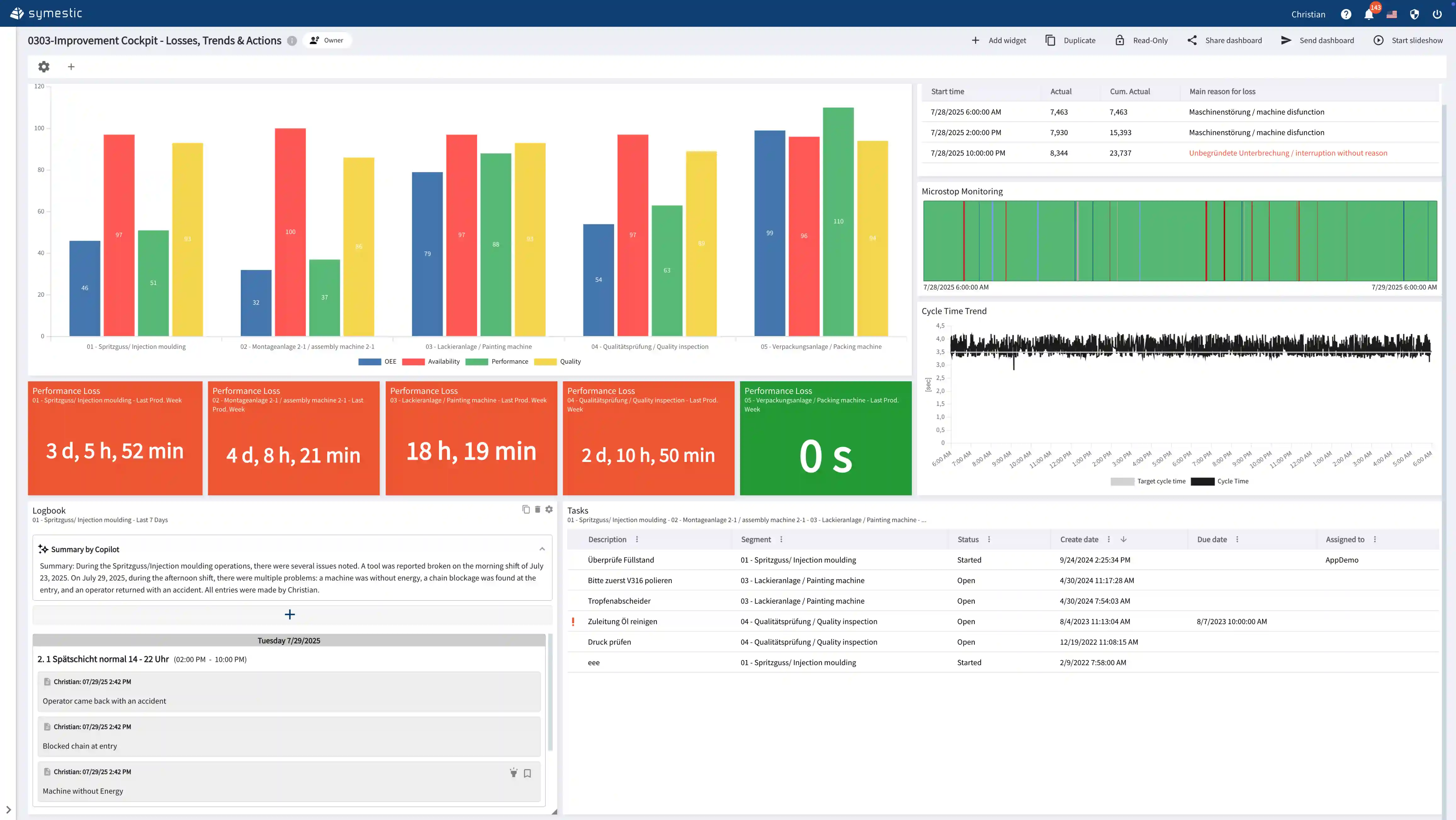
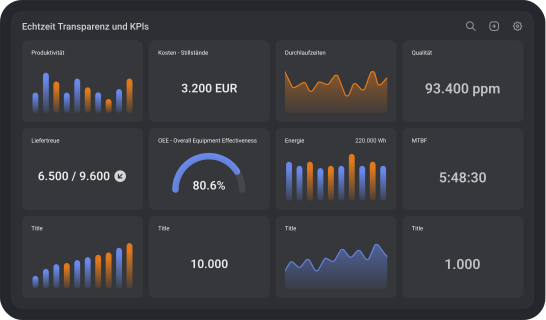
The central function: a dashboard showing the current state of production – machine status (green/red/yellow), OEE, part counts (target vs. actual), active downtimes with duration and cause, order progress. This board replaces the physical whiteboard and is displayed on large screens at the line, on shop floor terminals, or on tablets. The critical requirement is that data updates automatically – not hourly or per shift, but in real time.
Shop floor management operates on the principle "detect deviation → understand cause → initiate action." Software makes this process systematic: automatic alerts when thresholds are exceeded (downtime duration, cycle time deviation, scrap rate), structured capture of deviation causes, and a digital action tracker with owners, deadlines, and completion status. What used to be a sticky note reading "Miller to check" becomes a trackable action with accountability.
Same line, two shifts, different OEE values. Why? On the physical board, this comparison requires pulling shift reports from the past four weeks and laying them side by side. In the software, it is a single click: Shift A vs. Shift B, visualized as a trend line over weeks. These comparisons reveal differences in work practices, setup procedures, or material handling that otherwise go unnoticed.
The daily shop floor meeting – typically 15 minutes at the board with the team leader and operators – benefits enormously from software support. Instead of reading numbers that are already on the board, the meeting focuses on deviations, open actions, and priorities. The software delivers the agenda automatically: What happened since yesterday? Which actions are open? Which KPIs deviate from target? This reduces meeting time while increasing outcome quality.
This is where the market divides. Simple digital shop floor boards display data that is manually entered or imported from external sources. Integrated platforms capture machine data themselves – through automated machine data collection (MDC) and production data acquisition (PDA) – and link it with orders, quality data, and maintenance events. A downtime on the shop floor board is then not just "Machine 7 has been down for 40 minutes" but "Machine 7 has been down for 40 minutes, Order 4711 is affected, cause category: tool breakage, maintenance has been notified, estimated restart: 2:30 PM."
The market divides into three categories that differ in feature depth, integration approach, and pricing model.
Vendors like SFM Systems, Valuestreamer, iObeya, Peakboard, and Visual Management Solutions focus on digitizing the shop floor board. They offer configurable digital boards, action tracking, continuous improvement boards, and in some cases integration with external data sources (Excel, ERP exports, OPC UA). Their strength is visual design and proximity to the traditional lean shop floor management approach.
The consideration: these tools do not capture machine data themselves. They visualize data that must come from elsewhere – either manually entered or imported from a separate MDC/MES system. For organizations that already have an MES and want a digital board as a visualization layer, this can work well. For organizations without an MES, it creates a dependency on manual data entry or an additional integration project.
MPDV (Hydra X), GFOS, industrieinformatik (cronetwork), FASTEC, Proxia, and in the international market Epicor (Mattec), Rockwell (Plex), and Siemens (Opcenter) offer shop floor dashboards as part of their MES platforms. The strength: dashboards are natively connected to MES data – machine states, order progress, quality data flow in automatically.
For organizations without an existing MES, this path means: implement the MES first (six to eighteen months, six-figure investment), then configure dashboards. For a company that wants to start with digital shop floor management, this is often too large a step.
SYMESTIC combines automated machine data capture, order management, and real-time dashboards in a single cloud platform. The shop floor board is not a separate tool or an aftermarket add-on – it is the natural visualization layer of the underlying production data. Machine status, OEE, downtimes, order progress, and quality KPIs flow automatically into configurable dashboards – without manual entry, without data imports, without integration effort.
The difference from specialized board tools: data comes directly from machines through standardized IoT gateways – including legacy equipment without modern controls. No separate MDC system needed, no Excel imports, no breaks in the data chain.
The difference from traditional MES vendors: implementation takes weeks, not months. The first shop floor board with live machine data is typically operational on the day of gateway installation. And access is from any device via browser – large display at the line, tablet during the shop floor walk, smartphone during the plant tour.
Shop floor board, machine data, and KPIs with your use case. No pitch – substance.
What does a digital shop floor board look like in daily operation?
At the line, a 55-inch display runs continuously showing the current production status. Top section: machine status for all equipment on the line – green for running, red for fault, yellow for setup, gray for planned downtime. Below: current shift OEE as a number and trend line, target vs. actual part counts, and the top three downtime causes as a Pareto chart. Everything updates in real time – no static numbers from yesterday.
For the daily shop floor meeting, the view switches: open actions from the last meeting, KPI deviations since yesterday, scheduled maintenance. The team leader does not need to prepare anything – the software has already assembled the agenda.
For the plant manager, a management dashboard aggregates data across all lines: OEE comparison between areas, downtime trends over weeks, utilization rates, top loss sources. This overview does not exist on a physical board – there, the view is limited to a single line.
Access is browser-based: desktop, tablet, smartphone. The maintenance manager sees machine status during the plant walk on a smartphone. The production manager sees the shift comparison during a meeting on a laptop. The team sees live data on the large screen at the line. No software installation, no dedicated app, no platform restrictions.
The cost structure mirrors the vendor categories.
Specialized shop floor board tools typically start at $200 to $500 per month for a limited number of boards or lines. Peakboard sells hardware (Peakboard Box) plus software license. iObeya and Valuestreamer operate SaaS models. These tools have a low entry cost but require a separate data source for machine data – either manual entry or an additional system.
Cloud-native MES platforms with integrated shop floor management run at approximately $900 to $2,500 per month for mid-sized plants. SYMESTIC starts with the Professional package at approximately $900 per month for up to five machines – including automated machine data capture, order management, shop floor dashboards, alerts, cloud hosting, updates, and support. No separate budget for a board tool needed – the shop floor board is part of the platform.
Additionally, one-time hardware costs for IoT gateways: $500 to $2,500 per machine, plus the shop floor displays themselves (commercial smart TVs or industrial monitors, $300 to $1,500 per display).
Traditional MES vendors with shop floor dashboards carry the standard MES cost structure: six-figure upfront investment, six to eighteen months of implementation. For organizations whose sole objective is digitizing shop floor management, this is typically oversized.
For the comprehensive MES vendor comparison: MES Software – Vendors, Features, and Costs.
Getting started is simpler than a full MES rollout because the result is immediately visible and tangible.
In the first step, three to five machines on a pilot line are connected via IoT gateways. Installation takes two to four hours per machine. By the end of the day, the first digital shop floor board displays live data: machine status, OEE, downtimes. No IT project, no server installation, no weeks of configuration.
In the second step, the board is used in the daily shop floor meeting. Team leaders and operators work with real-time data instead of yesterday's estimates. Experience shows that the biggest insights emerge in the first two weeks: downtimes that nobody noticed, speed losses that were considered normal, micro-stops that cost hours per week in aggregate.
In the third step, actions are captured and tracked systematically. Every deviation discussed in the shop floor meeting gets an owner, a deadline, and a status. This is the moment when shop floor management evolves from an information system to an improvement system.
In the fourth step, the rollout extends to additional lines and sites. With cloud-native platforms like SYMESTIC, this is a scaling step, not a new project – install additional gateways, extend dashboards, done.
The automotive supplier Meleghy Automotive uses SYMESTIC across six plants with over 300 machine segments. Shop floor boards display real-time OEE, machine status, and downtime causes consolidated to the SEMI E10 standard – comparable across all sites. What previously disappeared in local spreadsheets is now a company-wide decision-making foundation.
The Klocke Group achieved 12% higher output and seven additional production hours per week within three weeks of deployment. The majority of improvement came not from new technology but from visibility: micro-stops and speed losses that were previously invisible became measurable through real-time dashboards – and therefore eliminable.
Erlenbacher in the food industry replaced manual shift reporting with automated real-time dashboards. Response time to machine faults dropped from hours to minutes. The daily shop floor meeting shifted from "What happened yesterday?" to "What is happening now and what are we doing about it?"
What is shop floor management software?
Shop floor management software digitizes production control at the point of action. It replaces physical boards with digital real-time dashboards, automates KPI collection, and supports structured shop floor meetings with automatically prepared deviations and action tracking.
What is a digital shop floor board?
A digital shop floor board displays the current production status in real time on a screen at the line: machine status, OEE, part counts (target/actual), active downtimes, and open actions. Data updates automatically from the machines – unlike a physical board that shows last shift's numbers.
How much does shop floor management software cost?
Specialized board tools start at $200–$500/month. Cloud-native MES with integrated shop floor management starts at approximately $900/month (SYMESTIC, up to 5 machines, including data capture and dashboards). Plus hardware: gateways $500–$2,500/machine, displays $300–$1,500 each.
Can shop floor management software replace the physical whiteboard?
Yes – and it significantly extends the capability. Real-time data instead of yesterday's numbers, automatic deviation detection, cross-site comparisons, and digital action tracking. The physical board serves well – the digital version serves better.
Do I need an MES for shop floor management software?
Not necessarily. Specialized board tools work without an MES but need a separate data source for machine data. Cloud-native MES platforms like SYMESTIC integrate data capture and shop floor dashboards in one platform – no separate system, no integration effort.
How quickly is shop floor management software productive?
Cloud-native solution: first board with live data on the day of gateway installation. Pilot line fully configured in one to two weeks. Plant-wide rollout in one to three months.