



MES Software: Vendors, Features & Costs Compared 2026
MES software compared: vendors, functions per VDI 5600, costs (cloud vs. on-premise) and implementation. Honest market overview 2026.
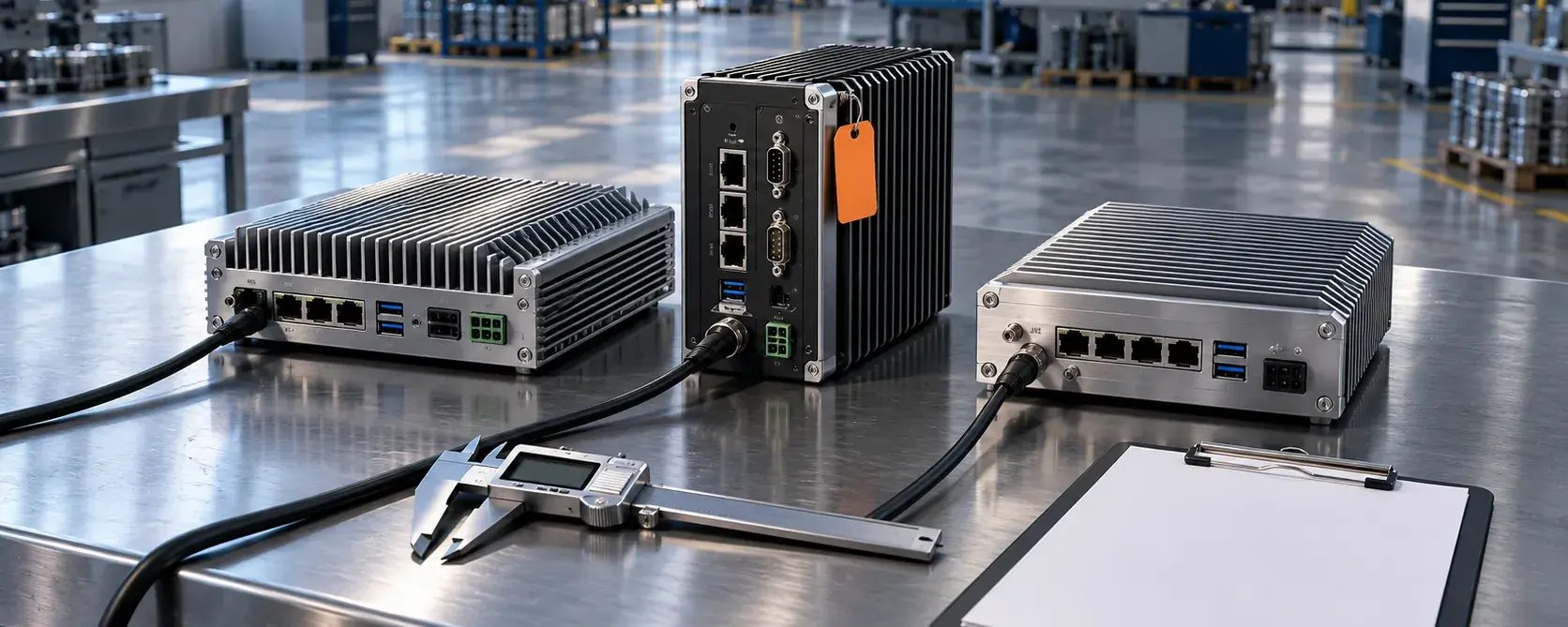
TL;DR: MES selection criteria determine whether a Manufacturing Execution System delivers measurable business value — or turns into a long IT project. Each criterion includes what good looks like, red flags to watch for, and the proof question to ask every vendor. At the bottom: a scoring matrix you can adapt to your steering committee.
Table of contents
Most MES selection guides list 20–30 criteria and treat them equally. In practice, 8 criteria account for 90 % of the difference between a successful implementation and a failed project. The table below shows each criterion, what to look for, and the red flags that predict failure.
| # | Criterion | What good looks like | 🚩 Red flag | Proof question to ask |
|---|---|---|---|---|
| 1 | Time-to-value | First KPIs in < 1 month. Pre-configured OEE, downtime, scrap. | "6-month specification phase before first dashboard" | "Show me a customer who went live on 10 machines within 30 days." |
| 2 | Economic focus | Losses quantified in € (€/hour downtime, €/unit scrap). Impact-based prioritization. | "We collect data — analysis is your job" | "Show me how your system calculates the cost of downtime, not just the duration." |
| 3 | Connectivity | OPC-UA, digital I/O, MQTT, REST API. No custom coding per machine. | Proprietary drivers. Custom development per machine type. Dependency on system integrator. | "How many machine types can you connect without custom code? Show me a brownfield example." |
| 4 | Cloud vs. on-premise | SaaS, no server required, updates included, predictable cost. | "You need a dedicated server per plant" | "What are the total IT infrastructure costs in year 1, 2, and 3?" |
| 5 | Scalability | Replicate config to new plants in weeks. Consistent KPIs across sites. | "Each plant is a new project with new scope" | "Show me a customer who scaled from 1 plant to 3+ in under 12 months." |
| 6 | Usability | Operators use it without training. Role-based views. Mobile access. | "Requires 3-day training per user role" | "Can I put an operator in front of it today and have them use it productively?" |
| 7 | Proof of Value | Proof of value: 30 days on one of your machines, success criteria agreed in writing. Clear go/no-go at the end. | "We can show you a demo, but a pilot requires a signed contract" | "Can we run a 30-day pilot on our machines without committing to a contract?" |
| 8 | Total cost & ROI | Full TCO transparent. Payback < 6 months. No hidden follow-up costs. | "Licence is cheap but implementation is €150k+" | "Give me the complete year-1 cost including implementation, integration, internal effort, and support." |
Time-to-value is the single most predictive criterion for MES success. Systems with long implementation phases delay ROI, erode internal support, and increase the risk of project cancellation. The question isn't "how many features does it have?" but "how quickly does it show me what I'm losing?"
| What to evaluate | Fast (days–weeks) | Slow (months) |
|---|---|---|
| First productive dashboard | Days after machine connection | After 6-month specification phase |
| OEE, downtime, scrap KPIs | Pre-configured, ready to use | Must be custom-configured per plant |
| Pilot with real machine data | Proof of value: 30 days on one of your machines, success criteria agreed in writing | Requires signed contract + project kickoff |
Customer benchmark: Klocke (pharma packaging) went from first machine connection to full plant coverage in 3 weeks. Meleghy (automotive) scaled from pilot plant to 4 plants in 6 months. At Neoperl, a 4-week PoC on one machine validated the business case — contract followed.
An MES must make production losses visible — but visibility alone doesn't drive action. What drives action is knowing that machine 7 cost € 23,000 in avoidable downtime last month, and the top cause is changeover overruns. Without cost context, even detailed OEE data results in a weak business case and no improvement actions. Typical starting points are collected in MES use cases.
What to look for: Clear attribution of downtime, scrap, and throughput losses to € values (€/hour, €/unit, €/shift). Pareto ranking by financial impact, not just frequency. Automatic ROI tracking showing how much has been recovered.
Connectivity determines project cost and scalability more than any other criterion. If every machine type requires custom development, your "MES project" is actually an integration project — and integration projects never end.
| Connectivity type | How it works | When to use | Customer example |
|---|---|---|---|
| OPC-UA | Standard protocol, reads PLC data directly | Modern machines with Siemens/Beckhoff PLCs | Brita: line controller integration via OPC-UA |
| Digital I/O | Simple signals (running/stopped, cycle complete) via DI-Gateway | Older machines, no LAN required | Klocke: all machines via DI-Gateway, no LAN infrastructure |
| MQTT / IoT | Lightweight messaging via IoT devices to cloud | Large-scale brownfield deployments | Carcoustics: 500+ machines via IXON IoT + MQTT in Azure |
| REST API | Bidirectional data exchange with ERP, QMS, WMS | ERP integration (orders, bookings, master data) | Schmiedetechnik: bidirectional InforCOM integration |
| SPS alarm capture | Reads PLC alarm codes directly for downtime classification | Automated lines with detailed alarm systems | — |
🚩 Red flags: Proprietary drivers that lock you into one vendor. Custom development per machine type. Dependency on an external system integrator for every new connection. If connecting 10 machines costs more than the first year of MES subscription, the connectivity model is wrong.
The deployment model directly affects TCO, maintenance effort, and scalability. This is covered in depth in the Cloud MES vs. On-Premise comparison. For evaluation purposes, the key trade-offs:
| Dimension | Cloud MES (SaaS) | On-premise MES |
|---|---|---|
| Server infrastructure | None required. Hosted on Azure. | Dedicated server per plant. |
| Updates | Automatic, included in subscription. | Upgrade projects every 2–3 years (additional cost). |
| Cost model | Predictable monthly OPEX. | High upfront CAPEX + ongoing maintenance. |
| Multi-plant scaling | Replicate config. Weeks per plant. | New server + project per plant. |
Many MES solutions work in the pilot — and fail during rollout. The evaluation must test scalability before you commit, not after.
What to look for: Can the first plant's configuration be replicated to a second plant without starting over? Are KPI definitions standardized or plant-specific? Can the customer's own team expand the system, or is the vendor needed for every change?
Customer benchmarks: Meleghy: 1 pilot plant (Wilnsdorf) → 4 plants in 6 months. Carcoustics: replaced legacy MES, scaled to 500+ machines in 8 countries in 6 months. Both teams expanded SYMESTIC independently using the modular platform — no vendor dependency for new connections.
Usage determines success. The most feature-rich MES is worthless if operators don't use it and supervisors work around it. Low adoption is the #1 killer of MES projects — ahead of technical issues, connectivity problems, or cost overruns.
What to evaluate:
Modern MES selection is based on evidence, not promises. A vendor who can't (or won't) run a pilot on your real machines is a vendor who isn't confident in their own product.
What a good Proof of Value looks like:
Customer proof — Neoperl: 4-week PoC on one assembly machine. Validated functionality and calculated ROI from real data. After successful PoC: contract and integration of first 3 machines. Since then: continuous expansion. The PoC model reduces investment risk and accelerates internal approvals — especially when internal skepticism is high.
Licence fees alone are misleading. The best MES is not the one with the lowest licence price — it's the one with the fastest ROI. For full cost analysis, see What should an MES cost in 2026? and MES ROI: Business Case Calculator.
What to include in TCO:
Use this matrix to score each MES vendor during your evaluation. Weight the criteria based on your specific priorities. The suggested weights reflect what matters most in practice for mid-market discrete manufacturing.
| # | Criterion | Weight | Score (1–5) | What 5/5 looks like |
|---|---|---|---|---|
| 1 | Time-to-value | 20 % | ___ | First KPIs in < 30 days on 10+ machines. Pre-configured dashboards. |
| 2 | Economic focus | 15 % | ___ | Losses in €, Pareto by impact, automatic ROI tracking. |
| 3 | Connectivity | 15 % | ___ | OPC-UA + DI + MQTT + REST. No custom code per machine. Customer can connect new machines independently. |
| 4 | Cloud deployment | 10 % | ___ | 100 % SaaS. No server. Updates included. Predictable monthly cost. |
| 5 | Scalability | 15 % | ___ | Proven multi-plant (3+ plants). Customer team can scale independently. |
| 6 | Usability | 10 % | ___ | Operators productive in 30 min. Role-based views. Mobile access. |
| 7 | Proof of Value | 5 % | ___ | Proof of value: 30 days on one of your machines, success criteria agreed in writing. |
| 8 | Total cost & ROI | 10 % | ___ | Full TCO transparent. Payback < 6 months. No hidden costs. |
| Total weighted score | 100 % | ___ | Max: 5.0 | |
How to use this matrix: Score each vendor on each criterion (1 = poor, 5 = excellent). Multiply by weight. Sum the weighted scores. Compare vendors on the total. A score > 4.0 indicates strong fit. A score < 3.0 on any single criterion with weight ≥ 15 % is a disqualifier.
Practitioner tip: Don't let feature checklists dominate the evaluation. A vendor with 200 features and 18-month implementation scores worse than a vendor with 50 features and 30-day go-live — because the features you never use cost money, and the 12 months you wait for value erode the business case. Weight time-to-value highest (20 %) for this reason.
What's the single most important MES selection criterion?
Time-to-value. How quickly does the system show you what you're losing? If it takes 6 months to see the first dashboard, you've already lost the business case. If it takes 30 days, the system proves itself before internal skepticism can kill the project. Weight this criterion highest.
Should we create a long feature checklist for MES evaluation?
No. Feature checklists favour incumbent enterprise vendors with 200+ features — most of which you'll never use. Instead, focus on the 8 criteria above and ask for proof on each one: "Show me a customer who achieved this." Named references are worth more than feature checkboxes. For a vendor feature comparison, see the MES Software article.
How many vendors should we shortlist?
3–5 for initial evaluation. 2–3 for Proof of Value. 1 for contract. More than 5 makes the evaluation process longer than the implementation — which is itself a red flag. The shortlist should include at least one cloud-native vendor and one traditional on-premise vendor to test the architectural assumption.
Who should be on the MES evaluation team?
Production lead (owns the outcome), IT lead (validates integration), CI/OpEx manager (defines KPIs), and one shift supervisor (validates usability). If IT leads alone, you get an IT project. If production leads, you get a production improvement. MES is a production tool.
How do these criteria apply to small manufacturers (< 50 employees)?
Most of them still apply, but weight differently. Small manufacturers should weight time-to-value (20 %) and total cost (20 %) highest. Scalability and multi-plant are less relevant. A starter package with production KPIs (no full MES) may be the right entry point.
The key takeaway: MES selection is not about finding the system with the longest feature list. It's about finding the system that delivers measurable production improvements fastest, at predictable cost, with proof you can verify. The 8 criteria above — with their red flags and proof questions — give you the framework. The scoring matrix lets you present the evaluation to your steering committee. Use them.
→ What is MES? · → MES Software Compared · → Cloud vs. On-Premise · → MES Costs · → MES ROI · → Compare MES systems
See SYMESTIC on your own use case
In a free live demo, a product expert walks you through the running platform and shows what OEE, downtime and the connection of your machines and ERP look like in practice.
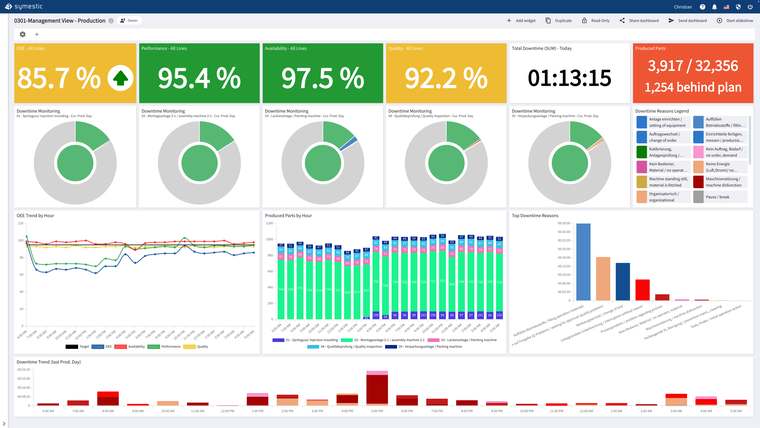

An MES productive in hours, not months
SYMESTIC connects machines, ERP and shop floor on one platform, the same in every plant. In use in more than 20 countries.

−10%downtime
Automotive supplier cut downtime by 10%
Meleghy Automotive also raised output by 7%. Started on one press line, SYMESTIC ran in all four plants six months later.
MES software compared: vendors, functions per VDI 5600, costs (cloud vs. on-premise) and implementation. Honest market overview 2026.
OEE software captures availability, performance & quality automatically in real time. Vendor comparison, costs & case studies.
MES (Manufacturing Execution System): Functions per VDI 5600, architectures, costs and real-world results. With implementation data from 15,000+ machines.