




Contents
What is Gemba?
Gemba (現場) is Japanese for "the real place" — in manufacturing, it means the shop floor: the exact location where products are made, machines run and value is created. The Gemba principle, formalised by Taiichi Ohno at Toyota, states that you cannot understand a production problem from a conference room. You have to go where the work happens, observe with your own eyes and talk to the people doing the work. In Lean production, Gemba is not a technique — it is a mindset. And in 2026, the question is no longer whether you should go to Gemba, but what data you bring with you when you get there.
How do you conduct a Gemba walk in 7 steps?
A Gemba walk is not a factory tour. It is not an audit. It is not a management inspection. It is a structured observation discipline with a specific purpose: understand the current state of the process, identify waste and support the people doing the work. Here is the practitioner sequence:
| Step | Action | What to do | Common mistake |
|---|---|---|---|
| 1 | Define the theme | Choose one focus per walk: changeover time, scrap at station 4, material flow between press and assembly. Never try to observe "everything." | Walking without a theme → you see everything and learn nothing. |
| 2 | Prepare with data | Review the MES dashboard before leaving the office: current OEE, downtime Pareto, alarm history, scrap rate for the theme area. Arrive with a hypothesis, not a blank mind. | Going to Gemba "open-minded" without data → you default to confirming what you already believe. |
| 3 | Observe the process | Stand and watch for at least 10–15 minutes. Follow the product, not the person. Note what actually happens vs. what the standard work document says should happen. | Walking too fast — the Gemba walk becomes a Gemba run. You miss the waiting time, the workarounds, the micro-stops. |
| 4 | Ask, don't tell | Talk to operators: "What makes your job harder today?" "What happens when this alarm fires?" "Why is this material staged here?" Listen more than you speak. | Giving instructions on the spot — this turns the walk into an audit and operators stop telling the truth. |
| 5 | Compare observation vs. data | Does what you saw match the MES data? | Trusting only the data or only the eyes. The power of Gemba is in the gap between the two. |
| 6 | Document findings | Record 3–5 specific observations with location, time and context. Not "changeover is slow" but "changeover on press 7, order 48291→48295, took 42 min. Internal setup not separated from external." | Vague notes that cannot be acted on. If you can't assign a root-cause investigation to it, don't write it down. |
| 7 | Follow up | Present findings in the next shopfloor management meeting. Assign actions. Close the loop in the following walk. | Observing without follow-up — operators notice immediately and stop engaging. "Management walks through, nothing changes." |
Frequency: the Lean standard is daily for the production manager, weekly for the plant manager.
What is the difference between physical Gemba and digital Gemba?
This is the question that defines modern shop floor management. Traditional Gemba is physical: you walk, you observe, you talk. Digital Gemba is the real-time data layer that makes every walk more effective — and extends Gemba to locations you cannot physically visit.
| Dimension | Physical Gemba | Digital Gemba (MES dashboard) | Combined (best practice) |
|---|---|---|---|
| What you see | Operator behaviour, material flow, workarounds, body language, safety hazards | OEE trend, downtime Pareto, alarm history, cycle time distribution, scrap rate | Context: "The alarm data says bearing alarm #4017 fired 12 times today. Show me — what happens when it fires?" |
| Frequency | Daily or weekly, limited by physical presence | Continuous, 24/7, all shifts, all plants | Digital continuous monitoring → physical walk triggered by data anomalies |
| Blind spots | You see 15 min of a 480 min shift. You miss night shift entirely. | You see numbers but miss the why. A 5 % performance drop is a number — the reason is on the floor. | Minimal — data covers time; observation covers cause. |
| Multi-plant | Impossible for remote plants | Full visibility across all connected plants | Digital Gemba for remote plants, physical Gemba for home plant + periodic visits to remote sites |
At Meleghy Automotive — 4 plants — the COO cannot walk every shop floor every day. The SYMESTIC Cloud MES provides digital Gemba across all plants: one dashboard showing OEE, downtime and alarm patterns for every press line in every plant. When the data shows an anomaly at one plant, the local team conducts the physical Gemba walk. The COO sees the same data remotely and can ask the right questions in the morning call. That is the practical integration of physical and digital Gemba.
What are the 3 principles Taiichi Ohno built Gemba around?
Ohno's three Gemba principles are simple, but they are violated in most plants every day:
- Genchi Genbutsu (現地現物) — Go and see for yourself. Do not rely on reports. Do not trust second-hand information. The manager who reads the OEE report but never stands at the machine has no right to make decisions about that machine. Data is a guide, not a substitute for observation.
- Genba ni sae ike — When in doubt, go to Gemba. When the production meeting produces conflicting opinions, nobody wins the argument in the conference room. The answer is on the shop floor. At Schmiedetechnik Plettenberg, the introduction of real-time dashboards at the machine made this principle practical: when a question arises in the planning meeting, the data is pulled up live and, if the data is not enough, the team goes to the line.
- Respect the people at Gemba. Operators know what is broken. They have known for months. The question is whether anyone asks them — and whether anything changes when they answer. A Gemba walk without follow-up is worse than no walk at all, because it teaches operators that speaking up is pointless.
How does an MES transform the Gemba walk?
Without an MES, the Gemba walk is observation + conversation. Powerful, but limited to what happens while you are standing there. With an MES, the walk gains a time dimension: you can see what happened before you arrived, compare today to last week and validate observations against historical data.
- Pre-walk preparation: The MES shows which machines underperformed on the last shift, which alarm codes fired most frequently, where scrap spiked. You arrive at Gemba knowing exactly where to look — not wandering randomly.
- During the walk: The shopfloor monitor at the machine shows live cycle time, current order, target vs. actual. The operator and the manager look at the same data. Conversations become specific: "Your cycle time drifted from 4.2 s to 4.8 s after the material change at 14:30 — what happened?" instead of "How's it going?"
- After the walk: Findings are entered as actions in the shopfloor management system. The MES tracks whether the countermeasure reduced the loss. If changeover time on press 7 was the Gemba finding on Monday, the MES shows whether changeover time actually improved by Friday. Closed-loop Gemba.
- Pattern recognition across walks: Individual Gemba walks capture snapshots. The MES captures the movie.
FAQ
How often should a Gemba walk happen?
Daily for the production manager (15–20 minutes, one theme). Weekly for the plant manager (30–45 minutes, cross-area). Monthly for the operations director. The key is discipline, not duration. A 10-minute walk every day beats a 2-hour event once a quarter.
What is the difference between a Gemba walk and a management audit?
Intent. An audit checks compliance against a standard: "Is the control plan followed? Are the gauges calibrated?" A Gemba walk seeks understanding: "What is actually happening? What makes this process hard? Where is the waste?" Audits are periodic, checklist-driven and judgemental. Gemba walks are frequent, curiosity-driven and supportive. Mixing the two destroys trust — operators will never tell the truth to someone who is scoring them.
Can you do Gemba remotely?
Partially. A Cloud MES gives you digital Gemba — real-time visibility into machine status, OEE, alarms and order progress across multiple plants. At Carcoustics, 500+ machines in 12 plants are visible on a single dashboard. That is remote Gemba for the data layer. But it will never replace standing at the machine, watching the operator, and noticing that the material bin is in the wrong position. Remote digital Gemba identifies where to look. Physical Gemba reveals why.
Related: Kaizen · Lean Production · Shopfloor Management · OEE Explained · MES: Definition & Functions · Muda (7 Wastes)
When the board goes up in the morning meeting, it shows yesterday's numbers.
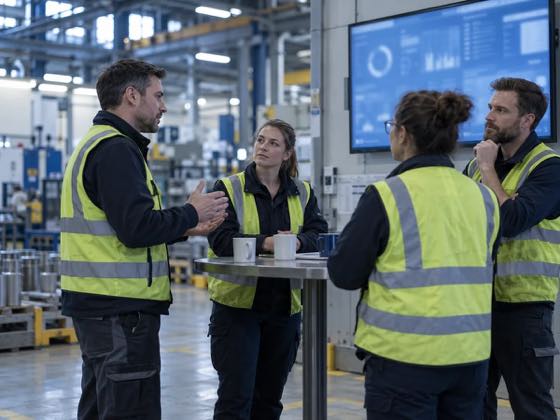
Shop floor meetings on live data, not whiteboards
SYMESTIC shows KPIs per line and shift live, sends push notifications on downtime and summarizes the digital shift log for handover.