




Contents
What is machine runtime?
Machine runtime is the total time a machine spends actively producing not scheduled, not available, not planned, but actually running and generating output. It is the denominator of the hourly machine rate, the numerator of the OEE availability factor, and the single most over-reported number in manufacturing.
Reported machine runtime is often higher than the real number. Not because anyone is cheating — because without continuous automatic measurement, short stops, micro-breaks, and unreported changeover minutes vanish from the record. The first week a plant switches on honest runtime capture, availability drops noticeably. The plant didn't get worse. The measurement finally got right.
Machine runtime vs. the terms it gets confused with
Runtime is one of five closely related time concepts in manufacturing. Mixing them up is the single most common source of disagreement between production, controlling and maintenance.
The meaningful metric for productivity and OEE is runtime. The meaningful metric for controlling is machine hours. They are numerically the same but serve different conversations, which is why both operations and finance claim ownership of the number and why it is almost never defined identically across the two departments.
How machine runtime is calculated
The formula is simple:
Runtime = Available Time − (Unplanned Downtime + Micro-Stops + Unreported Stops)
The arithmetic is not the hard part. The hard part is the third term — unreported stops — which in most plants is invisible because it is shorter than the threshold operators bother to enter manually. Any stop under two minutes typically falls below the reporting floor: the operator fixes it, restarts the line, and moves on. Multiply by twenty such events per shift and the gap between reported and actual runtime becomes significant.
For the hourly machine rate, the same runtime number is used as the divisor:
Hourly Rate = (Depreciation + Maintenance + Energy + Tooling) ÷ Runtime (h)
This is where runtime over-reporting quietly damages controlling. If runtime is inflated by 20 %, the hourly machine rate is understated by 20 %, product costing is wrong, and every make-or-buy decision based on that costing is biased toward making in-house.
The six losses that eat runtime
Nakajima's classic Six Big Losses map cleanly onto runtime. Three of them reduce runtime directly, three reduce its usefulness:
- Breakdowns — unplanned equipment failures. Usually visible in the stop log.
- Setup and changeover — time spent not producing between orders. Often booked separately as "setup" rather than as runtime loss.
- Idling and minor stops — the invisible 60–80 % of downtime on most lines. Under 120 seconds each, not manually recorded.
- Reduced speed — machine runs, but slower than design. Counts as runtime but not as output.
- Startup rejects — produced during runtime but scrapped. Runtime captured, output wasted.
- Quality defects — same thing, later in the run.
A plant that only counts breakdowns and changeovers as runtime loss will miss 60–80 % of the actual loss. This is why automated capture at sub-second resolution is not a nice-to-have but a precondition for the metric to mean anything.

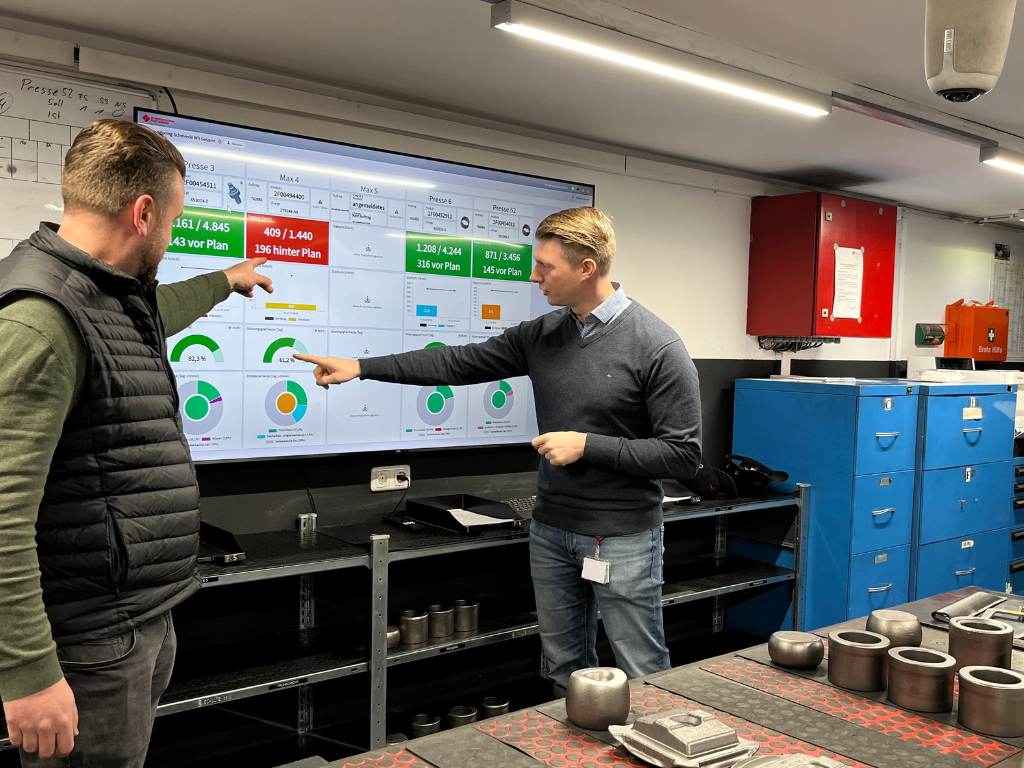
How Schmiedetechnik Plettenberg improves press performance with data
- Real-time OEE at every press
- Downtime reasons documented end to end
- Shift handovers backed by hard data
- Fast response to disruptions & bottlenecks

 Case Study
Typical machine runtime by process type
Runtime targets vary widely by process. A number that looks poor in one industry is best-in-class in another. Rough ranges from real installations:
Comparing runtime across process families is meaningless — a 70 % CNC runtime is excellent, a 70 % injection-moulding runtime is mediocre. Benchmark within your own process.
Improving machine runtime — what actually moves the number
Runtime-improvement initiatives come in many varieties. The ones that work share three traits:
- Measure automatically first, optimise second. Without continuous capture, every improvement initiative targets a moving target. Most plants can recover 5–8 percentage points of runtime simply by making the losses visible — before changing anything else.
- Attack the micro-stops. Pareto analysis of stop durations almost always shows the long tail dominates: 70 % of lost minutes come from stops under 5 minutes each. Fixing the top three stop reasons on any line usually recovers 10–15 % availability.
- SMED on changeovers that matter. Every changeover minute saved is a minute of runtime won.
The Meleghy stamping implementation reduced stop time by 10 % across four plants in six months. The gain did not come from faster machines; it came from measuring runtime honestly and working the Pareto systematically.
FAQ
Is machine runtime the same as availability?
Closely related, not identical. Availability is the ratio of runtime to planned production time — it is how runtime turns into an OEE factor. Runtime is the raw time in hours; availability is the percentage.
Does changeover count as runtime?
No. Changeover is planned downtime by most conventions and sits outside runtime. Some plants book it as runtime to inflate availability, which is exactly the definitional sloppiness that makes cross-plant benchmarking worthless. Define it once, hold the definition.
How accurate is manually recorded runtime?
Typically 70–85 % of actual. The systematic bias is always in the same direction: runtime is over-reported because short stops go unrecorded. Automatic capture via PLC signals, OPC UA or digital I/O gateways closes the gap.
Why does runtime matter for the hourly machine rate?
It is the divisor. An hourly rate of €90 at 2,000 runtime hours becomes €120 at 1,500 — and 1,500 is often the honest number. Costing decisions built on inflated runtime understate true cost per part.
What software captures runtime automatically?
An MES or dedicated OEE platform reading machine states from the PLC. SYMESTIC's Production Metrics module does this as a day-one capability; installation on a new line typically takes hours, not weeks.
What is realistic target runtime for a new plant?
Do not set a target before measuring honestly for one quarter. The target that comes out of the measurement baseline is always better than the target imported from a benchmark document.
Related: OEE · Production Time · Process Monitoring · Machine Data Capture · MES · SYMESTIC Production Metrics

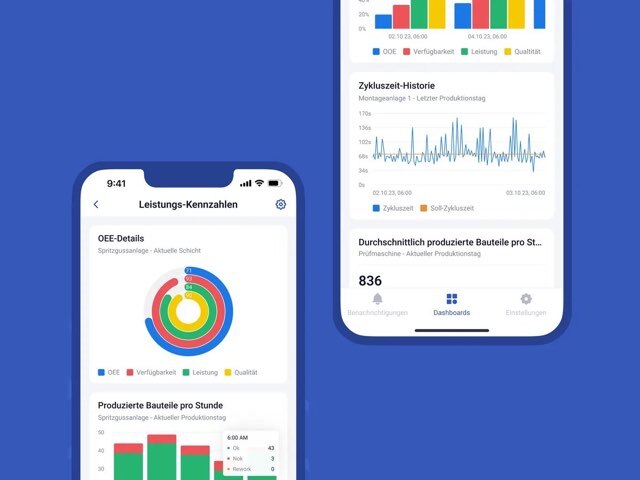
Your OEE live, not in Excel at month-end
SYMESTIC measures availability, performance and quality right at the machine. The first machine is connected in under three hours, even an older one.