




MES Software: Vendors, Features & Costs Compared 2026
MES software compared: vendors, functions per VDI 5600, costs (cloud vs. on-premise) and implementation. Honest market overview 2026.

MES software (Manufacturing Execution System) controls, monitors, and optimizes production in real time – bridging the gap between ERP planning and shop floor reality. It captures machine and production data, manages work orders, tracks quality, and delivers production KPIs like OEE, availability, and scrap rate.
If you are searching for "MES software," you are likely facing a concrete decision: Which system fits your plant? What separates one vendor from another? What does this realistically cost – not the marketing number, but the total cost over three years? And how long before the system delivers value?
For the foundational overview – what MES is, its role in the automation pyramid, and how it relates to ERP and SCADA – we recommend the main blog article: MES – Manufacturing Execution System: Functions, Benefits, and Architecture.
This article is the comparison: vendors, functions, costs, implementation, and the honest question of which approach fits which organization.
In most mid-sized manufacturing operations, a gap exists between what the ERP system plans and what actually happens on the shop floor. The ERP knows orders, bills of materials, and delivery dates. It does not know the current machine status, the actual cycle time, the downtime that has been running for 40 minutes, or the scrap that is jeopardizing the current batch.
This gap is filled with Excel spreadsheets, paper logs, and the institutional knowledge of individual shift leaders. It works – until it does not. Until the customer asks why the shipment is three days late. Until the OEE figures in the quarterly report do not match reality. Until the maintenance manager arrives Monday morning unaware that a machine failed during the night shift.
MES software closes this gap. It captures in real time what is happening at every machine, links that data to work orders and quality checks, and makes the actual state of production visible – for operators at the terminal, for shift leaders on the dashboard, for management in the monthly report. The difference between a production operation with and without MES is not theoretical – it typically amounts to 5 to 15 OEE percentage points, measured within the first three months of deployment.
The VDI 5600 guideline defines the functional scope of a Manufacturing Execution System and serves as the de facto standard for MES evaluation in European manufacturing. ISA-95 (IEC 62264) defines the integration architecture between MES and enterprise systems. Not every organization needs every function from day one – but the platform should be capable of covering them as requirements grow.
The foundation: automated capture of machine states (running, idle, setup, fault), part counts, cycle times, and process parameters – directly from the machine, without manual input. Production data acquisition extends this to order assignments, operator times, and quality feedback. Without this data layer, every other MES function is ineffective. For a detailed comparison of providers and costs: Production Data Capture Software.
MES software receives work orders from the ERP and manages their execution on the shop floor: sequence planning, machine assignment, priority management during bottlenecks, and real-time progress tracking. Advanced scheduling optimizes the sequence based on setup times, material availability, operator capacity, and delivery deadlines. Drag-and-drop planning boards allow manual intervention for unplanned events (machine failure, rush orders). Scheduling quality varies significantly between vendors – from basic sequencing to AI-driven optimization.
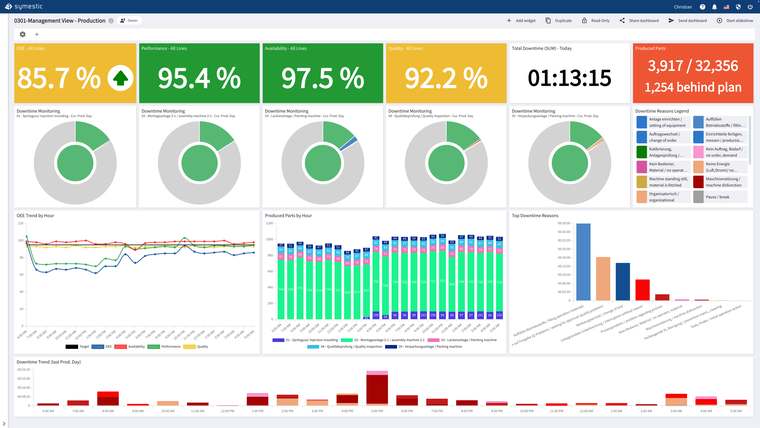
OEE (Overall Equipment Effectiveness), availability, performance rate, quality rate, MTBF, MTTR, utilization, downtime by category – MES software calculates these KPIs automatically from captured machine data. What matters is not the calculation itself but the presentation: real-time dashboards for the shop floor, management reports for weekly and monthly comparisons, Pareto analyses of loss sources, shift-to-shift comparisons. For the practical perspective on OEE tracking: OEE Software – Providers and Costs.
Inline inspections, SPC (Statistical Process Control), inspection plan management, scrap tracking with root cause categorization, and full traceability from raw material lot to finished part – MES software documents quality data end-to-end. For automotive suppliers (IATF 16949) and regulated industries, this function is not optional but a prerequisite for customer approval.
Planned maintenance intervals, condition-based maintenance driven by process data (vibration, temperature, operating hours), and structured fault recording with escalation logic. MES software does not replace a dedicated CMMS but provides the data foundation: Which machine fails most often? Which fault category dominates? What is the average repair time?
Assignment of operators to orders, machines, and workstations. Tracking of clock-in and clock-out times. Monitoring of qualification requirements (can operator X run machine Y?). Combined with machine data, this creates a complete picture: How many labor hours did order Z actually consume – not what the ERP planned?
Energy consumption tracking per machine, per order, and per product. With rising energy costs and growing reporting obligations (CSRD, ISO 50001), this function is gaining importance. MES software correlates energy consumption with production data: Which machine consumes disproportionate power during idle time? Which product has the highest energy input per unit?
The MES software market is fragmented – hundreds of vendors worldwide. A practical orientation comes from distinguishing four categories that differ fundamentally in architecture, target audience, and cost structure.
SAP (Digital Manufacturing Cloud), Siemens (Opcenter Execution), Rockwell Automation (Plex MES), Oracle (MES Cloud), Dassault Systèmes (DELMIA), and AVEVA (MES) offer MES as an extension of their existing platforms. Their strength is seamless integration with the parent ERP or automation ecosystem – Siemens TIA Portal flows into Opcenter, SAP DMC connects natively to S/4HANA, Rockwell Plex integrates with Allen-Bradley controls.
For large enterprises already standardized on SAP, Siemens, or Rockwell, this integration is a significant argument. The trade-off: these systems are built for enterprise scale. Implementation takes twelve to twenty-four months, requires specialized consulting, and costs – including licenses, infrastructure, and customization – in the mid-six to seven-figure range (USD). For a mid-sized manufacturer with 200 employees and 30 machines, this is typically oversized – functionally, financially, and organizationally.
In the German-speaking market (DACH), established vendors include MPDV (Hydra X), GFOS, industrieinformatik (cronetwork), FASTEC (4PRO), Proxia, forcam enisco, and Böhme & Weihs. In North America and internationally, vendors like Epicor (Mattec MES), Aegis Software (FactoryLogix), Critical Manufacturing, and Plex (before its Rockwell acquisition) occupy similar positions. Many of these companies have been operating for over 20 years with hundreds to thousands of installations.
These vendors offer comprehensive on-premise MES platforms with broad VDI 5600 coverage, deep ERP integration, and mature functionality across scheduling, quality, and maintenance. The common characteristic: on-premise deployment (servers at the customer site) with modular license models. Updates require upgrade projects, ongoing operation requires internal IT resources, and scaling to new sites means a new implementation project per plant. Implementation timelines of six to eighteen months and six-figure upfront investments are typical for this category. How the different layers fit together is explained under production software.
SYMESTIC, Tulip Interfaces, operations1, and 42Q (Sanmina) operate on SaaS models with cloud-native architecture. No server at the customer site, no IT project, no upgrade effort. Updates are deployed automatically, scaling to new sites is a configuration step, and access is from any device via browser.
SYMESTIC combines two characteristics that rarely appear together in the market: MES functionality aligned with VDI 5600 (order management, MDC/PDA, performance analysis, quality tracking, energy monitoring) and a cloud architecture with standardized IoT gateways for rapid machine connectivity – including legacy equipment without modern controls. Over 15,000 machine connections are active.
Tulip is a no-code platform with strong UX that enables users to build custom shop floor apps – from digital work instructions to quality checks. Tulip's core focus is no-code flexibility; advanced production scheduling and deep ERP integration are addressed more strongly by other platforms. operations1 focuses on digital work instructions and connected worker workflows – a specific area within the broader MES scope.
MachineMetrics, Factbird, Vorne (XL), Guidewheel, oee.ai, and Redzone focus on specific areas: machine data capture, OEE monitoring, shop floor dashboards, or connected frontline workers. They deploy quickly, often plug-and-play, and cost significantly less than a full MES platform. MachineMetrics and Factbird are particularly strong in fast machine connectivity and clear real-time visualization.
The consideration: these tools do not cover MES core functions like order management, production scheduling, quality management, and ERP integration. An organization that starts with a monitoring tool today and needs production control and traceability in two years faces a system change – with data migration, new machine connectivity, and a fresh rollout. Organizations that foresee the full MES scope should start with a platform that grows with them.
MES pricing is the area where the industry has historically been least transparent. "Contact us for a quote" is the only price information from many vendors. This makes comparison difficult – and that is intentional, because actual costs at many traditional vendors are significantly higher than expected.
An honest breakdown:
Monthly subscription, typically tiered by machine count or plant. SYMESTIC starts with the Professional package: the platform plus five machines costs €850 per month, billed annually, including all MES functions, cloud hosting on Microsoft Azure, updates, onboarding, and support. Unlimited users, dashboards, and shop floor clients at no additional charge. Enterprise packages for larger plants and multi-site rollouts available on request. No server costs, no upgrade projects.
Initial license costs: $80,000 to $350,000, depending on module scope and machine count. Often additional per-user licenses ($500–$1,500/user). Implementation costs (consulting, configuration, training): $50,000 to $200,000. Server infrastructure: $10,000 to $30,000. Annual maintenance fees: typically 18–22% of license costs. Upgrade projects every two to four years: additional consulting costs.
Total cost of ownership over three years for a mid-sized plant with 30 machines: $200,000 to $500,000.
Licenses, implementation, and infrastructure typically start at $500,000 and reach seven-figure totals for complex multi-site rollouts. Implementation duration: twelve to twenty-four months. These systems deliver ROI for corporations with thousands of machines and global plant networks – for mid-sized manufacturers, they are typically oversized.
The real cost trap is not the license price but the time to value. An on-premise MES that goes productive after twelve months of implementation has twelve months of OEE losses unrecorded – losses that could have been identified and eliminated during that time. At a typical OEE improvement of 5 percentage points and a machine hour rate of $150, that represents – conservatively calculated – missed savings in the high five-figure range. Cloud-native MES software that delivers the first KPIs within a week creates a fundamentally different ROI equation.
For a detailed cost overview: MES System Pricing – Transparent Cost Comparison.
The choice between cloud and on-premise is not purely an IT question – it determines implementation speed, ongoing costs, scalability, and innovation capacity.
On-premise MES installs software and database on servers in the plant. This gives the organization full control over infrastructure and data. The price: own servers, own IT administration, own backup strategy, own upgrade projects. Every update must be installed, tested, and released. Every new site requires its own installation.
Cloud-native MES runs the platform on Microsoft Azure, AWS, or comparable hyperscalers. The customer accesses it via browser, data is encrypted in transit and at rest, updates are deployed automatically. The advantage is not just cost savings – it is speed. Connecting a new machine: hours. Onboarding a new site: days. Configuring a new dashboard: minutes. And data from all sites is consolidated in a single platform – no data exports, no manual reconciliation.
The concerns about cloud – data security, outage risk, latency – are technically resolved. Microsoft Azure provides availability above 99.9%, data can be hosted in regional data centers (GDPR compliance for European operations, SOC 2 for US operations), and latency for shop floor dashboards is imperceptible with modern cloud architectures. What cloud MES cannot do: real-time machine control at the PLC level. That is the domain of PLCs and SCADA – and it stays there. MES operates at a different level (ISA-95 Level 3/4), where cloud latency is irrelevant.
Every MES demo looks good. The moment of truth comes with machine connectivity: Does the system work with the machines that actually stand in your plant?
A typical mid-sized plant contains machines from three to four decades and multiple vendors. The new injection molder speaks OPC UA, the machining center from 2008 has PROFINET, the press from 1995 has no digital interface whatsoever. An MES that only handles OPC UA captures 20 percent of the machine park.
SYMESTIC addresses this through standardized IoT gateways: the OPC UA Cloud Gateway for modern controls (pure configuration), the DI Cloud Gateway for legacy equipment (digital input signals directly from the machine). Installation takes two to four hours per machine – including wiring, gateway mounting, and signal testing. No modification to the machine control, no PLC programming, no production interruption.
Traditional MES vendors typically work with integration partners for machine connectivity. Connecting older equipment is a separate project with a separate quote. Cloud-native competitors like Factbird and MachineMetrics deploy their own hardware with a plug-and-play approach – particularly strong for fast initial connectivity.
For a detailed look at retrofitting and signal types: Production Data Capture Software – Retrofitting, Vendors, and Costs.
Successful MES implementation follows a proven pattern: start small, learn, scale.
Connect three to five machines on a representative line. Goal: real-time machine status, first OEE KPIs, first downtime Paretos. In this phase, the organization learns what the data reveals – and what it does not. Automated capture typically exposes a 10 to 20 percentage point deviation from manually estimated OEE values. That is not an error – it is the reality that was previously invisible.
Based on pilot data: systematically categorize downtime causes, implement first quick wins (typically setup time optimization and elimination of recurring faults), activate PDA functions (order sign-on, operator assignment), configure shift leader dashboards.
Connect all relevant machines, bring ERP integration into production, activate quality tracking and scheduling. With cloud-native MES like SYMESTIC, rollout per additional machine takes half a day – install gateway, configure, extend dashboards. No IT project, no change request, no consultant engagement.
For organizations with multiple plants: onboard additional sites. Cloud MES provides a structural advantage – all plants run on the same platform with unified KPIs, comparable dashboards, and consolidated reports. No separate IT project per site, no data synchronization, no infrastructure buildout.
The automotive supplier Meleghy Automotive operates SYMESTIC as an enterprise MES across four plants – press lines, welding cells, and assembly areas spanning multiple control generations. Standardized gateways enabled connectivity for modern OPC UA equipment alongside legacy machines.
The Klocke Group, specializing in pharmaceutical packaging, had all lines at its site live within three weeks of deployment, without any intervention in the PLCs.
Erlenbacher in the food industry reports a similar pattern: production data that was previously captured manually and analyzed the following day is now available in real time.
What these three companies share: different industries, different machine parks, different company sizes – but the same outcome. Automated data capture made losses visible that previously did not exist (because no one could measure them).
What is MES software?
MES software (Manufacturing Execution System) controls, monitors, and optimizes production in real time. It captures machine and production data, manages work orders, tracks quality, and calculates production KPIs like OEE. MES bridges the gap between ERP planning and shop floor reality.
How much does MES software cost?
Cloud-native MES starts at €850 per month, billed annually (SYMESTIC Professional, platform plus five machines). Traditional on-premise MES requires $200,000–$500,000 over three years (licenses + implementation + maintenance + infrastructure). Enterprise MES from SAP or Siemens starts at $500,000+.
What is the difference between cloud MES and on-premise MES?
Cloud MES runs on external servers (e.g. Microsoft Azure), accessed via browser. No servers of your own infrastructure, automatic updates, new sites onboarded in days. On-premise MES is installed on servers in the plant. Full data control, but own IT administration, manual updates, and a separate project per site.
How long does MES implementation take?
Cloud-native MES: pilot line in one to two weeks, plant-wide rollout in one to three months. Traditional on-premise MES: six to eighteen months. Enterprise MES (SAP, Siemens): twelve to twenty-four months.
Which MES software is best for mid-sized manufacturers?
Mid-sized manufacturers (50–500 employees, 20–200 machines) need full MES capability without enterprise complexity and cost. Cloud-native MES platforms like SYMESTIC are designed for this segment: fast implementation, transparent pricing, scalable from single plant to multi-site.
Can MES software connect to legacy machines?
Yes – and this is one of the most important selection criteria. Cloud-native MES like SYMESTIC uses IoT gateways that connect to machines without digital interfaces: relay contacts, current sensors, retrofit sensors. No PLC modification, no production interruption. Even machines from the 1980s and 1990s.
What is the difference between MES and ERP?
ERP plans at the enterprise level: orders, materials, financials, customer management. MES operates at the shop floor level: What is happening at which machine right now? How far along is which order? What quality deviations exist? MES provides the actual data that ERP needs for realistic planning. They complement each other – MES does not replace ERP, ERP does not replace MES.
Does MES software comply with industry standards?
VDI 5600 defines MES functional scope. ISA-95 (IEC 62264) defines integration architecture. Industry-specific standards include IATF 16949 for automotive (traceability), GMP/FDA 21 CFR Part 11 for pharma (validated processes), and ISO 50001 for energy management. SYMESTIC covers requirements for automotive, metal processing, food and beverage, and consumer goods manufacturing.
See SYMESTIC on your own use case
In a free live demo, a product expert walks you through the running platform and shows what OEE, downtime and the connection of your machines and ERP look like in practice.

An MES productive in hours, not months
SYMESTIC connects machines, ERP and shop floor on one platform, the same in every plant. In use in more than 20 countries.

−10%downtime
Automotive supplier cut downtime by 10%
Meleghy Automotive also raised output by 7%. Started on one press line, SYMESTIC ran in all four plants six months later.