




MES Software: Vendors, Features & Costs Compared 2026
MES software compared: vendors, functions per VDI 5600, costs (cloud vs. on-premise) and implementation. Honest market overview 2026.
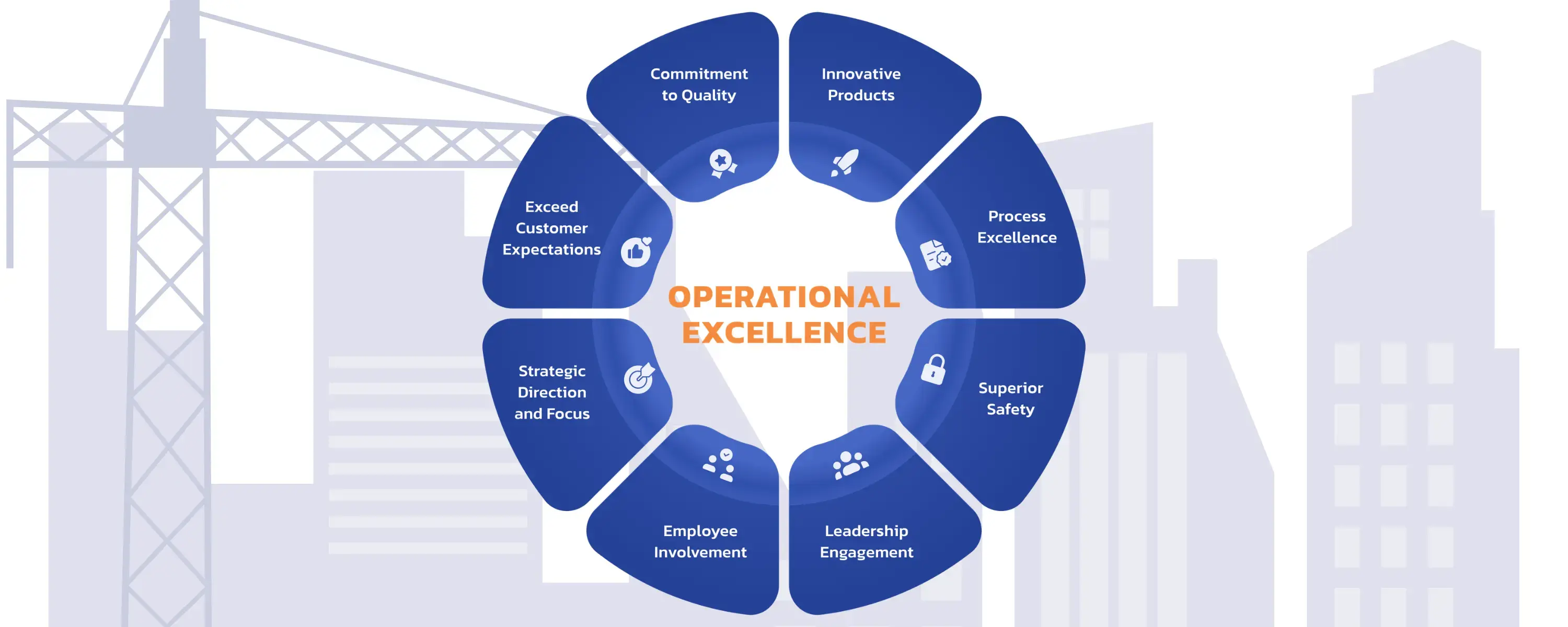
Operational Excellence (OpEx) is a management philosophy for achieving sustained, measurable improvement across all areas of a manufacturing organization. It is not a single method — it is the framework that connects Lean (eliminate waste), Kaizen (daily improvement), CIP (structured improvement cycles), Six Sigma (reduce variation), and Shopfloor Management (daily leadership structure). The missing piece in most OpEx programs: real-time data. Without an MES that automatically captures OEE, downtime, and process deviations, OpEx runs on opinions — and stalls within 12 months.
Transparency note: SYMESTIC is a cloud-native MES platform used by manufacturers including Meleghy Automotive, Carcoustics, and Neoperl to power their OpEx programs with real-time data.
Table of contents
Operational Excellence (OpEx) is a management philosophy that aims for sustained, measurable improvement in every process of an organization — from the shop floor to the supply chain. It integrates proven methods (Lean, Six Sigma, Kaizen, CIP) into a coherent system where every employee, every process, and every decision is aligned toward creating more value with less waste.
OpEx is not a project with a start and end date. It is an operating state — a way of running a manufacturing company where improvement is embedded in the daily rhythm, not delegated to a separate department. The term gained currency in the 1990s as companies like Toyota, GE, and Danaher combined elements from multiple improvement traditions into unified management systems.
In manufacturing specifically, OpEx means: machines run at their designed capacity, changeovers happen predictably, quality is built in (not inspected in), and every deviation from standard triggers a structured response — the same day, not the next month.
OpEx is not a method itself — it is the umbrella that connects multiple methods, each addressing a different layer of operational performance.
| Method | Core idea | What it addresses | Data dependency |
|---|---|---|---|
| Lean | Eliminate waste, create flow | System-level efficiency: 7 wastes, value stream, pull production | Medium — needs cycle times, lead times, inventories |
| Kaizen | Every day, everyone improves | Culture: daily micro-improvements, Gemba walks | Low to medium — starts with observation |
| CIP (PDCA) | Structured improvement cycles | Process: Plan–Do–Check–Act, problem-solving routines | Medium — needs baseline + post-change measurement |
| Six Sigma | Reduce process variation statistically | Quality: DMAIC, SPC, Cp/Cpk, root cause analysis | High — requires process data, statistical analysis |
| Shopfloor Management | Lead from the Gemba, daily | Structure: tiered meetings, visual boards, escalation | Medium to high — needs OEE, downtime, output on the board |
| TPM | Operators own machine care | Availability: autonomous maintenance, planned maintenance | Medium — needs failure history, MTBF, MTTR |
These methods are not alternatives to choose between. They are layers that build on each other: Lean provides the system view. Kaizen provides the daily habit. CIP structures the improvement cycle. Six Sigma solves the hard problems. SFM provides the daily management rhythm. TPM protects the equipment.
The connective tissue between all of them is data. An MES provides it automatically.
The number-one pattern in failed OpEx programs: they start strong (consultants, workshops, posters) and fade within 12 months. The reason is structural, not motivational. Without automatic data, every method in the OpEx toolkit breaks down at the "verify" step.
| OpEx activity | Without MES | With MES |
|---|---|---|
| Lean: "Where is the bottleneck?" | Value stream mapping done once, on paper, outdated in 2 weeks | Real-time cycle times per station — bottleneck visible on the dashboard |
| Kaizen: "Did our improvement work?" | Subjective assessment 3 days later | Before/after OEE comparison in seconds |
| CIP (PDCA): "What is the biggest loss?" | The loudest voice in the meeting decides | Pareto of downtime reasons — objective, updated daily |
| Six Sigma: "Is the process stable?" | Manual sampling, delayed analysis | Automatic SPC with real-time alerts on out-of-control conditions |
| SFM: "What happened on the night shift?" | Shift leader's memory + hand-written log | Full shift data on the SFM board before the morning meeting starts |
SYMESTIC implementation example: At Carcoustics (automotive, 500+ machines across 7 countries), SYMESTIC was implemented to create a unified data foundation for the OpEx program across all plants. IXON IoT devices + MQTT into Azure, bidirectional SAP R3 integration. Results within 6 months: 4 % fewer stoppages, 3 % higher output, 8 % better availability — all from the same data structure enabling plant-to-plant benchmarking that was previously impossible.
| Level | Characteristics | Data state | Typical result |
|---|---|---|---|
| 1. Reactive | Firefighting mode. Problems found after the shift. No structured improvement. | Manual, paper-based, delayed | OEE unknown or estimated |
| 2. Measured | Machines connected. OEE visible. Losses quantified for the first time. | Automatic via MES | OEE typically drops 15–20 % from "estimated" — because now it's real |
| 3. Improving | Daily SFM meetings. PDCA cycles running. Top losses attacked systematically. | Real-time dashboards, Pareto charts | 5–10 % OEE gain from targeted countermeasures |
| 4. Systematic | Cross-plant benchmarking. ERP integration. Standard KPIs across all sites. | Unified data model, bidirectional ERP | Best-practice transfer between plants. Consistent improvement culture. |
| 5. Predictive | Historical data enables predictive maintenance, demand-driven scheduling, AI-supported optimization. | Full data history + analytics | Proactive rather than reactive. The system improves itself. |
Most manufacturers are at Level 1 or early Level 2. The jump from Level 1 to Level 2 — connecting machines and making losses visible — is where the highest ROI sits. It is also where SYMESTIC's "days not months" implementation model has the most impact.
| Phase | Timeline | Focus | Methods activated |
|---|---|---|---|
| 1. Data foundation | Weeks 1–4 | Connect machines. Establish automatic OEE + downtime capture. | MES / MDC |
| 2. Visibility | Weeks 3–8 | Start daily SFM meetings at one line. Losses visible on the board. | SFM + OEE |
| 3. Quick wins | Weeks 5–12 | Attack top-3 losses with PDCA cycles. Kaizen events for changeover, 5S. | CIP + Kaizen |
| 4. Systematize | Months 4–6 | Roll out to remaining lines/plants. ERP integration. Standard KPIs. | Lean (value stream) + PDC |
| 5. Sustain & scale | Ongoing | Quarterly maturity audits. Six Sigma for complex quality problems. Cross-plant benchmarking. | Six Sigma + TPM |
The critical insight: do not start with philosophy. Start with data. When operators see their OEE on a dashboard for the first time, improvement becomes tangible. Culture follows evidence.
| Risk | What happens | How to prevent it |
|---|---|---|
| Philosophy without data | Workshops and posters, but no measurable improvement. Team loses trust. | Start with MES. Make losses visible before asking people to improve. |
| Consultant dependency | External firm drives OpEx for 6 months. They leave. Everything stops. | Build internal capability from day 1. The data stays when the consultant leaves. |
| Scope creep | Trying to implement Lean + Six Sigma + SFM + TPM simultaneously | Sequence: data → SFM → PDCA → scale. One layer at a time. |
| Leadership retreat | Plant manager attends SFM meetings for 3 months, then stops | Non-negotiable: L3 meeting is permanent. OpEx is the way of working, not a project. |
What is Operational Excellence?
Operational Excellence (OpEx) is a management philosophy for achieving sustained, measurable improvement across all areas of a manufacturing organization. It integrates methods like Lean, Kaizen, CIP, Six Sigma, and Shopfloor Management into a unified system focused on eliminating waste, improving quality, and increasing efficiency.
What is the difference between OpEx and Lean?
Lean is one method within the OpEx toolkit — focused on eliminating waste and creating flow. OpEx is the umbrella that combines Lean with CIP, Six Sigma, SFM, TPM, and other methods into a coherent management system.
What is the difference between OpEx and CIP?
CIP is the structured improvement process (PDCA cycles, tools, governance). OpEx is the strategic framework that includes CIP along with Lean, Six Sigma, SFM, and cultural elements. CIP is one engine within the OpEx system.
How does an MES support Operational Excellence?
An MES provides the automatic data foundation for every OpEx method: real-time OEE, downtime classification, before/after comparisons, cross-plant benchmarking, and SPC. Without automatic data, OpEx programs run on opinions and stall within 12 months.
How long does it take to see results from OpEx?
With automatic data capture (MES), the first measurable improvements appear within weeks. Meleghy Automotive achieved 10 % fewer stoppages within 6 months. Carcoustics achieved 8 % better availability across 7 plants. The speed depends on how quickly data is available — not on how many workshops are held.
The bottom line: Operational Excellence is not a methodology to choose. It is the operating state where Lean, Kaizen, CIP, Six Sigma, and SFM work together — powered by real-time data from the shop floor. Start with the data. The methods follow. The culture follows the methods. And the results follow the culture.
→ What is an MES? · → OEE Explained · → Shopfloor Management · → CIP · → Kaizen · → Six Sigma · → Lean Production · → Machine Data Collection