




Contents
What is process data?
Process data is the continuous stream of physical and logical values that describe a running production process in real time — temperatures, pressures, flow rates, motor currents, torque, cycle counts, machine states, setpoint-actual deltas and recipe parameters. It is captured at the machine (PLC, sensor, drive) and streamed upward for monitoring, control and analysis. In German: Prozessdaten. In the ISA-95 stack it originates at Level 1/2 (sensors, PLCs, SCADA) and is consumed at Level 3 (MES) and Level 4 (ERP/analytics). The difference between setpoints and actuals is covered under production parameters.
Process data is the raw material of every OEE calculation, every SPC chart and every predictive-maintenance model. Without it, the shop floor runs on intuition. From 30+ years wiring Simatic S5, S7 and TIA across beverage, wood and automotive plants, the pattern is consistent: a machine that seems "dumb" almost always exposes more signals than its operators realise — you just have to know where to look on the terminal block.
Process data vs. machine data (MDE) vs. operational data (BDE)
Three terms that get merged in every specification document and kept apart by every engineer who has ever built an interface. The distinction drives the architecture of the entire data capture layer.
Operational data (BDE) is the third layer — order, batch, operator and material context that makes the other two interpretable. A temperature reading without an order number is noise; attached to order 4711 on line 3 it becomes evidence. All three streams must converge in the MES or the analytics collapse.
How is process data captured in brownfield plants?
The myth: "Our machines are too old to deliver data." The reality: almost every PLC built since the mid-1990s exposes usable signals, and the ones that don't can be tapped at the terminal block or the drive. Four routes dominate in practice.
- OPC UA — the modern standard. Siemens S7-1500, Beckhoff, B&R, Rockwell and most drive manufacturers expose an OPC UA server natively. Read-only, secure, structured. First choice whenever available.
- Legacy PLC protocols — Simatic S5 AS511, S7 via PUT/GET or S7comm, Modbus TCP/RTU, Profibus DP. Requires a protocol-aware gateway but no PLC program change in most cases.
- Digital I/O gateways — hardware-wired parallel tap onto existing output signals (cycle pulse, fault relay, part-OK). Zero PLC intervention, zero production stop, works on every machine that was ever built.
- MQTT via IoT gateways (IXON, HMS, Siemens IOT2050) — pushes structured data through firewalls to the cloud without VPN tunnels.
The decision tree is simple: OPC UA first, legacy protocol second, digital I/O third, manual entry only where automation is genuinely impossible.
What makes process data trustworthy?
Captured data and correct data are not the same thing. Bad process data is worse than no data, because it produces confidently wrong decisions. Five quality dimensions decide whether the stream is actionable or decorative. Completeness — no gaps in the time-series, no silent dropouts when the gateway reboots. Accuracy — the value matches the physical reality, calibrated against a reference. Timeliness — the sample arrives quickly enough that the downstream consumer (SPC chart, alarm, MES) can act on it; for most shop-floor uses, under two seconds end-to-end. Consistency — the same sensor reported the same way across shifts, sites and systems, with identical engineering units. Traceability — every value carries its source, timestamp (synchronized to a common clock) and transformation history.
Skip any of the five and the data turns into a polished dashboard that nobody trusts by the third week.
What does the MES do with process data?
A modern MES is not a database for process data — it is a contextualizer. It joins the raw stream to four references the stream alone does not contain. The production order, so the data belongs to a specific batch. The operator and shift, so performance is attributable. The product and recipe, so the correct tolerance bands apply. The machine state from MDE, so a pressure spike during setup is not flagged as a quality event. This contextualization is what converts a time-series into a quality certificate, a traceability record or an energy-per-part figure. Downstream the MES feeds ERP (actual consumption per order), LIMS (sample triggers), CMMS (condition signals for maintenance) and the analytics layer (SPC, predictive models). Without contextualization the same data sits in a historian and is consulted twice a year for a root-cause analysis. An overview of all types of manufacturing data is given in a separate article.
What this looks like in the SYMESTIC deployment pattern
At Carcoustics, process data from more than 500 machines in 12 plants is linked to SAP orders. At Klocke in Weingarten, digital I/O gateways captured cycle and stop signals on packaging lines across the whole site in three weeks. The platform aggregates process data from 15,000+ machines. For authoritative protocol references, see the OPC Foundation specification for OPC UA and the NAMUR recommendations for process-data handling in process industries.
FAQ
What is process data in manufacturing?
Process data is the continuous stream of physical and logical values that describe a running production process: temperatures, pressures, flow rates, motor currents, cycle times, setpoint-actual deltas, recipe parameters and machine states. It is captured at the PLC or sensor level, timestamped, and streamed to the MES where it is contextualized with order, product and operator information for quality, OEE and traceability use cases.
Process data vs. machine data — what's the difference?
Machine data (MDE) is event-driven and state-oriented: running, stopped, fault, cycles counted, parts good or scrap. Process data is parameter-oriented and continuous: the actual physical values measured inside the process. MDE answers "is the machine producing?"; process data answers "is it producing within tolerance?" Most modern MES deployments capture both and join them on a common timestamp.
Can I capture process data from old machines without PLC changes?
Yes, almost always. Digital I/O gateways tap existing output signals at the terminal block — cycle pulse, fault relay, part-OK — in parallel, without touching the PLC program. Analog inputs can be mirrored the same way. For Simatic S5 and early S7 without OPC UA, protocol-aware gateways (S7comm, AS511, Modbus) read data via the programming port. Zero PLC intervention, zero production downtime.
How fast must process data be captured?
It depends on the use case. SPC on a stamping press needs every cycle, often under 100 ms. Temperature monitoring on a curing oven is fine at 1 Hz. Energy metering is usable at 15-minute intervals. The rule: sample fast enough that the downstream decision maker (alarm, chart, model) can still act meaningfully. Faster than that wastes bandwidth and storage without improving outcomes.
Do I need a time-series database?
Above a few thousand data points per second, yes. Relational databases collapse under sustained high-frequency writes. A time-series store (InfluxDB, TimescaleDB, Azure Data Explorer) or a cloud-native manufacturing platform with purpose-built process-data storage handles the volume and the query patterns — aggregation over time windows, downsampling, retention policies — that relational systems do not.
How does process data support traceability?
Every captured value is stamped with machine, timestamp, order, batch and operator. When a quality issue surfaces weeks later, the process-data history reconstructs the exact conditions — temperature curves, pressure profiles, parameter deviations — under which the affected parts were produced. This turns a vague complaint into a scoped recall or a dismissed claim, often the difference between six-figure liability and a defensible test record.
How does SYMESTIC capture and use process data?
Through process data and alarms modules, fed by OPC UA or digital I/O gateways and joined to live production KPIs and batch production control. Brownfield machines connected in hours not weeks — as Klocke proved by connecting the Weingarten site across all packaging lines in three weeks.
Related: MES · OEE · Machine Data (MDE) · Operational Data (BDE) · OPC UA · SPC · Traceability · Process Data Module · Alarms · Metal Processing.

Scrap isn't made at inspection. It's made minutes earlier at the machine.
Intervene while the part is still good
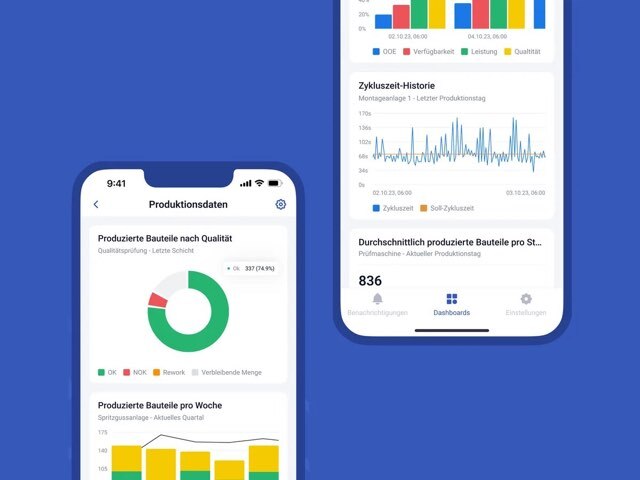
SYMESTIC continuously checks process values such as temperature and pressure against your limits and alerts you on deviation.