




Contents
What is a Unified Namespace (UNS)?
A Unified Namespace (UNS) is a real-time, event-driven data architecture in which every system on the shop floor and in the enterprise — PLCs, SCADA, MES, ERP, historians, analytics, quality, maintenance — publishes and subscribes to a single, structured, hierarchically organised data space, typically operated on an MQTT broker. Instead of N×N point-to-point integrations, all participants talk to one broker. The namespace becomes the operational single source of truth.
The concept was popularised around 2020 by Walker Reynolds (4.0 Solutions) as a pragmatic alternative to classic ISA-95 hierarchies for real-time data flows. It is not a product. It is not a standard. It is an architectural pattern, and that distinction is where most UNS projects succeed or fail.
UNS vs. ISA-95 vs. classic point-to-point
The three common patterns coexist in most plants. Understanding which one solves which problem is the actual engineering question.
UNS does not replace ISA-95. It complements it. Transactional flows — work order release, BOM, routings, quantity confirmation back to the ERP — still travel ISA-95 paths via IDoc, REST or file interface. Real-time state, cycle events, alarms, process variables and KPI streams belong on the UNS. Treating UNS as a wholesale ISA-95 replacement is a common and expensive mistake.
The anatomy of a working UNS
A production-grade Unified Namespace has four non-negotiable building blocks:
- An MQTT broker cluster. High availability, persistent sessions, bridging between sites. Common choices: HiveMQ, EMQX, Mosquitto (for small sites), AWS IoT Core, Azure Event Grid MQTT broker.
- A governed topic hierarchy. Typically ISA-95-aligned:
enterprise/site/area/line/cell/asset/variable. Consistency across plants is the single hardest part of the project. - A standard payload schema. Sparkplug B is the de facto payload standard — it defines birth/death messages, metric types, and stateful connection semantics. Plain JSON works, but without a governed schema it fragments fast.
- Edge publishers and cloud subscribers. IoT gateways at the machine (OPC UA → MQTT, digital I/O → MQTT), cloud services subscribing: MES, historian, analytics, digital twins.
What UNS is not
Three misconceptions recur in every UNS conversation with plants and system integrators:
- UNS is not a product you buy. Vendors sell MQTT brokers, Sparkplug libraries, schema tools — not "a UNS." The namespace is an agreement about topics and payloads, enforced through governance.
- UNS is not a data lake. Data lakes store history; a UNS streams current state. You normally run both — the UNS feeds the lake, not the other way around.
- UNS is not a replacement for transactional ERP↔MES flows. Work order release, BOM resolution, financial postings belong on typed, transactional interfaces. Putting an SAP work order release onto MQTT because "everything should be on the UNS" is an anti-pattern.
Note: A UNS is only as good as its governance. The topic tree and the payload schema have to be centrally owned and enforced from day one, or you end up with N fragmented namespaces instead of one unified one. Pick Sparkplug B or a strict JSON schema, publish it as the standard, and reject everything else at the broker edge.
When does a UNS actually pay off?
UNS is not free. Broker infrastructure, edge publishers, schema governance, security — all real cost. It pays off in three concrete situations, and honestly in only those three:
- Multi-site, multi-system real-time integration. More than two plants, more than three consuming systems per plant. Below that, point-to-point is cheaper and simpler.
- High event rates that request/response cannot absorb. Line-rate cycles, sub-second process variables, alarm storms. Polling a REST endpoint at 10 Hz across 500 machines is not a plan.
- Open analytics and digital-twin ambitions. When the same data needs to be consumed by MES, historian, ML pipeline, quality system and dashboard without building four separate integrations.
For a single plant with one MES, one ERP and twelve machines, a UNS is architectural theatre. OPC UA directly into the MES is the right answer. Be honest about the scale threshold.
How SYMESTIC uses MQTT and UNS patterns in practice
The platform view of this is described in manufacturing integration.
A typical enterprise setup: IoT gateways publishing machine events, MES consuming, ERP talking bidirectionally. On the UNS spectrum, this sits between "pure" UNS and a structured MES-centric architecture — real-time machine state flows over MQTT in a governed topic hierarchy, while transactional ERP flows stay on typed IDoc interfaces. That hybrid is where most enterprise deployments end up, because it is the pattern that actually scales in production without forcing every flow into a single paradigm.
FAQ
What is a Unified Namespace in simple terms?
A Unified Namespace (UNS) is a single, structured data space — usually an MQTT broker with a governed topic hierarchy — into which every system on the shop floor and in the enterprise publishes real-time data, and from which every consuming system subscribes. It replaces N×N point-to-point integrations with one central publish/subscribe data space.
Is UNS the same as MQTT?
No. MQTT is the transport protocol; UNS is the architectural pattern. You can build a UNS on MQTT (by far the most common choice), on Kafka, on AMQP, or on any pub/sub substrate. What makes it a UNS is the governed topic hierarchy, the shared payload schema and the single-source-of-truth discipline — not the protocol.
What is Sparkplug B and why does it matter for UNS?
Sparkplug B is an MQTT payload specification from the Eclipse Foundation. It defines birth/death messages, metric types, and stateful session semantics — things that raw MQTT leaves undefined. Using Sparkplug B gives every UNS participant the same contract for publishing and interpreting data, which is what turns a broker into a true unified namespace instead of a chaotic topic soup.
Does a UNS replace an MES?
No. A UNS is a data architecture; an MES is an execution system with orders, operators, quality and confirmation logic. The MES is one of the most important participants on the UNS — publishing order context, shift state and KPIs, subscribing to machine events. Tools like Ignition or Node-RED can orchestrate data around a UNS, but they do not replace the domain logic of a Manufacturing Execution System.
UNS vs. ISA-95 — which one should I follow?
Both. ISA-95 is the right model for typed, transactional flows (work orders, BOM, confirmations, master data). UNS is the right model for real-time state (cycles, stops, alarms, process variables, KPIs). In practice, mature architectures run ISA-95 flows for ERP↔MES transactions and a UNS for real-time machine and process data. Treating them as competitors is a false dichotomy.
Do I need a UNS if I already have OPC UA?
Not necessarily. OPC UA is a powerful protocol with its own information model, and for a single plant with a single MES it is often the simplest choice. A UNS becomes valuable when you have multiple plants, multiple systems that need the same data simultaneously, and you want to decouple producers from consumers. In most enterprise deployments, the OPC UA server at the machine publishes into an MQTT-based UNS via a gateway — the two are complementary, not exclusive.
What are the biggest risks in a UNS rollout?
Fragmented topic hierarchies across sites, missing payload governance, treating UNS as a product, under-investing in broker HA and security, and trying to force transactional flows onto pub/sub. Every one of these is fixable with governance — and governance is the part most teams underestimate.
See production metrics, process data, MQTT and the ISA-95 reference.
Related: MES: Definition, functions & benefits · Cloud MES vs. on-premise · MQTT · OPC UA · Sparkplug B · ISA-95 · Industrial IoT (IIoT) · Edge computing · Digital twin · Smart Factory.

See SYMESTIC on your own use case
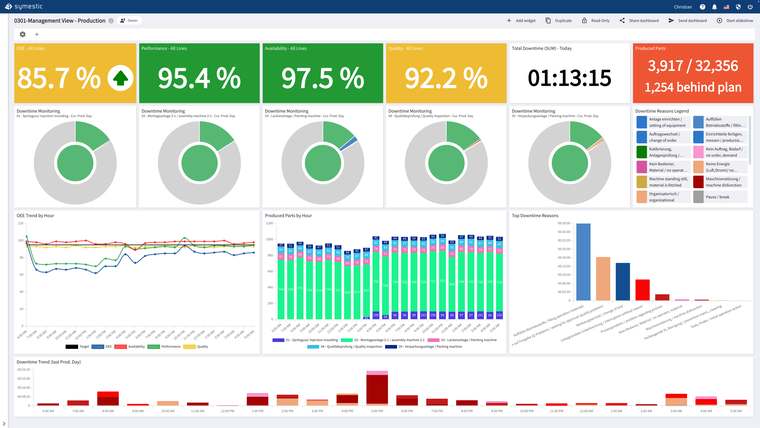
In a free live demo, a product expert walks you through the running platform and shows what OEE, downtime and the connection of your machines and ERP look like in practice.
- Live OEE
- Downtime and reasons
- Connecting machines and ERP
Old machine, new data, in under three hours
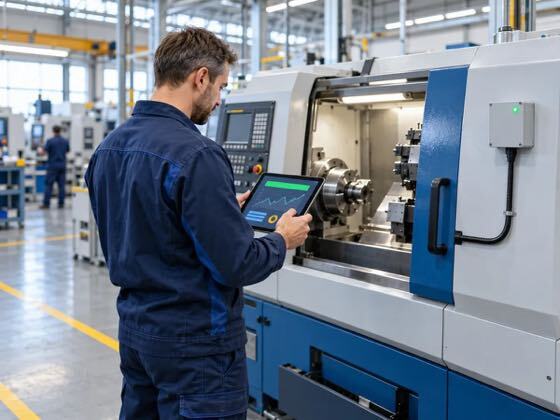
SYMESTIC's IoT Box reads the digital signals without touching the controller.