



Production Data Capture Software: Features, Providers & Costs
Production data capture software – also referred to as PDA (Production Data Acquisition) in standards-aligned environments – automatically collects shop floor data in real time: machine states, cycle times, piece counts, downtime events, order progress, quality metrics, and operator inputs. It replaces manual tracking via spreadsheets, whiteboards, and paper-based shift logs – and provides the data foundation that production teams need to actually manage output rather than just document it after the fact.
This article goes further: What features should production data capture software have? What does it cost? Which providers serve the market? And what should manufacturers look for when evaluating solutions?
Why production data capture software – and why now?
Most manufacturing plants already capture production data in some form. The question is not whether data is collected, but how – and whether the collected data is actually usable for decisions.
The reality in many plants looks like this: operators record piece counts and downtime reasons at the end of each shift in a spreadsheet. A supervisor consolidates the numbers the next morning. The plant manager receives a summary that is 24 to 48 hours old. Deviations are identified after they have already occurred. Micro-stops, speed losses, and short interruptions are never captured at all, because nobody documents them individually.
This system is not fundamentally wrong – it was the only practical method for decades. But it creates systematic blind spots. Studies consistently show that manually captured production data deviates from automatically measured values by 10 to 20 percentage points, almost always in the optimistic direction. Teams are making decisions based on numbers that significantly overstate actual performance.
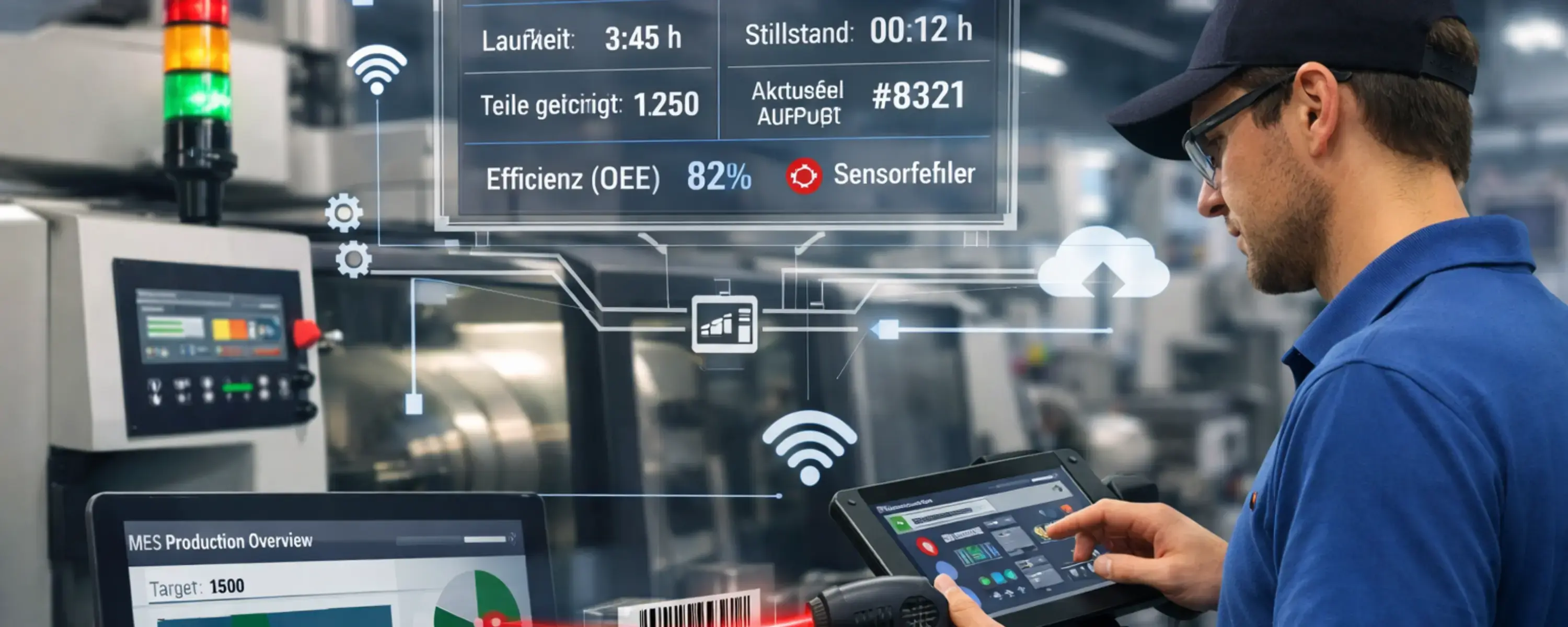
Modern production data capture software changes this fundamentally. It captures machine states directly from PLC signals, sensors, or digital I/O – without human input, without delay, and without interpretation bias. A downtime event appears on the dashboard the moment it occurs. Cycle times are measured at every takt, not estimated at shift end. Data quality does not improve incrementally – it jumps to a different level entirely.
The timing matters because the technology barrier has dropped dramatically. Cloud-native production data capture systems require no local servers, no months-long IT projects, and no six-figure investments. Connecting a machine takes hours, not weeks. And the SaaS cost structure makes professional data capture accessible to companies for which a traditional MES project was previously out of reach.
Core features of production data capture software
The feature range spans from basic machine state monitoring to full MES integration. Which features matter most depends on your production environment, but five capabilities form the core of any professional solution.
Automated machine data collection
The foundation of any production data capture system is how it acquires data. Professional software connects directly to machine controls via OPC UA, digital I/O signals, or industrial protocols like PROFINET and Modbus. This eliminates manual entry and captures every state change – including micro-stops of a few seconds that operators never report but that collectively account for 5 to 15 percent of total production time.
The critical differentiator is connectivity to legacy equipment. Most manufacturing plants operate machines from multiple decades and vendors. Software that only works with modern OPC-UA-enabled equipment leaves the majority of a typical brownfield shop floor uncaptured. Solutions like SYMESTIC address this through standardized IoT gateways that capture digital and analog signals from any machine – without modifying the machine control, without PLC programming, and without production interruption during installation.
Order tracking and production feedback
Production data capture software links machine data to manufacturing orders. Production progress, good and scrap quantities, order times, and setup times are captured automatically or semi-automatically – via shop floor terminals – and assigned to the respective order.
This closes the gap between ERP planning and shop floor reality. Instead of manually entering production feedback into the ERP on a daily or weekly basis, data flows in real time. Plan-vs-actual comparisons at the order level become possible during production, not after. Deviations in cycle times, quantities, or quality are visible before the order is completed.
Real-time dashboards and visualization
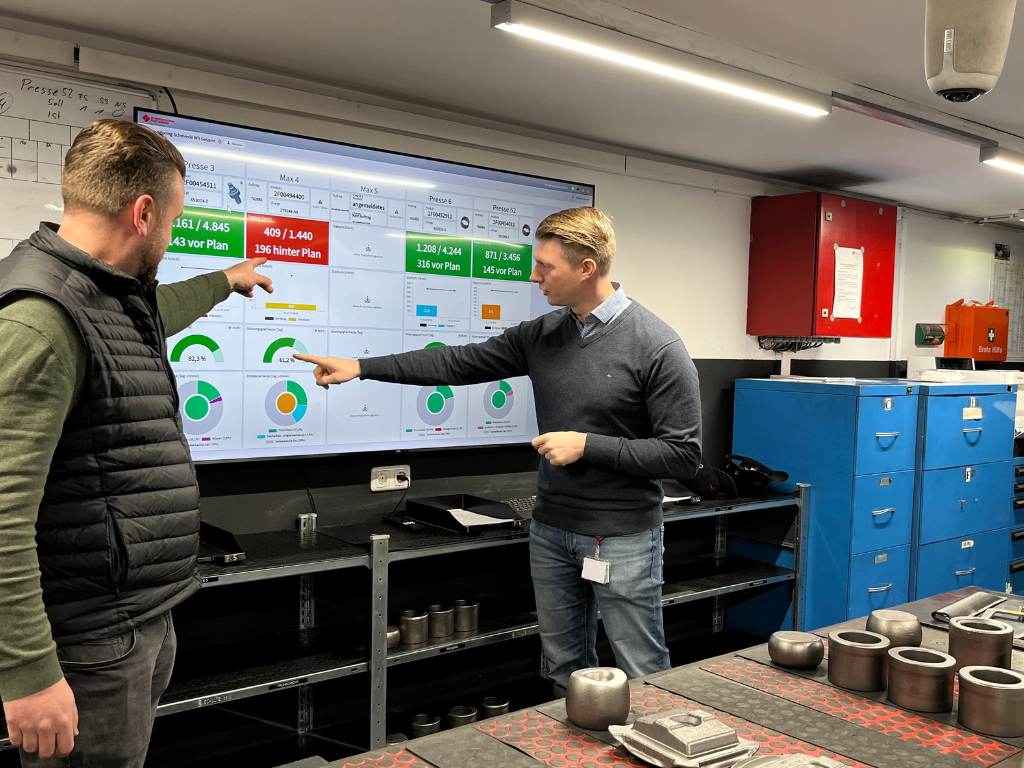
Data is only useful if it reaches the right people at the right time. Production data capture software visualizes KPIs in configurable dashboards: machine status and OEE on the shop floor display, order progress and utilization for the production manager, trend and loss analyses for the continuous improvement team, cross-site comparisons for management.
The key is configurability without complexity. Teams need to create views that match their specific KPI structure, shift models, and reporting hierarchy – without requiring IT involvement for every new dashboard.
Downtime tracking and root cause analysis
Knowing that a machine was down is useful. Knowing why it was down is actionable. Production data capture software categorizes every downtime event – either automatically through signal mapping or through structured operator input at shop floor terminals. Over weeks and months, this builds a Pareto of downtime causes that directly shows where improvement actions have the greatest leverage.
The distinction between planned and unplanned downtime, between technical failures and organizational causes (missing material, missing release, staffing gaps), makes it possible to assign problems to the correct area of responsibility. Technical failures belong to maintenance, organizational causes to production planning – but only if the data cleanly supports this separation.
Reporting and ERP integration
Production data capture software does not replace the ERP system – it supplements it with the data layer the ERP lacks: real-time information from the shop floor. Bidirectional integration – receiving orders from the ERP, sending production feedback to the ERP – closes the information gap between planning and execution.
Standardized reports for shift handovers, weekly reviews, and management reporting are generated automatically from captured data. KPIs like OEE, availability, utilization, and throughput times are calculated and consolidated in configurable reports – without manual effort for data preparation.
Machine data capture vs. production data capture – why the distinction is disappearing
In theory, there is a strict distinction between machine data capture – commonly abbreviated as MDC (Machine Data Collection) or MDA (Manufacturing Data Acquisition) – and production data capture, often referred to as PDA (Production Data Acquisition). MDC/MDA collects technical data – machine states, cycle times, process parameters. PDA collects organizational data – order times, operator assignments, quantities, quality feedback. Both concepts appear in textbooks and industry standards like VDI 5600 and MESA as separate system layers.
In practice, this distinction is increasingly irrelevant. A cloud-native MES platform like SYMESTIC captures both in one system: the machine automatically delivers state data, cycle times, and piece counts (MDC/MDA), while order assignments, operator logins, and quality feedback are captured simultaneously (PDA). The data flows into the same dashboards, the same reports, and the same analyses.
For companies evaluating production data capture today, the decisive question is not "MDC or PDA?" but: Do I need a system that only monitors machines, or one that connects machine, order, quality, and personnel data in a single platform? The first is a monitoring tool. The second is an MES with integrated data capture. And for most manufacturers, the second option is the more efficient long-term choice, because it avoids the platform switch later.
A note on terminology: the manufacturing industry uses MDC, MDA, and PDA inconsistently. Some vendors use MDC to mean what others call MDA. Some use PDA to encompass both machine and organizational data. The acronyms matter less than the underlying question: does the system capture only machine signals, or does it connect machine data with orders, quality, and personnel? In an MES like SYMESTIC, the distinction is moot – all data streams are captured and integrated natively.
Production data capture software providers
The market for production data capture software can be divided into three categories that differ in feature depth, architecture, and cost structure.
Specialized monitoring and data capture tools
Providers like MachineMetrics, Factbird, Vorne (XL), Guidewheel, and oee.ai focus on machine connectivity and real-time visualization. Their strength is fast deployment and clear dashboard interfaces. The feature scope is deliberately limited – order management, production scheduling, quality management, or deep ERP integration are either absent or available only as add-ons. For companies whose sole need is visibility into machine performance, this can be sufficient.
Traditional MES providers with data capture modules
Established MES vendors like MPDV (Hydra X), Siemens (Opcenter), SAP (Digital Manufacturing), Rockwell (Plex), and AVEVA (MES) offer comprehensive on-premise or hybrid MES platforms where production data capture is an integrated component. The advantage: broad functionality spanning scheduling, quality management, and deep ERP integration. The disadvantage: implementation timelines of six to eighteen months, six-figure upfront costs, and ongoing IT effort for operation, updates, and maintenance.
Cloud-native MES platforms with integrated data capture
SYMESTIC, Tulip, and operations1 are built on SaaS models, browser-based interfaces, and rapid deployment. SYMESTIC covers the full scope of MES functionality aligned with VDI 5600 – including automated machine data collection (MDC) and production data acquisition (PDA), production control, quality tracking, maintenance, and energy monitoring – as a fully cloud-native platform.
The difference from specialized monitoring tools: captured production data is natively connected to orders, quality records, maintenance events, and energy consumption. A downtime event is not just a downtime event – it is assigned to an order, has a categorized root cause, generates calculable costs, and is analyzable across shifts and time periods.
The difference from traditional MES: no server, no IT project, no maintenance. Implementation takes days, not months. The monthly SaaS fee covers hosting on Microsoft Azure, all updates and feature enhancements, onboarding, and support.
What does production data capture software cost?
Costs vary significantly by system type. A realistic overview prevents budget surprises.
Spreadsheet-based tracking has no direct software cost. The hidden price is the time operators and supervisors spend on manual entry and consolidation – realistically 30 to 60 minutes per shift per line. For a plant with ten lines running two shifts, this adds up to thousands of dollars per year in labor that could be directed toward improvement rather than data entry. Add the systematic inaccuracy that leads to suboptimal decisions, and the true cost of "free" spreadsheet tracking is substantial.
Specialized monitoring tools typically start at $200 to $500 per month for a limited number of machines. Gateway hardware for machine connectivity adds a one-time cost, typically $500 to $2,000 per machine depending on the connection type and existing infrastructure.
Cloud-native MES platforms with integrated data capture range from $800 to $2,000 per month for mid-sized plants. SYMESTIC's Professional package starts at approximately $900 per month for up to five machines and includes all MES functions – machine data collection (MDC), production data acquisition (PDA), OEE, production control, dashboards, reporting – plus cloud hosting, updates, and dedicated support. Scaling is linear with the number of connected machines.
Traditional on-premise MES with data capture modules requires six-figure upfront investment. Licenses, server hardware, implementation consulting (typically $50,000 to $150,000), training, and machine connectivity add up. Annual maintenance at 20 percent of license fees plus internal IT staffing for operations follows. Over three years, total costs for a single plant regularly reach $200,000 to $400,000.
The decisive comparison factor is not the monthly price but total cost of ownership over three to five years – and the point at which the system actually starts delivering value. A cloud-native system that is productive in two weeks generates optimization insights from month one. An on-premise system that requires twelve months to implement generates only costs for the first year.
For detailed pricing information: SYMESTIC Pricing.
Hardware: gateways, terminals, and machine connectivity
Production data capture software is only as good as the data it receives. The hardware components for data collection fall into three categories.
IoT gateways for machine connectivity
Gateways bridge the gap between machines and the cloud platform. They capture digital and analog signals directly from machine controls and transmit them encrypted to the production data capture system. For modern machines with OPC UA interfaces, connectivity is a configuration step completed in hours. For older legacy machines without digital interfaces, gateways capture relay contacts, sensor outputs, or voltage signals – without modifying the machine control, without PLC programming, and without production interruption.
This is the decisive practical test for many manufacturers. A typical machine park includes equipment from multiple decades and vendors. Software that only connects to the newest 20 percent of machines leaves the majority of the shop floor uncaptured. SYMESTIC provides standardized gateways for both scenarios – OPC UA Cloud Gateways for modern controls and DI Cloud Gateways for retrofitting legacy equipment.
Shop floor terminals
For data that does not come automatically from machines – downtime reasons, order check-ins, quality feedback, operator assignments – terminals at the workstation are used. Modern production data capture software runs in the browser, so any device can serve as a terminal: industrial-grade touchscreens (IP65 for harsh environments), standard tablets, or existing PCs near the production line.
The trend is clearly moving away from dedicated proprietary hardware toward browser-based solutions on standard devices. This significantly reduces hardware costs and simplifies maintenance.
Retrofit sensors
For machines where even analog signals are not readily accessible, retrofit sensors offer a pragmatic solution. Current sensors on the main power supply detect whether a machine is running or idle. Light barriers count pieces. Vibration sensors detect operating states. These sensors work completely non-invasively – they are attached, not installed.
Which KPIs does production data capture deliver?
The KPIs generated by a production data capture system fall into four categories.
Machine KPIs include OEE (Overall Equipment Effectiveness), availability, performance rate, quality rate, MTBF (mean time between failures), MTTR (mean time to repair), and utilization rate. These metrics show how effectively existing equipment is used and where the largest losses occur.
Order KPIs include throughput times, setup times, plan-vs-actual comparisons at the order level, on-time delivery rate, and capacity utilization. These connect machine data to the order level and show how efficiently manufacturing fulfills customer orders.
Quality KPIs include scrap rate, rework rate, first-pass yield, and process-related defect statistics. Combined with machine and order data, they reveal which product-machine combinations systematically cause quality issues.
Personnel KPIs include productivity per operator or shift, attendance assignments, and team-level performance metrics. This data serves capacity planning and activity-based costing – not individual employee surveillance.
For a deep dive into OEE calculation and its components: OEE – The Complete Guide.
Implementation: from pilot to plant-wide rollout
The most effective implementation strategy follows the proof-of-value principle: start small, achieve measurable results, then scale.
Step one is selecting a pilot line – ideally a bottleneck or a line where you suspect significant hidden losses. Machine connectivity via gateways, dashboard configuration, and order integration can be completed within days with cloud-native production data capture software.
Step two is the learning phase. In the first two to four weeks, automated capture typically reveals results that differ significantly from previous manual values. Actual OEE typically falls 10 to 20 percentage points below the previously assumed value. This is not a setback – it is the first moment of genuine transparency. Micro-stops, systematic speed losses, and recurring downtime patterns become visible for the first time.
Step three is targeted improvement. With a Pareto of real loss causes, production teams can prioritize actions based on data rather than intuition. The Klocke Group achieved a 12 percent output increase and seven additional production hours per week within three weeks of deployment – solely by eliminating losses that had been invisible under the previous manual tracking system.
Step four is the rollout. When the pilot delivers measurable results – and in practice, it almost always does – the business case for a plant-wide expansion writes itself. Cloud-native production data capture software makes this step straightforward: new lines and sites are added in the existing platform without a new IT project and without additional servers.
Production data capture in practice
The automotive supplier Meleghy Automotive operates SYMESTIC across six plants with over 300 machine segments. The platform consolidates production data to a cross-plant standard (SEMI E10) and enables systematic benchmarking between sites for the first time. What previously disappeared in local spreadsheets becomes a company-wide decision-making foundation: which plants achieve better results on comparable processes, which best practices are transferable, and which investments have the highest impact.
The Klocke Group, specializing in pharmaceutical packaging, achieved a 12 percent output increase and seven additional production hours per week – within three weeks of going live with SYMESTIC. The gains came entirely from eliminating losses that had been invisible under manual tracking.
In the food industry, Erlenbacher reports a similar pattern: data that was previously captured manually and evaluated the next day is now available in real time. Response time to disruptions dropped from hours to minutes.
The common pattern: the biggest gains come not from new machines or additional staff, but from eliminating losses that were simply not visible before. Production data capture software makes these losses visible – the rest is systematic improvement work.
Frequently asked questions about production data capture software
What is production data capture software?
Production data capture software is a system for automatically collecting, processing, and visualizing shop floor data. It captures machine states, piece counts, order times, downtime events, and quality data directly from production and presents them in real-time dashboards. It replaces manual tracking via spreadsheets and provides the data foundation for informed production decisions.
What do PDA, MDA, and MDC stand for in manufacturing?
PDA stands for Production Data Acquisition and covers the systematic collection of both organizational and technical production data – order times, quantities, machine states, quality metrics. MDA (Manufacturing Data Acquisition) and MDC (Machine Data Collection) focus specifically on technical machine data – run times, cycle times, faults, and process parameters. In practice, modern MES platforms like SYMESTIC integrate all three into a single system. The terms originate from different standards and regional conventions but describe overlapping functions.
What is the difference between machine data capture and production data capture?
Machine data capture (MDC/MDA) focuses on technical machine data – run times, cycle times, faults, process parameters. Production data capture (PDA) includes organizational data as well – order times, operator assignments, quantities, quality feedback. In modern MES platforms like SYMESTIC, both are integrated in a single system, making the distinction largely academic.
What KPIs does production data capture deliver?
Machine KPIs (OEE, availability, performance, MTBF, MTTR), order KPIs (throughput times, plan-vs-actual, on-time delivery), quality KPIs (scrap rate, first-pass yield), and personnel KPIs (productivity per shift, capacity utilization). These form the foundation for data-driven improvement programs.
How much does production data capture software cost?
Specialized monitoring tools start at $200–500/month. Cloud-native MES platforms with integrated data capture range from $800–2,000/month for mid-sized plants. SYMESTIC starts at approximately $900/month including all functions. Traditional on-premise MES requires six-figure upfront investment plus ongoing maintenance.
How long does implementation take?
With cloud-native software, initial machine connectivity and dashboard setup can be completed in days. A typical pilot line is productive within one to two weeks. Full plant rollouts are measured in weeks, not months. Traditional on-premise implementations typically require six to eighteen months.
Can production data capture software connect to older machines?
Yes – this is one of the most important evaluation criteria. Solutions like SYMESTIC use IoT gateways that capture digital and analog signals from any machine regardless of age or manufacturer, without modifying the machine control or PLC. Even machines from the 1980s and 1990s can be integrated into modern real-time monitoring.
What production improvements can manufacturers expect?
Manufacturers deploying professional production data capture software typically see 10 to 15 percentage points of OEE improvement within the first six to twelve months. Initial gains come from eliminating previously invisible losses. The Klocke Group achieved a 12 percent output increase within weeks of deploying SYMESTIC.