



Contents
What is digital production control?
Digital production control — also called digital shop-floor control, real-time manufacturing control, MES execution or, in ERP-contexts, production order dispatching — is the discipline of translating a production plan into actual output on the shop floor, in real time, with continuous feedback from machines and operators. It is not a planning exercise; planning decides what should happen, digital production control governs what does happen. In the ISA-95 stack it lives at Level 3 (MES) and the upper end of Level 2 (SCADA / line control). In practice, it is the layer where a well-designed plan either becomes reality or becomes noise.
The pattern is consistent: a plant's operational performance is not determined by its planning sophistication; it is determined by how fast the gap between plan and reality gets closed. Digital production control is that closing mechanism. When it works, deviations surface in minutes and get resolved in the same shift. When it doesn't, deviations surface in the Monday management report and get "resolved" in PowerPoint.
What digital production control actually does — four core loops
Digital production control is best understood not as a feature list but as four closed-loop mechanisms that run continuously during production. Each loop has a different time constant, a different data source and a different failure mode. Most MES projects that underperform have two or three of these loops broken; the ones that deliver results have all four running.
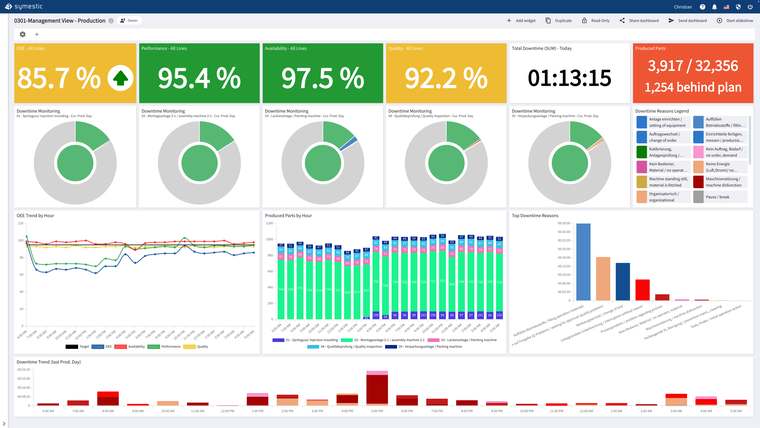
A common failure mode: plants invest heavily in the dispatch loop (schedule published to the floor, work orders digital, operator terminals installed) and barely at all in the OEE reactivity loop. The result is a beautifully released plan that nobody adjusts when Line 3 loses twelve percent availability at 09:30 on Monday. Digital production control without real-time OEE is a publishing system, not a control system.
Manual, semi-digital and fully digital control — what each actually delivers
Most plants are somewhere on a spectrum, not at one extreme. It helps to be honest about where you actually sit — because the ROI case for moving up a level is different at each stage.
The honest observation from hundreds of plants: the biggest step-change in operational performance is not from stage three to stage four — it is from stage one or two to stage three. Getting reaction time from 8–24 hours to 30–60 minutes is where the OEE points come from. Getting from 30 minutes to 5 minutes is valuable, but marginal compared to what digital dispatch plus live OEE unlocks in the first place.
Where digital production control projects fail
The five recurring failure patterns
Four of these five failures share a common root cause: the feedback loop is incomplete or has friction that operators route around. Digital production control is the discipline of making those loops fast, honest and acted upon.
The architecture that actually works in 2026
Cloud-native MES is now the default for the execution layer in mid-market discrete manufacturing, and for good reason. It gives you elastic compute for real-time event processing across hundreds of machines, fast deployment, natural integration with cloud-hosted ERPs, and — critically — consistent behaviour across sites. A plant in Hungary and a plant in Germany can run the same execution logic against the same data model, and the plant manager in either location sees live state from both without an integration project. The Meleghy rollout demonstrates this cleanly: four plants on one execution platform, bidirectional SAP R3 integration via ABAP IDoc, in six months total — 10 % reduction in downtime and 7 % improvement in output. Those numbers come from closed-loop execution, not from a better plan.
What closed-loop execution looks like in the SYMESTIC pattern
Production orders flow from ERP to the shop floor terminal in the operator's workflow. Machines report cycles, states and downtimes continuously via OPC UA (modern PLCs), MQTT, or digital I/O gateways for brownfield lines with no LAN infrastructure (Klocke pharma, Weingarten site scaled in three weeks). Deviations auto-escalate to the right role — maintenance for mechanical alarms, supervisor for sequence overrides. Completions and scrap flow back to the ERP. Five industries — automotive (Meleghy, Carcoustics), food, FMCG, pharma non-validated (Klocke), metal processing — one execution pattern, one data model. Operators report through shop floor terminals.
FAQ
What is digital production control?
Digital production control is the discipline of translating a production plan into actual output on the shop floor, in real time, with continuous feedback from machines and operators. It governs four closed loops — dispatch, OEE reactivity, quality, and material/WIP — and sits at ISA-95 Level 3 (MES) with links to Level 2 (SCADA / line control). It is known by several names: digital production control, digital shop-floor control, real-time manufacturing control, MES execution, production order dispatching. All refer to the execution layer below planning and above the machine.
What is the difference between production planning and production control?
Planning decides what should happen; control governs what does happen. Planning sets the sequence, resource allocation and timing for the next hours to weeks; control dispatches orders, tracks execution against the plan, surfaces deviations in real time and closes the loop back to planning with actual cycle times and availability. A plant can have excellent planning and poor control — the result is a good plan that collapses by 09:30 on Monday. A plant can also have adequate planning and excellent control — the result is steady, measurable output even when the plan is imperfect.
What are the four closed loops of digital production control?
Dispatch loop (shift-to-shift order release, sequence, priority overrides), OEE reactivity loop (minute-level response to availability, performance and quality deviations), quality loop (scrap detection, rework routing, SPC triggers), and material/WIP loop (component availability, staging, shortage escalation). Most underperforming MES deployments have two or three of these loops broken. The ones that deliver operational results have all four running with acceptable time constants.
How fast should reaction time to deviations be?
The biggest step-change in performance is moving from paper/manual (8–24 hour reaction time) to fully digital with loose loop (30–60 minutes). That is where the bulk of the OEE improvement lives. Moving from 30 minutes to 5 minutes via closed-loop auto-escalation is valuable but marginal compared to the initial jump. Plants still in the 8–24 hour band should not over-engineer the 5-minute target; they should first get reliably to 30 minutes.
Why do digital production control projects fail?
Five recurring patterns: dispatch without feedback (plan flows down, nothing flows back), OEE reporting instead of OEE reactivity (dashboards nobody acts on during the shift), first-option-in-dropdown syndrome (classification data dominated by one code because the UX is friction-heavy), escalation to the wrong role (andon fires to a generic mailbox), and ERP-disconnected execution (completions never close the financial loop in time). Four of the five share the same root cause: the feedback loop is incomplete or has friction that operators route around.
How does digital production control integrate with ERP?
Bidirectionally. From ERP to execution flow production orders, routings, BOMs and material master data — the context the operator needs. From execution to ERP flow confirmations, quantities, personnel time and scrap — the feedback ERP needs to close the order financially and update inventory. Integration mechanism is ERP-specific: SAP ABAP IDoc bidirectional in SAP environments, REST APIs for Navision, proAlpha, Infor and modern ERPs, file-based for older systems. At SYMESTIC this is a standard work package, which is why Meleghy's bidirectional SAP integration landed across four plants in six months rather than eighteen.
Should digital production control be cloud-native or on-premise?
For the vast majority of mid-market discrete manufacturers, cloud-native is the better answer in 2026. It provides elastic compute for real-time event processing, fast deployment, consistent behaviour across sites, and natural integration with cloud-hosted ERPs. The latency caveat applies only to sub-second closed-loop control at the machine level, which belongs at the MES edge or PLC regardless of where the execution layer sits. On-premise in 2026 is a choice made for specific regulatory, data-sovereignty or legacy-integration reasons — not for performance.
What results should I expect from closed-loop digital production control?
Benchmarks from the SYMESTIC installed base — Meleghy, four plants: 10 % reduction in downtime and 7 % improvement in output, rolled out in six months. Carcoustics: more than 500 machines across 12 plants, connected to SAP. Klocke pharma Weingarten: all lines at the site live in three weeks. Different industries, different starting points, same pattern — closed-loop execution delivers measurable improvement in the first 3–6 months, not the first 18.
How does SYMESTIC implement digital production control?
Production orders from ERP in the operator workflow via the shop floor terminal, machine data in continuously via OPC UA, MQTT or digital I/O gateway (brownfield without LAN retrofit), auto-escalation to the right role, completions and scrap back to ERP. 15,000+ machines on this pattern, validated in automotive, food, FMCG, pharma non-validated and metal processing. See SYMESTIC Production Control.
Related: MES · MES Software · OEE · OEE Software · Production Planning Software · Shop Floor Terminal · Digital Manufacturing · Manufacturing Analytics · Paperless Manufacturing · SYMESTIC Production Control · Production Metrics · Alarms

See SYMESTIC on your own use case
In a free live demo, a product expert walks you through the running platform and shows what OEE, downtime and the connection of your machines and ERP look like in practice.
- Live OEE
- Downtime and reasons
- Connecting machines and ERP