




MES Software: Vendors, Features & Costs Compared 2026
MES software compared: vendors, functions per VDI 5600, costs (cloud vs. on-premise) and implementation. Honest market overview 2026.
Production planning software — also called APS software (Advanced Planning and Scheduling), production scheduling software, manufacturing planning software or, in ERP-contexts, the production planning module — is the category of tools that decide what gets produced, when, on which resource, in which sequence, and with which materials. In the official ISA-95 stack it spans Level 4 (business planning) down to Level 3 (detailed scheduling). In practice, it is not one product but a set of overlapping categories — MRP, ERP production planning, APS, MES-level dispatch — that handle different time horizons and different decision types. Buyers who treat it as a single market end up either buying a tool that doesn't do what they need or buying four tools that fight each other at the integration layer.
The quality of a production plan is determined almost entirely by the quality of the execution data that feeds it. The planning algorithm can be perfect, but if it plans against stale cycle times, assumed availability and yesterday's WIP, the plan is theatre.
Production planning in a real factory happens at four distinct layers with different time horizons, different decision variables and different primary systems. Conflating them is the single most common source of buyer confusion.
The two layers where customers most often misbuy are master planning and detailed scheduling. Master planning runs on MRP logic — infinite capacity, static lead times, weekly buckets. It tells you that an order needs to be done by week 34; it does not tell you in which sequence the 47 orders running on Line 3 that week will actually be built. Detailed scheduling — APS — answers that question, and it is a fundamentally different algorithmic problem (finite capacity, setup-dependent sequencing, constraint propagation). An ERP planning module and an APS tool look similar in a demo and behave very differently in production.
The fundamental rule: each layer has a different algorithmic purpose and consumes different data. Plants that skip this distinction buy the wrong tool for the problem they actually have, and then blame the software when the plan collapses by Monday lunchtime.
There is no such thing as "accurate production planning" separate from "good execution feedback". They are the same thing. If your APS plans with standard cycle times from 2021 against an ERP-claimed availability of 92 % when actual availability is 74 %, the schedule is infeasible before the first shift starts. What you see afterwards is not "plan deviation" — it is a plan that was wrong at the moment it was released, and nobody knew because the execution layer wasn't feeding back.
A six-figure APS installation can produce beautiful Gantt charts nobody on the shop floor follows. Supervisors override the schedule every shift and schedule from a spreadsheet. The reason is usually not the APS — the APS may be well-configured. The reason is that the APS reads standard cycle times out of the ERP that have not been updated in years, while the actual cycle times have drifted across the machine park. Once real cycle times from MES machine data flow into the APS, the schedule starts holding and supervisor overrides drop. The APS does not get better. The data underneath it does. This is what happens by default unless the execution-to-planning feedback loop is treated as a core architecture problem, not as "nice-to-have integration."
The honest answer: it depends on four variables, and most mid-market plants don't need a separate APS tool.
Plants that tick mostly the left column get better outcomes from a competent ERP bucketed plan combined with a real MES that dispatches and re-sequences in real time. Plants that tick the right column genuinely benefit from a finite-capacity APS. Buying APS for a left-column plant is a common way to spend six figures on a tool that produces plans the shop floor ignores.
The planner is not an island. It is the decision layer of a data stack that reaches up to ERP and down to the machine. The integrations that have to work cleanly are well-defined and — in 2026 — well-standardised. Where the work actually sits is the feedback loop, not the integration protocol.
Historically, APS and planning software were on-premise, often installed alongside the ERP. In the 2020s the market has shifted decisively toward cloud-native delivery — with one structural caveat that matters for planning specifically. Cloud-native planning software gives you elastic compute for scheduling solves (a finite-capacity solve on 30 resources × 500 orders × 4-week horizon is non-trivial compute), fast deployment, continuous updates, and — critically — natural integration with cloud MES platforms that host live execution data. The latency caveat applies only to sub-second closed-loop control, which belongs at the MES or edge layer regardless of where the planner sits. For hourly or shift-level re-planning, cloud latency is a non-issue; modern cloud platforms reach the shop floor in tens of milliseconds end-to-end.
The Meleghy rollout across four plants demonstrates this cleanly. Bidirectional SAP R3 integration via ABAP IDoc means production orders flow ERP → MES, machine cycles map to orders, and completion data flows MES → ERP. Full enterprise MES with planning feedback integrated across four plants in Germany, Spain, the Czech Republic and Hungary in six months. Ten percent reduction in downtime and seven percent improvement in output. Carcoustics connected more than 500 machines in 12 plants on the same pattern in six months. Klocke's packaging lines under GMP scaled to full Weingarten site in three weeks via digital I/O gateways with no LAN retrofit. Five industries, five planning profiles, one data model. The pattern is consistent: the planning algorithm is not the limiter; the execution-data feedback loop is. Executing the plan in real time is the job of digital production control.
What is production planning software?
Production planning software is the category of tools that decide what gets produced, when, on which resource, in which sequence, and with which materials. It spans four layers — long-range S&OP, master planning / MRP (ERP), detailed scheduling (APS), and shop-floor dispatch (MES). It is known by several names: production planning software, APS software (Advanced Planning and Scheduling), production scheduling software, manufacturing planning software, ERP production planning module. All refer to overlapping categories handling different time horizons and decision types — not a single product.
What is the difference between MRP, APS, and MES scheduling?
MRP explodes demand through the BOM and assumes infinite capacity. ERP production planning adds rough-cut capacity checks at the work-centre / week level. APS is a finite-capacity scheduler that sequences orders on specific resources respecting setup, tooling, alternate routings, skills, and material arrival. MES scheduling is short-horizon dispatch and live re-sequencing driven by actual machine state and current downtime. Each layer has a different time horizon and a fundamentally different algorithm.
Do I need a dedicated APS tool, or is ERP plus MES sufficient?
Depends on four variables. If your setup is sequence-dependent (colour changes, alloy changes, cleaning cycles), your routings have real alternates, you have hundreds of concurrent orders with high mix, and you need to re-plan multiple times per day, a dedicated APS is justified. If your setup is relatively stable, routings are straightforward, order volume is moderate, and daily or weekly plans hold, a competent ERP bucketed plan combined with a real MES that dispatches and re-sequences in real time produces better outcomes than buying APS. Most mid-market discrete manufacturers fall in the second category.
Why do production planning projects fail?
Five recurring failure modes: planning on stale master data (cycle times that haven't been updated in years), planning without live MES feedback (plan drifts out of reality by mid-morning), over-constrained models (solver times explode, re-planning becomes impractical), plan-ignored-at-the-line (supervisors override every shift because operators don't see the plan in their workflow), and the Excel shadow system (expensive APS installed, the real plan still lives in a spreadsheet). Four of the five share a common root cause: the planner isn't properly closed-loop with the execution layer.
Should production planning software be cloud-native or on-premise?
For the vast majority of mid-market discrete manufacturers, cloud-native is the better answer in 2026. It provides elastic compute for scheduling solves, fast deployment, continuous updates, and natural integration with cloud MES platforms. The latency caveat matters only for sub-second closed-loop control, which belongs at the MES or edge layer regardless of where the planner sits. On-premise in 2026 is a choice made for specific regulatory, data-sovereignty, or legacy-integration reasons — not for performance.
How does production planning software integrate with ERP and MES?
Four flows, all required for a closed-loop system. ERP → Planner: demand, production orders, routings, BOMs, material availability. MES → Planner: actual cycle times, real availability, current WIP, active downtime, scheduled maintenance. Planner → MES: released schedule, sequence per resource, setup matrix, priority overrides. MES → ERP: completions, scrap, actual times, order status. Without the MES → Planner flow, the planner runs on assumptions. Without the Planner → MES flow, the plan never reaches the operators. At SYMESTIC, bidirectional SAP IDoc integration is a standard work package rather than a custom project, which is why rollouts like Meleghy land in six months across four plants rather than eighteen.
What is the typical implementation timeline?
A cloud-native planning rollout integrated with a modern MES typically runs 2–4 months for a single plant with standard processes, with first productive use in weeks. A traditional on-premise APS implementation with heavy ERP customisation typically runs 9–18 months. The decisive variables are ERP integration complexity (SAP with heavy customisation is the longest-tail case), master-data quality (cleaning routings and cycle times often consumes more calendar time than the software itself), and scope discipline (attempting to model every edge case in the first release is the most common schedule-killer).
How does SYMESTIC implement production planning?
Cloud-native planning on the same Azure platform as the SYMESTIC MES — production orders and BOMs flow in from ERP (SAP IDoc bidirectional, REST for Navision, Infor and modern ERPs, file-based for older systems), actual cycle times and availability flow in continuously from the MES, the released plan flows back to the shop floor terminal in the operator's workflow. 15,000+ machines running on this architecture, with the same rollout pattern working in automotive (Meleghy, Carcoustics), food, FMCG and pharma (Klocke). See SYMESTIC Production Planning.
Related: MES · MES Software · OEE · OEE Software · Shop Floor Terminal · Digital Manufacturing · Manufacturing Analytics · Paperless Manufacturing · SYMESTIC Production Planning · Production Control · Production Metrics
See SYMESTIC on your own use case
In a free live demo, a product expert walks you through the running platform and shows what OEE, downtime and the connection of your machines and ERP look like in practice.
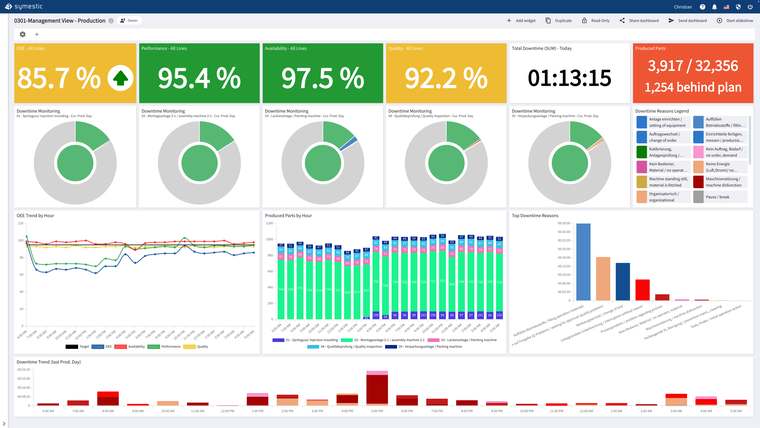

No more walking the floor to find where an order is
SYMESTIC shows the status and current operation of every order live, with every confirmation documented without paper.

Day 1real-time data on the line
Real-time data on the line from day one
At Schmiedetechnik Plettenberg, shift teams and managers see cycle times, quantities and downtime in the same view. Orders come from the ERP InforCOM, confirmations flow straight back.