




Contents
Kaikaku (Japanese 改革, "reform") is a radical redesign of a value stream carried out in a short time. Kaizen improves an existing process step by step. Kaikaku replaces the arrangement itself: separate batch departments become a connected cell, or a stationary assembly becomes a moving line.
The Lean Enterprise Institute defines kaikaku in its Lean Lexicon as radical improvement of a value stream that quickly creates more value with less waste, and also calls it breakthrough kaizen or kakushin. Its example is moving equipment over a weekend so that products built in batches can be made in single-piece flow in a compact cell. Yuji Yamamoto, who wrote his doctoral thesis on kaikaku at Mälardalen University in Sweden, describes it as large-scale improvement of a radical and innovative nature. His studies at Swedish and Japanese manufacturers led him to conclude that a kaikaku can run less linearly and more cyclically, as a series of smaller projects that drive exploration and learning.
When Kaizen Is Enough and When to Consider Kaikaku
| Observation | Kaizen is likely enough | Kaikaku candidate |
|---|---|---|
| Where the loss sits | One station loses time to setups or searching | Parts wait for days between departments |
| Material flow | Short distances, one queue | Batches travel by forklift between distant areas, several queues |
| Capacity and demand | Demand fits after small gains | A demand change or new product needs a different flow |
| Cause of the loss | A method or standard that can be adjusted | The layout itself forces transfers and waiting |
| Investment | None or small | Moving equipment, new fixtures, sometimes new machines |
These are criteria for a review. A rapid improvement workshop can qualify as kaikaku when it changes the flow itself. A value stream map of the current state shows where parts wait and how far they travel, and it is the usual starting point for that review.
Check Capacity Before Moving Equipment
The Lean Enterprise Institute defines takt time as available production time divided by customer demand. All times and quantities below are assumed for illustration. A plant has 7 hours of available time per shift, which is 25,200 seconds, and the customer needs 420 components per shift. Takt time is 25,200 ÷ 420 = 60 seconds.
Three operations make the component. Operation B is a machining step with an automatic cycle; the operator only loads and unloads.
| Operation | Manual work | Machine time | Station cycle |
|---|---|---|---|
| A, deburring | 40 s | 0 s | 40 s |
| B, machining | 10 s load and unload | 45 s | 55 s |
| C, assembly and check | 45 s | 0 s | 45 s |
Today each operation sits in its own department with one operator per station. Every station cycle is below 60 seconds, so capacity is sufficient, but each operator waits part of every takt and parts travel in batches. Labor per component is 3 × 60 = 180 operator-seconds.
In a U-shaped cell, the operators walk between stations; assume 8 seconds of walking per cycle in total. Manual work per component is then 40 + 10 + 45 + 8 = 103 seconds. One operator cannot cover that within a 60-second takt. Two operators can: operator 1 runs A and loads machine B (40 + 10 + 4 = 54 seconds), operator 2 runs C (45 + 4 = 49 seconds). Machine B still needs 55 seconds per cycle, which also fits the takt. Labor per component drops to 2 × 60 = 120 operator-seconds, a third less.
Two errors are common in this calculation. Counting machine time as operator work gives 40 + 55 + 45 = 140 seconds and leads to three operators. Forgetting the walking time makes the cell look easier than it is. Operator 1 has 6 seconds of margin per cycle; replenishing material or clearing a jam uses that up quickly. Put support tasks into the work study before the move, and check the bottleneck again with real times from a trial.
Prepare the Changeover
- Standard work for each operator, based on the split above
- Material supply at the cell: who replenishes, how often, in which containers
- Machine guarding and safety approval for the new layout; in the US, OSHA 29 CFR 1910.212 sets the general guarding requirements for all machines
- First-piece inspection after each machine restarts
- A baseline of output, downtime and scrap from comparable shifts before the move
- A fallback plan for the first days, including who decides to use it
Measure Before and After
Compare equivalent periods: the same product mix, staffed time and shift pattern. Useful measures are output per staffed hour, OEE per machine, downtime by reason and the number and length of setups. A higher hourly output after the redesign may partly reflect a simpler product mix; keep that difference visible instead of crediting the layout with all of it.
Yamamoto's observation that a kaikaku can unfold in cycles has a practical consequence. The first weeks in the new cell reveal problems the plan did not show. Daily kaizen then stabilizes the new flow, and each round of fixes is measured against the same baseline.
What SYMESTIC Contributes to a Kaikaku
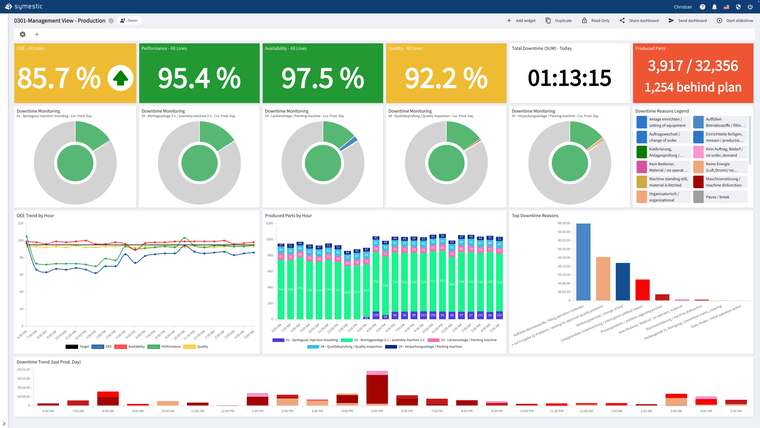
The layout itself is designed by your engineering team. SYMESTIC, a Cloud MES, measures the flow before and after the change. Quantities, scrap and downtime are recorded automatically, OEE is visible live per machine and shift, and setup counts as a downtime reason of its own. Cycle time is displayed as the last and the average value, so you can see whether machine B stays at 55 seconds in the new cell. The digital shift log records what happened in each shift during the ramp-up.
Details are on the pages for OEE software and downtime tracking.
Sources
- Lean Enterprise Institute: Lean Lexicon, Kaikaku
- Lean Enterprise Institute: Lean Lexicon, Takt Time
- Yuji Yamamoto: Kaikaku in production toward creating unique production systems, doctoral thesis, Mälardalen University
- OSHA: 29 CFR 1910.212, General requirements for all machines
- Live demo
- 30 minutes
- Free
See SYMESTIC on your own use case
In a free live demo, a product expert walks you through the running platform and shows what OEE, downtime and the connection of your machines and ERP look like in practice.
- Live OEE
- Downtime and reasons
- Connecting machines and ERP

About the author
Christian FiegHead of Sales
Six Sigma Black Belt with more than 25 years in manufacturing, previously at Johnson Controls, Visteon, iTAC and Dürr. Author of the book “OEE: Eine Zahl, viele Lügen”.
All articles by Christian Fieg