




MES Software: Vendors, Features & Costs Compared 2026
MES software compared: vendors, functions per VDI 5600, costs (cloud vs. on-premise) and implementation. Honest market overview 2026.
Kanban (看板, literally "visual sign" or "card") is the pull-based production control method invented by Taiichi Ohno at Toyota in the 1950s. The principle: the downstream process tells the upstream process what to produce, when and how much — by sending back a signal (originally a physical card). Nothing is produced until the signal arrives. That is the opposite of push-based scheduling, where a central planner sends production orders based on a forecast. Kanban replaces forecast-driven overproduction with demand-driven replenishment. In a manufacturing context, it controls material flow between workstations, between warehouse and line, and between supplier and plant — using the simplest possible signal: "I consumed one container. Send me another."
A Kanban loop is a closed circuit between a consuming process (the customer) and a supplying process (the producer). Every loop has a fixed number of Kanban cards. Each card authorises the production or movement of one defined quantity (one container, one pallet, one bin). The loop works in 6 steps:
| Step | What happens | Example | Key rule |
|---|---|---|---|
| 1 | Consume | Assembly station takes a container of brackets from the supermarket (line-side buffer). | Only take what you need. |
| 2 | Detach card | The Kanban card on the empty container is removed and placed in the collection box. | No card = no authorisation to produce or move. |
| 3 | Card returns to supplier | The card is transported back to the supplying process (stamping press, warehouse or external supplier). | The card travels in the opposite direction of the material. |
| 4 | Produce / pick | The supplier sees the card and produces exactly one container quantity of brackets (or picks it from stock). | Produce only what the card authorises — never more, never less. |
| 5 | Attach card | The card is attached to the full container. | Every container in the system must have a card. |
| 6 | Deliver | The full container is delivered to the supermarket at the consuming station. | The loop is closed. The total number of cards (and therefore containers) in the loop never changes unless deliberately recalculated. |
The number of Kanban cards in a loop directly controls the work-in-progress (WIP). Fewer cards = less WIP = shorter lead time = less capital tied up in inventory. But too few cards = starvation = line stop. The Kanban formula calculates the right number: N = (D × L × (1 + S)) / C — where D = demand per unit of time, L = lead time (production + transport), S = safety factor, C = container quantity. Getting this number right requires accurate data on actual demand, actual lead times and actual variability — exactly the data that an MES provides.
| Dimension | Push (MRP-driven) | Pull (Kanban) |
|---|---|---|
| Trigger for production | Forecast / production schedule from ERP | Actual consumption by the downstream process |
| WIP control | Implicit — WIP is whatever accumulates between stations | Explicit — WIP is limited by the number of Kanban cards |
| Overproduction risk | High — forecast errors create excess inventory | Low — production stops when all containers are full |
| Scheduling complexity | High — centralised planner must sequence every work centre | Low — the Kanban card is the schedule |
| Best suited for | Low-volume, high-mix, project-based production | Repetitive production with stable demand patterns |
| Visibility requirement | ERP data (planned vs. actual) | Real-time consumption data — exactly what an MES delivers |
Most real-world factories use a hybrid: MRP/ERP for long-range planning and customer order management, Kanban for short-range shop-floor execution. The ERP says "we need 10,000 brackets this week." Kanban controls how those 10,000 brackets flow through the shop floor — container by container, pulled by actual consumption. At Schmiedetechnik Plettenberg, SYMESTIC is integrated with the InforCOM ERP.
| Kanban type | Signal direction | Use case | Example |
|---|---|---|---|
| Production Kanban | Consuming station → producing station | Authorises production of one container quantity | Assembly consumes brackets → card goes to stamping press → press produces one bin of brackets |
| Withdrawal Kanban (transport Kanban) | Consuming station → supermarket/warehouse | Authorises movement of one container from stock to point of use | Assembly needs brackets → withdrawal card → logistics picks one container from the warehouse |
| Supplier Kanban | Plant → external supplier | Authorises delivery of one container from an external supplier | Supermarket level drops below reorder point → supplier Kanban sent electronically → supplier delivers |
| Signal Kanban (triangle Kanban) | Batch process trigger | Used when changeover time is long and one-piece-flow is not feasible — triggers batch production at a reorder point | Paint line: stock drops to 3 pallets → signal Kanban triggers production of a batch of 10 pallets |
| e-Kanban (electronic Kanban) | Digital signal via MES/ERP | Replaces physical cards with electronic signals — essential for multi-plant or high-speed environments | MES detects that a machine completed a container → automatic replenishment signal to the upstream process or supplier |
e-Kanban is where a Manufacturing Execution System transforms Kanban from a manual process into a real-time digital system. Physical cards get lost, are miscounted, travel slowly and provide no data trail. e-Kanban — triggered by actual MES production signals — eliminates all four problems.
Physical Kanban works. It has worked since 1953. But it has three structural weaknesses that an MES eliminates:
The SYMESTIC production metrics module provides the real-time consumption data that Kanban needs, and the production control module provides the order-level tracking that connects Kanban signals to ERP production orders.
When does Kanban not work in manufacturing?
Kanban is designed for repetitive production with reasonably stable demand. It struggles in three situations: (1) Highly variable demand — if demand for a part number swings from 50 to 500 per day, the fixed number of Kanban cards cannot adapt fast enough. (2) Long lead times with high variability — if the supplying process takes 2–8 hours depending on changeover and breakdowns, the safety factor in the Kanban formula explodes, requiring so many cards that you are back to building buffer stock. (3) Pure make-to-order with no repeat parts — Kanban needs a supermarket (buffer stock of standard items), which is pointless if every order is unique. For these situations, MRP-driven scheduling or finite capacity scheduling is more appropriate.
What is the relationship between Kanban and Just-in-Time?
Kanban is the execution mechanism of JIT. JIT is the philosophy: produce only what is needed, when needed, in the quantity needed. Kanban is the practical system that enforces it: the card limits what can be produced and when. You cannot have JIT without some form of pull signal — and Kanban is the most proven form of pull signal in manufacturing.
How many Kanban cards should a loop have?
Use the formula: N = (D × L × (1 + S)) / C. Example: demand D = 100 parts/hour, lead time L = 2 hours (production + transport), safety factor S = 0.2 (20 % buffer for variability), container quantity C = 50 parts. N = (100 × 2 × 1.2) / 50 = 4.8 → 5 cards. Start with this calculation, then observe. If containers are always full when you check, you have too many cards. If the consuming station runs dry, you have too few — or the supplying process has a reliability problem that the OEE data from the MES will reveal.
Is Kanban the same as the Kanban board used in software development?
Same name, different application. Manufacturing Kanban controls material flow using pull signals and WIP limits between physical work centres. Software Kanban (popularised by David J. Anderson around 2007) adapted the visualisation and WIP limit principles for knowledge work. Both share the core ideas — visualise work, limit WIP, manage flow — but manufacturing Kanban is a production control system with physical or electronic cards tied to specific part numbers and container quantities, while software Kanban is a workflow management method on a task board.
Related: Just-in-Time (JIT) · Lean Production · Just-in-Sequence (JIS) · Kaizen · Muda (7 Wastes) · SYMESTIC Production Control · OEE Explained · MES: Definition & Functions
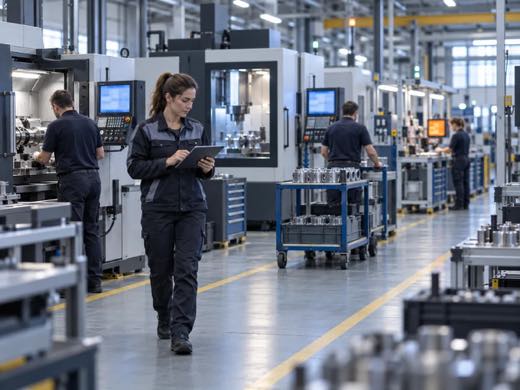
If someone walks the shop floor every day asking where an order stands, you're missing live status.
Track every order live, from start to confirmation
SYMESTIC shows the status and current operation of every order. Orders come from your ERP or are created directly in SYMESTIC, and every confirmation is documented without paper.