




MES Software: Vendors, Features & Costs Compared 2026
MES software compared: vendors, functions per VDI 5600, costs (cloud vs. on-premise) and implementation. Honest market overview 2026.
Manufacturing processes are the systematic sequences through which raw material becomes finished product. The textbook classification — six main groups under DIN 8580 (forming, cutting, joining, coating, changing material properties, primary shaping) — is correct and academically tidy, but productive conversations on the factory floor rarely start there. The taxonomy that matters in practice is a different one: how the work is organised, how the material flows, and how the data behaves. That taxonomy determines everything downstream — which KPIs make sense, which MES architecture fits, which integrations are realistic, and whether an improvement programme has any chance of working.
The SYMESTIC platform has connected 15,000+ machines in every process type that matters: job-shop metalworking, discrete high-volume automotive assembly, batch pharma packaging, continuous food lines, hybrid plants where all four coexist within 100 metres of each other. This article treats the manufacturing-process taxonomy not as a textbook classification, but as the single most important upfront decision that determines whether a digitisation programme will succeed or spend three years trying.
Any useful conversation about manufacturing processes needs both classifications — the physical one (what happens to the material) and the organisational one (how the work is arranged in time and space). Most confusion in production planning, KPI definition and MES selection comes from conflating the two, or from picking one and ignoring the other.
Every real plant sits at an intersection of the two classifications. A press shop doing forming on serial orders is organisationally flow; a press shop doing forming on varied short runs is organisationally job-shop; the physical process is identical but the management problem is a different one. This is not hair-splitting — it is the difference between an MES that fits and an MES that gets shelved after 18 months.
The most important pattern for anyone starting a production-digitisation programme: the organisational process type determines the shape of the data, and therefore the shape of the system that manages it. Ignoring that fit is the most expensive mistake in manufacturing IT.
Job-shop production generates data organised around orders and operations. Each order has a unique routing through the shop; tracking is about knowing where order 4711 is at any given moment and how much of its work content has been consumed. The natural unit of data is the operation confirmation. KPIs are order-throughput-time, schedule-adherence, setup-to-run ratios. Typical industries: contract metalworking, tool-and-die, custom fabrication.
Batch production generates data organised around recipes, batches and lots. Each batch runs a known recipe; tracking is about recipe integrity, batch genealogy, and lot-level quality. The natural unit of data is the batch record. KPIs are batch yield, batch cycle time, right-first-time. Typical industries: pharma packaging, food processing, specialty chemicals, coatings.
Flow / line production generates data organised around cycles and takt. The machine produces a stream of identical (or near-identical) units; tracking is about cycle-count, takt adherence, and stop/run state. The natural unit of data is the machine cycle. KPIs are OEE, takt-time adherence, stop-reason Pareto. Typical industries: automotive assembly, consumer goods assembly, packaging, bottling.
Continuous production generates data organised around time-series. The material never stops moving; tracking is about process-parameter stability, rate, and composition. The natural unit of data is a timestamped measurement. KPIs are rate, specific energy, specific yield. Typical industries: bulk food, paper, glass, metals, petrochemicals.
A frequent mistake: a plant selects an MES that was designed for one process type and tries to stretch it across a different one. A cycle-oriented OEE tool deployed into a batch pharma plant produces numbers that are arithmetically valid and operationally meaningless. A batch-record system deployed into a job-shop produces paperwork nobody reads. A time-series historian deployed into discrete assembly captures signals nobody can act on. The software is rarely the problem — the process-type mismatch is. Any manufacturing-digitisation programme that does not start by classifying the plant honestly on the organisational axis will spend its first year discovering why nothing fits.
If the classification were clean, MES selection would be easy. It almost never is. Plants above a certain size usually turn out to be hybrid on closer inspection. A continuous bulk line feeds into a batch-packaging step. A batch mixing process feeds into discrete bottling. A job-shop press feeds into a flow-assembly cell. The organisational type shifts every time the material changes physical form.
Pharma packaging is the classic example: the upstream formulation is batch or continuous, the downstream blister or sachet line is discrete flow. Both must be captured, both must be tied to the same batch record for regulatory reasons, and neither can be ignored. Food plants look identical in structure — a continuous bulk process terminating in discrete high-speed packaging. Metal forming plants combine job-shop order structures on the press side with flow-production dynamics within individual orders. The realistic manufacturing-process classification is almost never "we are a flow plant" — it is "we are 60 % flow, 30 % batch, 10 % job-shop, and the interesting operational problems sit at the handovers between them."
The practical consequence: the MES data model has to accommodate both orders and cycles and batches and time-series, with clean translation layers between them. A system that only speaks one of those languages will work for part of the plant and fail for the rest, and the part it fails on is usually the part with the most improvement potential. This is the hidden reason that single-process-type MES tools have such mixed success records in real European plants — the real plants are almost never single-process-type.
Once the process-type classification is honest, everything downstream becomes clearer. KPI definitions follow from the data model: OEE in the strict flow-production sense does not mean the same thing in a batch plant, and pretending otherwise produces numbers that cannot be compared. Machine connectivity strategy follows from the process type: a continuous plant needs time-series capture at high frequency, a flow plant needs cycle-count and stop-state capture, a job-shop needs order-level operation-start/finish events. ERP integration depth follows: batch plants need recipe-level data flow, job-shops need operation-level data flow, flow plants need cycle-aggregate data flow. Planning systems follow: finite-capacity scheduling matters more in job-shops, line balancing matters more in flow production, campaign planning matters more in batch.
None of this is a theoretical point. MES selections that skip the honest process-type conversation at the start tend to end up renegotiating the project scope once the mismatch becomes visible. Every single one where the classification was done carefully upfront either hit its targets or — on the rare occasions where it did not — failed for reasons that were visible early enough to correct.
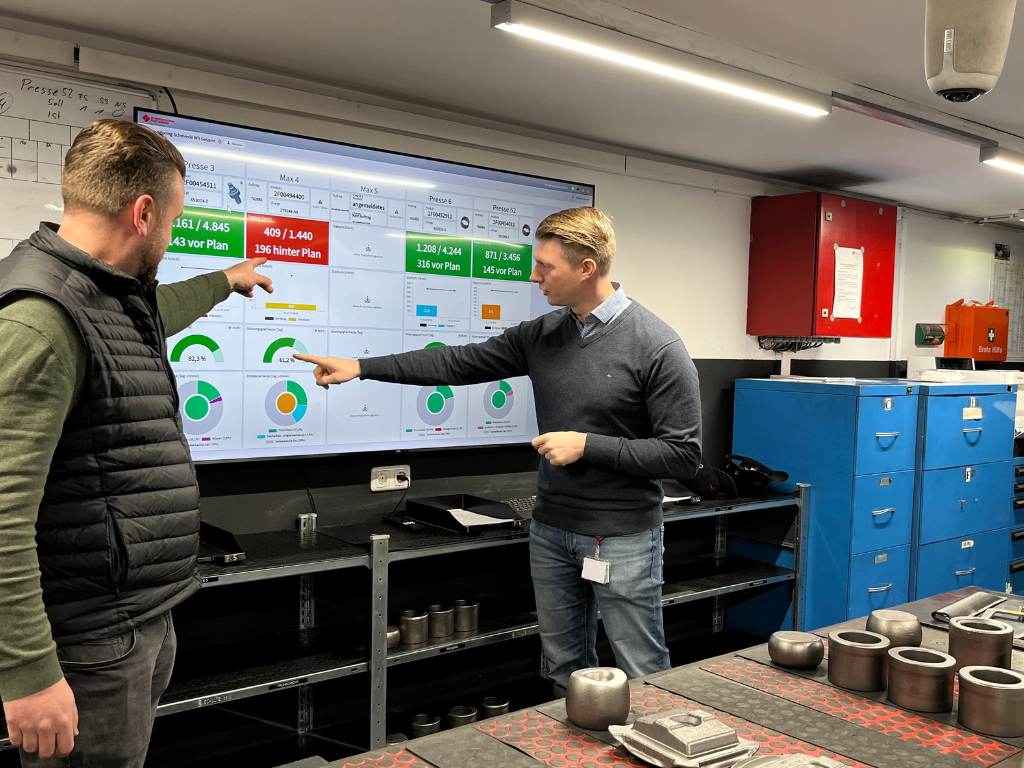
Schmiedetechnik Plettenberg is a mid-sized forging operation in metalworking — a textbook example of the hybrid-process problem that most metal-fabrication plants face. The production profile includes strongly varying order sizes, demanding setup processes, high quality requirements and frequently parallel machine chains. Organisationally the plant operates somewhere between job-shop and batch: the press side runs high-mix with short runs, the heat-treatment and finishing steps are more flow-oriented, and customer-order structures cut across all of it. Physically the dominant process is forming, with joining, cutting and material-property-changing steps at various points in the routing.
The starting problem was a common one in mid-market metalworking: data existed, but not in the right place at the right time. InforCOM handled the order world cleanly — releases, routings, work centres, due dates. What was missing was the fast, accurate feedback from the physical shop floor that would close the loop between the planned state and the actual state. Machine conditions were only partially visible; stoppages, performance differences and quality deviations were often identified after the fact instead of in the moment. This is the classic hybrid-plant gap: the ERP speaks in orders and operations (job-shop language), the shop floor speaks in cycles and stop-states (flow language), and without a layer that translates between them the two systems produce inconsistent views of the same reality.
The implementation started directly at the machine in a hands-on workshop. The first machine was connected live, data points were defined, dashboards were configured within hours. From that point forward the line team had real-time visibility into cycle times, quantities, stoppages and process deviations — the flow-production data layer — while the bidirectional interface into InforCOM maintained the order-oriented view for planning. Released production orders flow automatically from ERP into SYMESTIC with all relevant operations, machine references and time data; quantities, times, stop reasons and status information flow back. One data layer, two representational languages, consistent across both.


 Case Study
The measurable consequences on the shop floor:
The lesson for the manufacturing-process discussion is the general one: the plant was neither purely job-shop nor purely flow, and any attempt to pretend otherwise would have produced either a rigid scheduling tool that the shop floor ignored or a cycle-oriented monitor that the planners could not reconcile with their ERP. Accepting the hybrid reality — and building the data model to match — is what turned a complex forging operation into a plant where transparency, efficiency and stability moved in the same direction.
How many types of manufacturing processes are there?
Two parallel classifications matter. Physically, DIN 8580 defines six main groups: primary shaping, forming, cutting, joining, coating, and changing material properties. Organisationally, the practically useful split is four plus one: job-shop, batch, flow/line, continuous, plus project/one-off. Most real plants sit at the intersection — e.g. forming (physical) organised as job-shop (organisational), or joining (physical) organised as flow (organisational). Using only one classification is the most common source of confusion in production planning and MES selection.
What is the difference between batch and continuous production?
Batch production runs discrete quantities of a known recipe, with clear start and end points for each batch; tracking is organised around batch records and batch genealogy. Continuous production runs material in an uninterrupted stream, often 24/7; tracking is organised around time-series measurements of rate, temperature, composition and similar parameters. A pharma plant that formulates in batches and packages in discrete units is batch-then-flow. A bulk food plant that processes continuously and packages in cartons is continuous-then-flow. Most real plants combine both at some point in the routing.
Why does the manufacturing process type matter for MES selection?
Because the process type determines the data model, and the data model determines whether an MES fits or not. Job-shop plants need order-and-operation data structures; batch plants need recipe-and-batch-record data structures; flow plants need cycle-and-state data structures; continuous plants need time-series data structures. An MES designed for one data model can be stretched to others, but stretched systems produce numbers that are arithmetically valid and operationally misleading. Any MES selection that skips the honest process-type conversation upfront will spend its first year discovering the mismatch.
What is a hybrid manufacturing process?
A plant where the organisational process type changes along the routing — typically a continuous or batch process feeding into a discrete flow or packaging line. Pharma packaging, food plants, metal-forming operations, coatings and consumer goods plants are overwhelmingly hybrid. The realistic shape of manufacturing in 2026 is hybrid more often than not. MES systems that can only handle one process type work for part of the plant and fail for the rest, and the part they fail on is usually the part with the highest improvement potential.
How does OEE differ across process types?
Strict-sense OEE (availability × performance × quality) was formulated for flow production with a definable takt time. In flow production it is directly meaningful. In batch production it has to be reframed around batch cycle time and batch yield, and the numbers do not compare to flow-plant OEE. In continuous production it becomes an overall utilisation metric against design rate, and the "quality" axis becomes a specification-conformance metric. In job-shop production it is often less useful than order-throughput and schedule-adherence metrics. Applying flow-plant OEE to a non-flow-plant produces honest-looking numbers that lead to the wrong decisions.
Can one MES handle all manufacturing process types?
Technically yes, if the data model is designed to accommodate orders, cycles, batches and time-series with clean translation layers between them. Practically, MES products split into two broad families: those originally designed for discrete flow production (strong on OEE, cycle-capture and order-to-machine flow) and those originally designed for process/batch production (strong on recipes, batch records and regulatory compliance). Products that claim to do both well frequently do one excellently and the other adequately. For hybrid plants the realistic question is not "can it do both" but "does it do both cleanly enough that the handovers at the interface between process types work in practice."
What is the first step in digitising a manufacturing process?
Honest classification of the plant on the organisational axis — job-shop, batch, flow, continuous, or which combination — followed by honest classification of which data model the existing ERP and planning systems actually produce. The physical process matters second. Machines, connectivity, dashboards and reporting all follow from these two classifications, and none of them can be decided sensibly until both are clear. Projects that skip this step invariably spend their first six months rediscovering it the hard way.
How does SYMESTIC handle different manufacturing process types?
A unified data model that accommodates orders, cycles, batches and time-series with clean translation between them — the hybrid-plant reality is the design starting point, not an afterthought. Cycle-based OEE and stop-reason capture for flow and assembly production; batch-and-recipe capture for pharma, food and coatings (non-validated, per ICP); order-and-operation capture for job-shops feeding into cycle-based execution; time-series capture at gateway level for continuous processes. Bidirectional ERP integration (SAP, Infor, proAlpha, Navision, Dynamics) that carries the right representation for each process type. 15,000+ machines covering every process combination described above. See SYMESTIC Production Metrics.
Related: MES · OEE · Batch Production · Flow Production · Job-Shop Production · Order Processing · Production Scheduling · SYMESTIC Production Metrics