




Contents
What is production capacity?
Production capacity is the maximum quantity of output a plant, line, or machine can produce in a defined period of time under defined operating conditions. That definition sounds straightforward, and then the first serious question arrives: which operating conditions? The capacity a manufacturer publishes on the data sheet, the capacity a plant could theoretically reach if everything ran perfectly, and the capacity a plant actually reaches on any given Tuesday are three different numbers — often diverging by 30 % or more. Most misunderstandings about capacity come from conflating them.
A practical definition: production capacity is your nameplate output rate multiplied by your real Overall Equipment Effectiveness. A press rated at 1,000 parts per hour running at 55 % OEE has a real capacity of 550 parts per hour, not 1,000. The 1,000 is an aspiration; the 550 is a fact. The difference between them is not a detail — it is typically where the entire growth runway of a plant lives.

How Meleghy Automotive connects its plants with a single MES platform
- Standardized MES platform across all sites
- Real-time transparency in body production
- OEE & loss reasons captured automatically
- Scales from pilot to series production

 Case Study
The five types of capacity — and why they get confused
Five capacity concepts circulate interchangeably in production conversations and operate at completely different levels of realism. The table below separates them.
| Type | What it means | Typical gap to reality |
|---|---|---|
| Theoretical / nameplate capacity | What the machine could produce at ideal speed, 24 × 7, with no losses | 30–50 % above real output |
| Design capacity | What the OEM engineered the machine to produce under specified conditions | 25–40 % above real output |
| Effective capacity | Design capacity minus planned losses (changeovers, breaks, maintenance) | 15–25 % above real output |
| Practical / demonstrated capacity | What the plant actually achieves sustainably in real conditions | Matches real output |
| Capacity utilisation | Actual output ÷ capacity, expressed as a percentage | Not a capacity — a ratio |
The first row is where most of the damage happens. Sales sheets, investment proposals, and ERP master data are populated with theoretical capacity numbers because those are the numbers the OEM printed. Production planning, shift scheduling, and due-date promises then get built on those numbers. When reality fails to deliver, the plant concludes it needs more equipment — when what it actually needed was an accurate capacity number to plan against in the first place.
How to calculate production capacity
The base formula is direct:
Theoretical Capacity = Available Time × Number of Machines × Output Rate
A single press running one shift (8 hours) at 1,000 parts/hour has a theoretical capacity of 8,000 parts/shift. A line of three identical presses has a theoretical capacity of 24,000 parts/shift. Those numbers are correct — and almost useless, because the plant will never produce that many. The version of the formula that actually predicts real output is:
Effective Capacity = Theoretical Capacity × OEE
At 55 % OEE — a typical figure for a discrete-manufacturing plant that has never measured itself automatically — the three-press line produces 13,200 parts/shift, not 24,000. At 75 % OEE (achievable within 6–12 months of a properly run improvement programme), it produces 18,000. The difference between those two numbers — 4,800 parts per shift — is the most commonly ignored piece of capacity in any factory. It doesn't require buying a machine. It requires measuring the one you already have.
The hidden capacity problem
A common pattern:
- Management believes the plant is running near capacity and that expansion requires investment.
- Capacity numbers in the ERP are nameplate numbers from the OEM data sheet.
- Actual OEE has never been measured automatically — it is estimated manually at 75–85 %, typically in the "we're doing fine" range.
- SYMESTIC gets installed, automatic measurement begins, and the real OEE turns out to be far below the estimate.
- The delta between what the plant thought it was producing and what it was actually producing was the growth runway nobody knew existed.
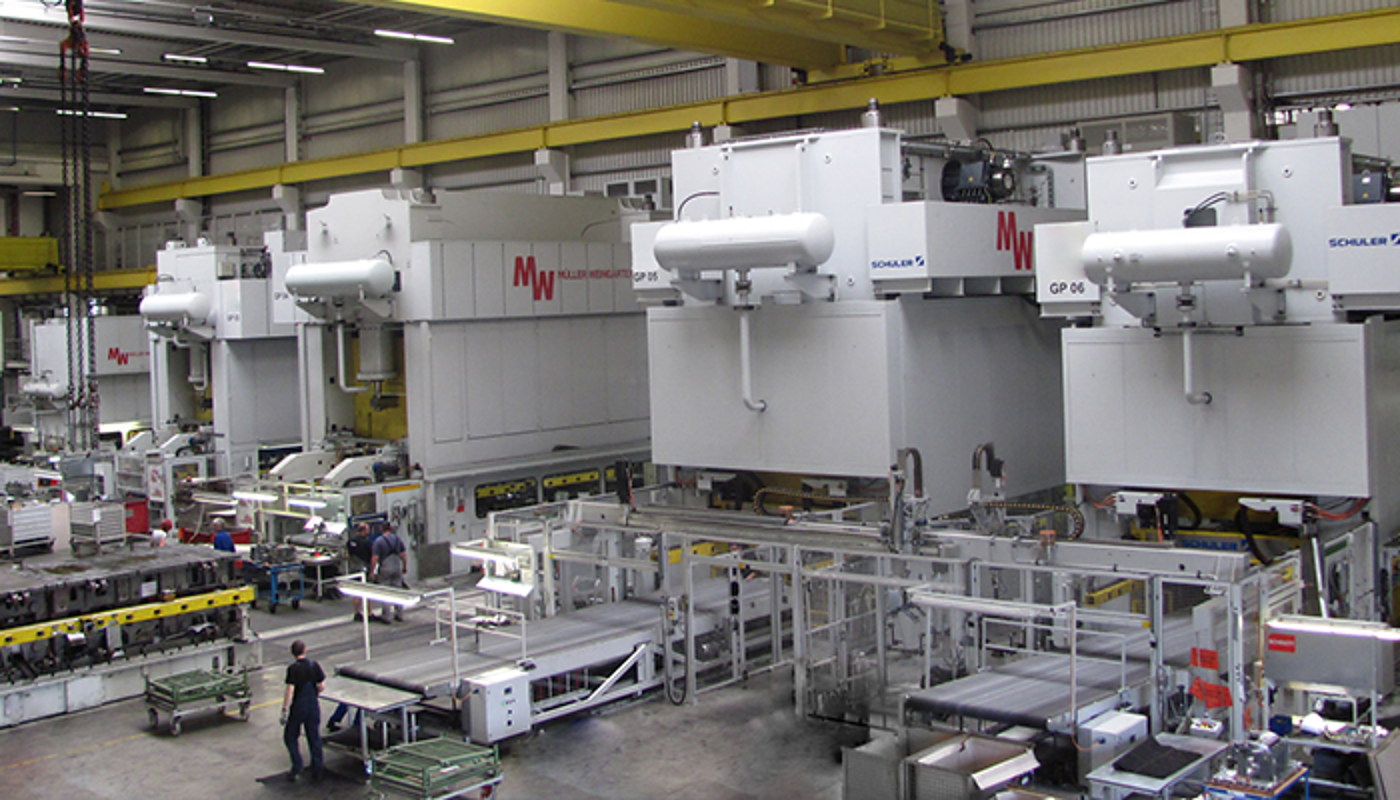
In numbers from a real implementation: Meleghy Automotive recovered +7 % output from existing equipment across four plants. That is not a miracle. It represents the normal gap between nameplate capacity and real capacity, made visible and then addressed. The first 5–15 % of additional capacity is almost always available in a plant that has never measured itself accurately. It is the cheapest capacity you will ever buy.
The expansion ladder — what to do before buying more machines
When a plant hits its perceived capacity ceiling, the instinct is to invest. Before signing a capital-expenditure request, the right sequence of questions is:
- Do we know our real capacity? Automatic OEE measurement for 90 days will tell you whether you are at 60 % or 80 % of your nameplate rate. The answer almost always surprises.
- Can we close the OEE gap? If you are running at 55 % OEE, every percentage point of OEE gain is equivalent to roughly 1.8 % more capacity. Moving from 55 % to 70 % is +27 % capacity — without capital expenditure.
- Can we cut changeover time? SMED programmes routinely recover 20–40 % of changeover time on a given line. In high-mix environments, that is pure capacity gain.
- Can we add a shift? Variable-cost capacity expansion at a fraction of the cost of new equipment. Often the correct answer for growth that is expected to moderate within 12–24 months.
- Then, and only then, invest in new equipment. If after steps 1–4 the plant is genuinely demand-constrained rather than equipment-constrained, the investment case is now real — and sized correctly, because you know what your existing equipment is actually producing.
Plants that skip to step 5 tend to end up with more equipment running at the same 55 % OEE — which means they have bought more unused capacity, not more production. The physics of capacity do not change because the plant got bigger.
Capacity utilisation — the companion number
If production capacity is the ceiling, capacity utilisation is how much of it you are using. The formula is straightforward:
Capacity Utilisation = Actual Output ÷ Production Capacity × 100 %
The single most important thing about this metric is that its answer depends entirely on which capacity number you divide by. A plant producing 13,200 parts/shift against a 24,000-part theoretical capacity shows 55 % utilisation. The same plant against its effective capacity of 17,000 shows 78 % utilisation. Neither number is wrong; they are answering different questions. For investment decisions, compare actual output to effective capacity. For improvement programmes, compare actual output to theoretical capacity — the gap is your opportunity set. The related KPI is the capacity utilization rate.
FAQ
What's the difference between production capacity and throughput?
Capacity is the ceiling (what could be produced). Throughput is the actual output per unit time (what is being produced). A plant can have 24,000 parts/shift of theoretical capacity and 13,000 parts/shift of throughput — the gap is the losses you are currently carrying.
Is production capacity the same as production volume?
No. Production volume is the quantity actually produced over a period — a historical fact. Production capacity is the maximum that could be produced — a theoretical or planning construct. Volume is what you report to the CFO; capacity is what you use to plan next year's orders.
What's a good capacity utilisation rate?
Against effective capacity (not theoretical), 85–95 % is strong, 75–85 % is typical, below 70 % indicates structural under-use. Against theoretical capacity, 60–75 % is typical of discrete manufacturing — and largely composed of OEE losses, most of which are recoverable.
How often should production capacity be recalculated?
Whenever any input changes: new products, equipment modifications, shift-pattern changes, material-specification updates. In stable operations, annually as part of S&OP; in fast-changing environments, quarterly. A capacity number that hasn't been refreshed in three years is almost certainly wrong.
When should we actually invest in new capacity?
When the following three things are all true: (1) effective capacity utilisation is above 85 % on a sustained basis; (2) OEE has already been driven into the 75–85 % range; (3) demand is projected to grow by more than the remaining capacity can absorb within the equipment's lead time. If any of those three is missing, improve before investing. Investing to hide a measurement problem is the most expensive mistake in this field.
How does production capacity relate to MES?
An MES does not create capacity; it reveals capacity that already exists. The typical pattern: automatic measurement uncovers a 15–20 percentage-point OEE gap that manual reporting had been hiding. Closing that gap — through visibility, accountability, and structured improvement — converts latent capacity into real output. Customers consistently report this as the largest single-year ROI of their MES investment, specifically because it defers or eliminates capital expenditure they had believed was necessary.
Related: OEE · Production Efficiency · Production Optimization · Production Time · MES · Lean Production

Your losses in euros, calculated with your figures
In a free 30-minute potential analysis we go through downtime, changeovers and scrap with you and turn the losses into euros using your own figures. No software demo.

Your OEE live, not in Excel at month-end
SYMESTIC measures availability, performance and quality right at the machine. The first machine is connected in under three hours, even an older one.