




Contents
What are Industry 1.0 through 5.0?
Industry 1.0 to 5.0 is a shorthand framework for the five major waves of industrial change since roughly 1760: mechanisation by steam (1.0), mass production by electricity (2.0), automation by computers and PLCs (3.0), networked production by IoT and cloud (4.0), and human-centred, sustainable production by collaborative AI and robotics (5.0).
That is the textbook version, and it is useful as historical taxonomy. It is misleading as a planning framework, and the rest of this article explains why. The clean wave-by-wave story is a presentation slide; the real factory is a stack of layered eras that all run at the same time.
How do the five industrial revolutions actually compare?
The dates are approximate and the boundaries are fuzzy — the steam engine didn't politely retire when electricity arrived. That fuzziness matters more than the labels, and it's the heart of why the framework gets misused.
Why is the clean wave-by-wave story misleading?
This is the part that doesn't appear on the conference slides, and the reason the Industry-X.0 framework is only half useful as a way to think about real production.
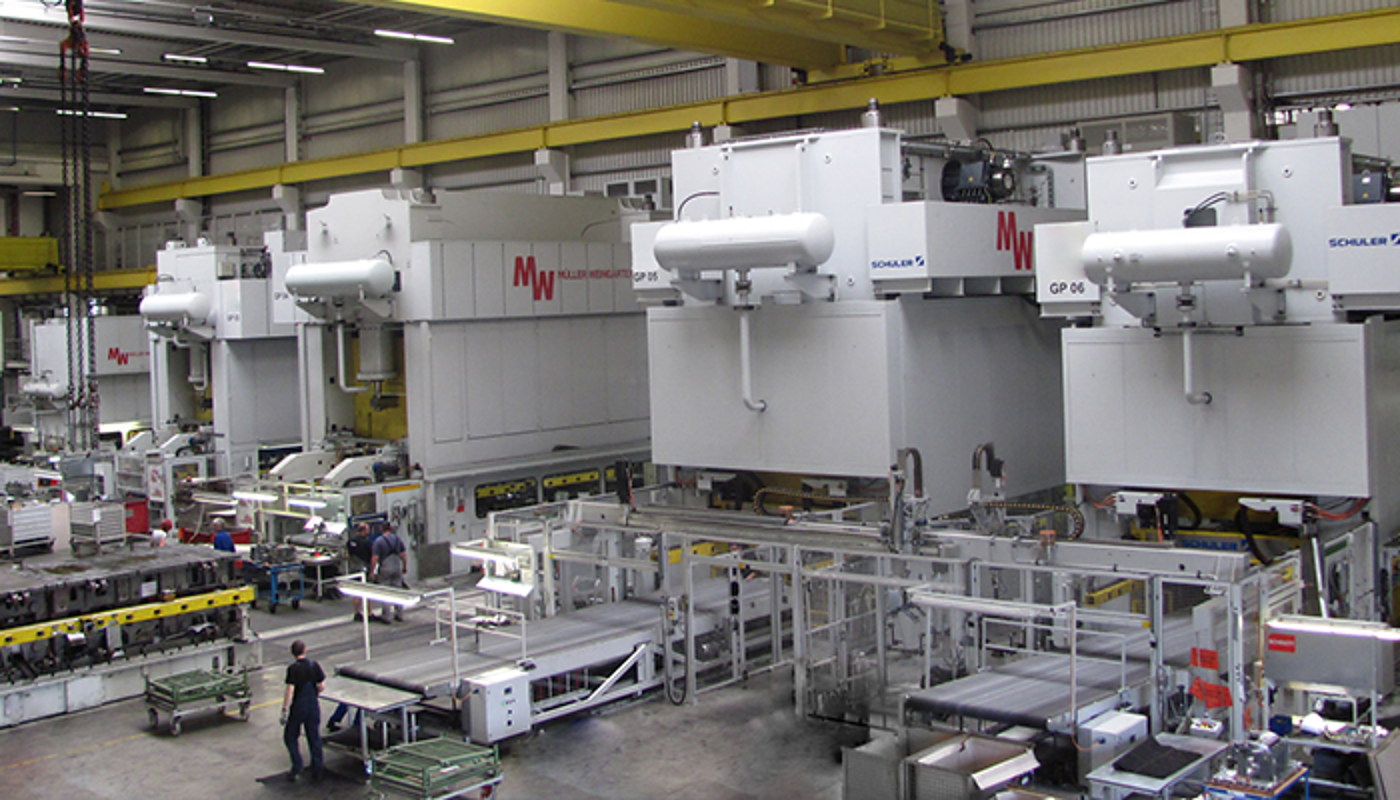
In real plants the five eras do not exist in succession. They exist in parallel, in the same building, often on the same line: a press from the late 1980s with a hard-wired control panel next to a CNC machining centre from the early 2000s, both connected through a small IoT gateway that streams cycle counts and machine states to a cloud MES. The press is Industry 2.0 mechanics, the CNC is Industry 3.0, the gateway and the MES are Industry 4.0, and an AI-generated shift-end summary on the foreman's tablet is a first step towards 5.0.
One factory. One production line. Four industrial revolutions running simultaneously. The typical mid-sized European manufacturer in 2026 has equipment with first commissioning dates spanning 1985 to 2025. The "we are now in Industry 4.0" announcement that gets made at the trade fair describes the gateway and the dashboard; it does not describe the press, which is still firmly in 2.0 and will stay there for another decade because it works fine and replacing it would cost €400,000.
The frame that actually matches reality is layering, not succession. Each new era adds a layer on top of the existing ones; the old layers don't disappear, they just get instrumented. The IoT gateway doesn't replace the old press — it gives the press a voice it never had. The MES doesn't replace the SCADA system that already exists for the CNC — it sits above it. Industry 5.0's collaborative robot doesn't replace the welder; it stands next to him.
This matters for planning. If you treat the framework as succession — "we need to skip 3.0 and go straight to 4.0" — you make terrible decisions, because you assume the existing equipment will go away. It won't. If you treat it as layering — "we need to add a 4.0 layer on top of our existing 2.0 and 3.0 equipment" — you get something a brownfield gateway can actually deliver in two hours per machine, with no PLC modifications, no production interruption, no replacement capex.
What does each revolution actually feel like on the shopfloor?
The three most recent eras are the ones that shape today's shop floor, and the texture of each says more than the technology list:
- Industry 3.0, as it looked around 1990. A Simatic S5 with a battery-backed RAM, a STEP 5 programmer that connected via a 25-pin serial cable, and a control cabinet you opened with an Allen key. Every program change was a physical visit to the cabinet. Every diagnostic was a multimeter and a wiring diagram. The "computer" in the line was the PLC; the "data" was whatever you read off the analogue meter and wrote in the shift book.
- Industry 4.0, as it actually arrived in the 2010s. Not as a sudden revolution but as a slow accumulation of small things — Ethernet connectors on PLCs, OPC servers that sort-of worked, the first IoT gateways that were really just industrial PCs running unreliable software. The shift wasn't the technology; it was that for the first time, the data on the machine could leave the machine without somebody walking up with a USB stick. That sounds small. It changed everything downstream of the machine.
- Industry 5.0, as it is appearing right now. A collaborative robot at a packaging line that adjusts its grip based on what the vision system sees. An AI assistant in the MES that suggests reasons for an unexplained micro-stop based on similar past patterns. The operator who used to enter scrap reasons by hand now confirms or corrects the system's suggestion. The role of the human is not eliminated; it is upgraded. Whether that is "5.0" or just "good 4.0 done well" matters less than whether it works on the line.
What every transition has in common, from inside the control cabinet: the new layer never replaces the old one cleanly. It always adapts, mediates, translates. The practical skill in every transition is exactly that: making the new layer talk to the old one without breaking either.
What does Industry 4.0 actually require to be real?
The most overused phrase in the industrial-software market right now is "Industry 4.0-ready." Almost every machine, every gateway, every dashboard claims it. Here is the unromantic checklist for what it actually means in 2026:
- The machine has a voice. Either modern (OPC UA, MQTT) or made-modern via a gateway (digital I/O, signal tap, retrofit sensor). If a machine cannot emit a count, a state and a timestamp, it is not part of Industry 4.0 regardless of marketing.
- The data leaves the machine without a human in the loop. If the data flow requires a USB stick, an end-of-shift report or a manual entry, the machine is still in Industry 3.0. The 4.0 transition is automatic data extraction.
- The data is contextualised. A raw cycle count means nothing. A cycle count tied to an order, a product, a shift and an operator means everything. The MES — not the gateway — is what does this.
- Decisions are made on the data, not just dashboards. Industry 4.0 implementations that stop at "we now have dashboards" have built a vanity layer. Real 4.0 closes the loop: the data triggers an alert, the alert triggers an action, the action changes the next cycle.
- The architecture survives the next equipment generation. If your 4.0 system breaks when you replace one PLC, you have built a fragile 3.5, not a real 4.0. The semantic layer must be independent of the capture layer.
By that checklist, the share of plants that are actually "in" Industry 4.0 is much smaller than the marketing suggests. Most are partially there — some lines instrumented, others not, some data flowing, some still on paper. That is also fine; partial 4.0 is still better than no 4.0. The mistake is claiming the whole plant is 4.0 because one line is.

How Meleghy Automotive connects its plants with a single MES platform
- Standardized MES platform across all sites
- Real-time transparency in body production
- OEE & loss reasons captured automatically
- Scales from pilot to series production

 Case Study
What is Industry 5.0 actually about?
The European Commission's framing of Industry 5.0 — human-centric, sustainable, resilient — is genuinely useful as a corrective to the tech-first framing of 4.0. The technology of 4.0 is necessary; on its own it is not sufficient. A plant can be heavily digitalised and still produce burnt-out operators, energy-wasteful processes and brittle supply chains. 5.0 is the explicit recognition that the goal of digitalisation is not "more digital" — it is more sustainable, more human-friendly, more resilient production.
What that looks like in concrete terms in 2026:
- Energy-conscious production. Real-time energy monitoring per machine, peak-load shedding, scheduling that takes electricity prices into account. This is not exotic anymore — it's standard MES functionality, but it requires Industry 4.0 to even be possible.
- Operator support, not operator replacement. AI assistants that suggest downtime reasons, fault diagnoses, parameter adjustments — and a human who confirms, corrects or overrides. The relationship is collaborative, not autonomous.
- Resilient supply chains. Traceability that lets you contain a recall to a specific batch instead of a whole month's production. Cross-plant visibility that lets you reroute production when one site has a problem.
- Skills that matter. An operator in a 5.0 plant needs different skills than in a 3.0 plant — interpretation of dashboards, light data work, collaboration with automation. The training catches up slower than the technology, every time.
None of this requires waiting for 5.0 as a separate wave. It requires doing 4.0 well, with these goals in mind. Calling it a separate revolution is partly real (the goals genuinely matter) and partly marketing (the tech overlap with 4.0 is enormous).
FAQ
Are we currently in Industry 4.0 or Industry 5.0?
Honest answer: somewhere on the spectrum from 2.5 to 5.0, depending which corner of which plant you're looking at. Most mid-sized European manufacturers are partway through 4.0 and beginning to think about 5.0 goals. The "we are in [era X]" claim is almost always overstated.
Can we skip Industry 3.0 or 4.0 and jump straight to 5.0?
No, and trying to is a common strategic mistake. 5.0 sits on top of 4.0, which sits on top of 3.0. You cannot have AI-assisted operator support without real-time data; you cannot have real-time data without instrumented machines; you cannot instrument machines without addressing your existing equipment. Skipping a layer means building on sand.
Does old equipment really fit into Industry 4.0?
Yes — and this is the single piece of good news that most plant managers don't believe until they see it. A 1990 press, a 1985 lathe, a 2003 packaging line — all of them can be brought into Industry 4.0 via a brownfield gateway, without modifying the PLC, without interrupting production. The cost per machine is in the low thousands of euros, not the hundreds of thousands. The myth that you need to replace old equipment to digitalise is the most expensive misconception in the industry.
What's the difference between Industry 4.0 and the IIoT?
Heavily overlapping. Industry 4.0 is the broader concept (cyber-physical systems, smart factories, the entire transformation); IIoT (Industrial Internet of Things) is the connectivity layer that makes it possible. You can have IIoT without Industry 4.0 (just connecting devices without doing anything with the data) but you cannot have Industry 4.0 without IIoT (you need the connectivity).
Is Industry 5.0 a real thing or marketing?
Both. The label is partly marketing — much of what's branded "5.0" is just well-implemented 4.0 with sustainability and human factors taken seriously. But the corrective framing is real and useful: technology for its own sake is not the goal, and the EU's framing of human-centric, sustainable, resilient production is a meaningful redirection of priorities. Use the label cautiously; use the goals seriously.
Where should a mid-sized manufacturer focus today?
The honest answer for most plants: get the existing equipment instrumented, get real data flowing, get one or two KPIs trustworthy, then build from there. The plants that try to "do Industry 4.0" as a strategic programme usually overspend and underdeliver. The plants that start with "let's connect three machines and see what we learn" usually scale further and faster — because they're building on evidence instead of slides.
How does SYMESTIC fit into the Industry 4.0/5.0 picture?
Concretely: the platform is the 4.0 layer that makes the rest possible. Brownfield gateway connectivity for old equipment, OPC UA for modern equipment, real-time data streaming into Process Data, contextualised KPIs in Production Metrics, AI-assisted operator support that's emerging on top — that's the 5.0-flavoured layer. Many plants have equipment from three or four industrial eras coexisting on the same shop floor. The architecture is built for that reality, not for the slide-deck reality where everyone is uniformly in Industry 4.0.
Related: MES · OEE · Machine Data Acquisition (MDE) · Operational Data Acquisition (BDE) · Industrial IoT (IIoT) · OT/IT Convergence · OPC UA · Smart Factory · Edge Computing · Process Data · Production Metrics.

Machines, orders and quality in three systems means three versions of the truth in every meeting.
One cloud MES, productive in hours, not months
SYMESTIC connects machines, ERP and shop floor on one platform. The first machine is connected in under three hours, and your team adds further plants itself. In use in more than 20 countries.