




Contents
What is machine utilization?
Machine utilization is the share of available time a machine is actually running and producing, expressed as a percentage. In its most common formulation, it is run time ÷ available time, where "available time" is the denominator every plant defines differently — and that is where almost every dispute about the number begins. The metric sounds elementary, but two people in the same plant rarely define it the same way on the first attempt. The formula is trivial; the honest conversation is about which clock you are measuring against.
Calculate utilization and OEE with the free OEE calculator
This article does three things that most glossary entries on this topic refuse to do. First, separate machine utilization from the four adjacent metrics that are routinely confused with it — availability, OEE, TEEP and asset utilization. Second, show the full time model so that you can see exactly which losses each metric captures and which it ignores. Third, give honest benchmarks by shift pattern and industry, because quoting "world-class is 85 %" without stating the denominator is the single most common source of bad capital decisions in this field.
The five time layers — and which metric measures which
Before any formula, you need the time model. Every equipment-effectiveness metric is defined relative to a specific slice of time, and the slice is what makes the metric meaningful. In the ISO 22400 and OEE traditions the model looks like this:
| Time layer | What it is | Typical size in a week | Losses removed at this layer |
|---|---|---|---|
| Calendar time | All hours in the period | 168 h | — |
| Scheduled time | Hours the plant intends to run | 120 h (3-shift, 5 days) | Non-scheduled time (weekends, nights, holidays) |
| Loading time / planned production time | Scheduled time minus planned stops | 112 h | Planned maintenance, breaks, planned changeovers |
| Run time / operating time | Loading time minus unplanned stops | 100 h | Breakdowns, minor stops, unplanned changeovers |
| Net operating time | Run time × performance rate | 93 h | Speed losses |
| Valuable operating time | Net operating time × quality rate | 91 h | Quality losses, rework |
"Machine utilization" can legitimately be measured against any of the first four layers, and that is exactly where the ambiguity comes from. A plant quoting 85 % utilization against loading time and a plant quoting 85 % utilization against calendar time are talking about entirely different realities — one is close to world-class operational performance, the other is a 24/7 process plant with very little latent capacity left.
The four common definitions — pick one and commit
| Definition | Formula | Also known as | When to use it |
|---|---|---|---|
| Operational utilization | Run time / Loading time | Availability (OEE) | Daily operational management |
| Scheduled utilization | Run time / Scheduled time | Uptime | Production scheduling, reliability work |
| Capacity utilization | Scheduled time / Calendar time | Utilization rate (TEEP factor) | Capital and capacity planning |
| Asset utilization | Run time / Calendar time | True utilization | CFO-level capital efficiency |
These are not alternative names for the same number. They can differ by 30–50 percentage points on the same machine in the same week, and the difference is where most KPI arguments in manufacturing live. One rule for every plant manager: write the chosen denominator into the KPI definition document, publish it, and when someone quotes the number in a meeting, ask which denominator before responding. Ninety percent of the time they will not know, and that is the real finding.
Machine utilization vs. OEE vs. TEEP — the distinction that matters
Utilization is a time-based metric. OEE is a composite metric that combines three effects (availability, performance, quality). TEEP is OEE measured against calendar time rather than loading time. These three metrics sit at different levels of the time model and answer different business questions.
| Metric | What it captures | What it ignores | Primary user |
|---|---|---|---|
| Machine utilization (operational) | Stops (planned and unplanned) vs. available running time | Speed losses, quality losses, non-scheduled time | Production supervisor, reliability engineer |
| OEE | Availability, performance, quality during planned production | Non-scheduled time | Plant manager, operational excellence lead |
| TEEP | Full capacity utilization against calendar time | Nothing — but structurally capped by shift pattern | COO, CFO, capex committee |
A machine with 90 % operational utilization, 85 % OEE and 60 % TEEP is not contradicting itself. It is telling three coherent stories at three different levels. Stripping the picture down to any single number destroys the diagnostic value. Treating them as competing metrics, or assuming that improving one automatically improves the others, is the classic mistake — operational utilization can go up while TEEP stays flat because you are just filling loading time that already existed.
A worked example — same machine, four different utilization numbers
Consider a CNC machining centre in a three-shift plant running Monday to Friday, 24 hours a day. Calendar time per week is 168 hours. Scheduled time is 120 hours (three shifts × five days × eight hours). Planned stops account for eight hours (breaks, preventive maintenance, scheduled changeovers), leaving 112 hours of loading time. Breakdowns and unplanned stops consume another 12 hours, so actual run time is 100 hours. Using the four definitions from the previous section:
| Metric | Calculation | Result | Interpretation |
|---|---|---|---|
| Operational utilization | 100 / 112 | 89.3 % | Good — tight unplanned-stop control |
| Scheduled utilization | 100 / 120 | 83.3 % | Solid — planned stops are well managed |
| Capacity utilization | 120 / 168 | 71.4 % | Structural — pure function of the shift pattern |
| Asset utilization | 100 / 168 | 59.5 % | CFO view — share of calendar time creating value |
All four numbers are correct, derived from the same machine in the same week. Reporting "machine utilization is 89 %" to the CFO is misleading — the CFO cares about asset utilization, which is 59.5 %. Reporting "machine utilization is 59 %" to a maintenance team is equally misleading — they cannot influence the shift pattern and will (rightly) refuse to be held accountable for the calendar-time component. The rule: choose the layer that matches the audience's decision space.
Honest benchmarks by shift pattern and industry
There is no universal "good" machine utilization number. The ceiling is structurally determined by the shift pattern, the nature of the process (discrete vs. continuous) and the demand profile. Publishing a single benchmark without these qualifiers is how bad decisions get justified.
| Pattern / industry | Operational (vs. loading) | Scheduled (vs. scheduled time) | Asset (vs. calendar) |
|---|---|---|---|
| Single-shift discrete manufacturing | 85–92 % | 75–85 % | 18–22 % |
| Two-shift discrete | 85–92 % | 75–85 % | 36–45 % |
| Three-shift discrete (5 d/week) | 85–92 % | 78–88 % | 55–66 % |
| 24/7 continuous process (chemical, pulp, glass) | 93–98 % | 90–95 % | 86–94 % |
| Semiconductor fab (24/7) | 95–98 % | 92–96 % | 88–93 % |
| Job-shop / high-mix low-volume | 60–75 % | 50–65 % | 15–30 % |
Two patterns to notice. Operational utilization ceilings are remarkably similar across shift patterns — good reliability work brings any well-run machine into the high 80s to low 90s regardless of how many shifts it runs. Asset utilization ceilings are entirely driven by the shift pattern and demand profile — no amount of operational excellence lifts a single-shift plant above ~22 % asset utilization. Comparing asset utilization across plants with different shift patterns is a category error.
The five root causes of low machine utilization
| Root cause | Typical share of the gap | Dominant countermeasure |
|---|---|---|
| Unplanned breakdowns | 20–35 % | TPM, condition monitoring, spare parts strategy |
| Changeovers & setups | 15–30 % | SMED, batch-size optimisation |
| Material & operator waiting time | 10–25 % | Pull systems, standardised work, multi-machine manning |
| Micro-stops & minor stops | 10–20 % | Root-cause analysis, poka-yoke, automation |
| Scheduling losses & shift patterns | 15–40 % (only visible at asset level) | Shift addition, weekend work, lights-out on bottlenecks |
The last category is invisible to operational utilization by definition — it sits above the loading-time line. This is why improving operational utilization alone can leave asset utilization flat, and why the metric layer you optimise must match the business outcome you want.
Common measurement pitfalls
| Pitfall | What actually happens | Counter-measure |
|---|---|---|
| Undefined denominator | Each team quotes a different version of "utilization" and numbers never reconcile | Publish the chosen formula alongside the KPI; enforce it everywhere |
| Planned-stop reclassification | Unplanned stops get reclassified as "planned" after the fact to protect the number | Reason-coded stop classification in an MES, locked after shift close |
| Micro-stop under-counting | Stops < 3 minutes are invisible to manual tracking, quietly inflating utilization by 5–10 pts | Automated capture at sub-second resolution |
| Operator self-reporting | End-of-shift paper logs bias systematically toward the expected number | Machine-state capture from the PLC, not operator entries |
| Single-machine focus | Utilization is maximised on individual machines at the cost of overall flow (overproduction) | Track utilization only on bottleneck machines; pace non-bottlenecks to takt |
| Demand-blind optimisation | Higher utilization produces inventory, not profit | Tie utilization targets to takt time and demand signals |
The second pitfall is the most common and the most damaging. A major reason published utilization numbers are too high is reason-code drift — stops that should be classified as unplanned being quietly absorbed into "planned" categories. Automating stop classification through an MES does not eliminate this entirely, but it forces the drift to become visible.
Utilization and the bottleneck — the rule most plants get wrong
High utilization is only worth chasing on bottleneck machines. On non-bottleneck machines, high utilization is a direct cause of excess WIP, longer lead times and working-capital inflation. Eliyahu Goldratt's Theory of Constraints states this cleanly: an hour lost on the bottleneck is an hour lost for the whole system; an hour saved on a non-bottleneck is a mirage. In concrete terms: if a downstream assembly line runs at 80 parts/hour and an upstream CNC machine can run at 120 parts/hour, pushing the CNC machine's utilization from 70 % to 90 % creates 40 surplus parts per hour that sit as WIP. The plant's throughput does not change. Its inventory does.
This is why more mature plants track utilization only on identified constraint resources, and track takt adherence on the rest. The metric is the same mathematically; the intent is the opposite.
How a modern MES changes machine-utilization measurement
Machine utilization as a metric has existed for decades. What changed in the last ten years is not the formula; it is the honesty of the inputs. Before automated machine-state capture, utilization was calculated from end-of-shift paper logs, which are systematically optimistic. With a live MES capturing run, idle, fault and changeover states directly from the PLC, the measurement becomes trustworthy — often with the uncomfortable side effect that published utilization numbers drop overnight.
| Dimension | Without MES | With SYMESTIC MES |
|---|---|---|
| Data source | Operator paper logs, end-of-shift summaries | PLC signals, per-second machine-state capture |
| Micro-stop visibility | Effectively zero | Full distribution including sub-minute stops |
| Reason-code integrity | Drifts over time; unplanned reclassified as planned | Rule-based classification, locked post-shift |
| Cross-plant comparability | Near zero; each plant defines the denominator differently | Central definition applied identically across sites |
| Bottleneck identification | Opinion-based, revisited quarterly | Automatic from cycle-time and queue data |
The honest point about machine utilization: plants do not have a utilization problem as often as they think. They have a utilization-measurement problem. In first-time MES deployments, the correctly measured utilization is often substantially lower than the number the plant had been reporting internally. That delta was not a performance collapse — it was the first honest measurement. The plants that responded well treated it as the new baseline and improved from there. The plants that responded badly went looking for ways to adjust the definition until the new number matched the old one.
FAQ
What is a good machine utilization?
There is no universal answer — the number only makes sense against a specific denominator and a specific industry. At the operational layer (run time / loading time), 85–92 % is typical for well-run discrete manufacturing and 93–98 % for continuous process industries. At the asset layer (run time / calendar time), the ceiling is set by the shift pattern: a single-shift plant cannot realistically exceed 22 %, while a 24/7 process plant can reach the low 90s. Quoting a target without specifying the denominator is a common source of bad capital decisions — plants chase an 85 % number that was meaningful for a three-shift discrete operation but impossible for their own single-shift job-shop environment, and end up concluding they need capex they do not need. The right sequence: define the denominator first, benchmark against comparable operations second, set a target third.
Is machine utilization the same as availability?
Not quite, but they are closely related. Availability in the OEE framework is specifically run time divided by loading time, which is the operational-utilization definition above. In practice the two terms are used interchangeably, and in most contexts that is acceptable. Where the distinction matters: availability is always a component of OEE, while "machine utilization" is an umbrella term that can refer to any of the four denominators in the time model. When a machine builder quotes availability in a specification sheet, they mean the narrow OEE-style definition. When a CFO asks for utilization, they almost always mean asset utilization — run time divided by calendar time — which is a very different number. Ask which definition is intended before answering; misalignment here causes more cross-functional miscommunication in manufacturing than almost any other KPI issue.
Can machine utilization be too high?
Yes, on non-bottleneck machines, and this is one of the least understood truths in production management. A machine that is not the constraint of the overall line has no business running at 95 % utilization — doing so produces parts faster than the downstream process can consume them, which appears as WIP inventory, longer lead time and working-capital inflation. Theory of Constraints is explicit on this point: utilization is only valuable on the bottleneck. On everything else, the right metric is takt adherence, not utilization. Mature plants track utilization only on identified constraint resources and deliberately leave non-bottlenecks running at lower utilization to pace them to demand. Less mature plants celebrate high utilization everywhere and then wonder why their inventory turns are poor and their lead times are long. The metric itself is the same; the interpretation is the opposite. This single misunderstanding can tie up significant working capital.
How is machine utilization measured in practice?
Honestly, only via automated machine-state capture — typically from the PLC, sometimes from OPC UA interfaces, occasionally from digital I/O gateways on older equipment. Paper logs and operator self-reporting systematically overstate utilization, not because operators are dishonest, but because they cannot realistically track micro-stops, because end-of-shift summaries bias toward memorable events, and because reason-code drift is inevitable without system-enforced rules. The practical sequence for a plant that wants trustworthy utilization data: connect the machine states directly to an MES, define stop reason codes centrally, apply rule-based classification (not post-hoc manual reclassification), and publish the chosen denominator alongside the KPI. The first-measurement delta — the drop between what a plant thought its utilization was and what it actually was — is often substantial. That delta is not a crisis. It is the starting point of every serious improvement programme.
How does SYMESTIC help improve machine utilization?
By separating the measurement problem from the improvement problem, in that order. SYMESTIC captures machine state directly from the PLC at sub-second resolution, classifies stops by reason code automatically, and presents utilization at all four time-model layers simultaneously so that operators, plant managers and CFOs each see the denominator relevant to their decisions. Once the measurement is honest — typically within days of go-live — the improvement programme can start from a real baseline rather than a wishful one. SYMESTIC uses the same definitions at every site, which means the definition of "utilization" on site A matches the definition on site B — a prerequisite for any cross-plant benchmarking that a multi-site organisation wants to take seriously.
Related: OEE · TEEP · Machine Downtime · TPM · Predictive Maintenance · Value Stream Mapping · Production Metrics Product · MES

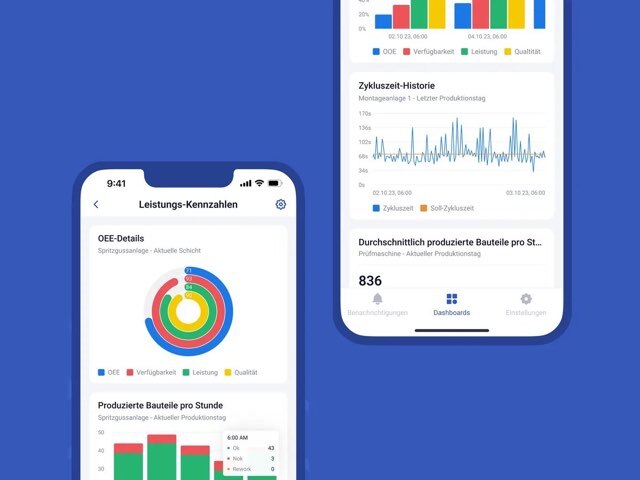
Your OEE live, not in Excel at month-end
SYMESTIC measures availability, performance and quality right at the machine. The first machine is connected in under three hours, even an older one.