



MES Software: Vendors, Features & Costs Compared 2026
MES software compared: vendors, functions per VDI 5600, costs (cloud vs. on-premise) and implementation. Honest market overview 2026.
_11zon-2.webp)
Total Productive Maintenance (TPM) is the maintenance methodology that turns OEE from a passive metric into an active improvement system. OEE reveals where losses occur — TPM provides 8 structured pillars to eliminate them. Each of the six major loss categories maps to at least one TPM pillar. Manufacturers that integrate both achieve 15–25 % fewer unplanned stops. The prerequisite: automatic data collection. TPM without OEE measurement is blind. OEE without TPM remains a number on a dashboard.
Table of contents
OEE measures Overall Equipment Effectiveness as the product of availability, performance, and quality. The metric makes losses visible but does not fix them. That is where TPM comes in: Total Productive Maintenance is a holistic system that shifts maintenance from reactive repair to proactive prevention.
The connection is direct: Each of the six major loss categories captured by OEE maps to at least one TPM pillar. Unplanned downtime is addressed by planned maintenance. Performance losses from minor stops are reduced through autonomous maintenance and focused improvement. Quality issues are systematically lowered through the interplay of quality maintenance and operator training.
In practice: TPM without OEE measurement is blind because improvements cannot be quantified. OEE without TPM remains a number on a dashboard that no one translates into concrete action.
TPM is built on eight pillars originally defined by the Japan Institute of Plant Maintenance (JIPM). Each pillar targets specific loss sources that directly affect one or more OEE factors.
Machine operators take ownership of basic tasks: cleaning, lubrication, visual inspection. This prevents gradual deterioration that leads to breakdowns and performance losses. Standardized cleaning routines and visual checkpoints alone can reduce minor stops by 10–20 %. The challenge: in most plants, autonomous maintenance exists on paper but is not consistently followed.
Primary OEE impact: Availability and Performance
Maintenance is scheduled based on usage and condition rather than fixed intervals or failure events. A machine stop during a planned window between shifts costs zero output. The same stop occurring unexpectedly during production can jeopardize an entire batch.
Primary OEE impact: Availability
Small, cross-functional teams analyze the largest loss sources and eliminate them systematically, based on the Pareto principle. At Neoperl, focused improvement on 4 PLC alarm codes — which caused 80 % of all machine stops — reduced technical downtime by 25 %. Without automated data collection through an MES, these patterns remain invisible because individual incidents are too short for manual documentation.
Primary OE impact: Availability and Performance
Process stability through early defect detection. The goal: zero-defect production by eliminating root causes rather than relying on final inspection. Every improvement in first-pass yield directly increases the OEE quality factor.
Primary OEE impact: Quality
Operators trained to recognize deviations and respond correctly. A significant share of performance and quality losses is not caused by machine defects but by operator errors, incorrect settings, and failure to act on early warning signals. Skilled operators who detect anomalies before they escalate are the most effective lever for stable OEE.
Primary OEE impact: All three factors
Reduces startup losses when introducing new machines or product changeovers. Lessons learned from maintenance data feed into the design and commissioning of new equipment.
Primary OEE impact: Availability and Performance (during ramp-up)
Extends loss-based thinking to administrative processes that cause production delays: order scheduling errors, material procurement gaps, late engineering changes.
Primary OEE impact: Indirect (availability through planning quality)
Ensures that OEE improvements do not come at the expense of worker safety or regulatory compliance. No improvement is sustainable if it creates safety risks.
Primary OEE impact: Indirect (sustainability of all improvements)

| # | TPM Pillar | Availability | Performance | Quality | Typical improvement |
|---|---|---|---|---|---|
| 1 | Autonomous Maintenance | ● | ● | ○ | 10–20 % fewer minor stops |
| 2 | Planned Maintenance | ● | ○ | ○ | 5–10 % fewer unplanned stops |
| 3 | Focused Improvement | ● | ● | ○ | Pareto: top 3–5 causes = 60–80 % of losses |
| 4 | Quality Maintenance | ○ | ○ | ● | 5–15 % less scrap (Neoperl: 15 %) |
| 5 | Training & Skills | ● | ● | ● | Operator-caused losses reduced |
| 6 | Early Equipment Mgmt | ● | ● | ○ | Faster ramp-up, fewer startup losses |
| 7 | Office TPM | ○ | ○ | ○ | Indirect: fewer planning-caused delays |
| 8 | Safety & Environment | ○ | ○ | ○ | Indirect: sustainability of all gains |
● = direct impact · ○ = indirect or no impact
The theory behind TPM has been documented for decades. Yet implementation regularly fails — almost always for the same three reasons.
| # | Failure pattern | What goes wrong | What to do instead |
|---|---|---|---|
| 1 | Maintenance project, not production strategy | Only the maintenance department "does TPM." Operators — who hold the biggest lever through autonomous maintenance — are not involved. | Shared ownership between production and maintenance from day one. |
| 2 | No reliable data foundation | TPM runs blind because results cannot be quantified. After 3 months, no one can say which downtime causes decreased by how much. | Automatic OEE capture first. TPM second. Always in this order. |
| 3 | Methodology over outcomes | TPM pillars treated as a checklist instead of aligned with actual loss data. | Measure OEE → identify largest losses → activate the pillars that address those losses. |
A Manufacturing Execution System connects TPM and OEE operationally. It captures machine data and production data automatically and provides the data foundation that TPM teams need.
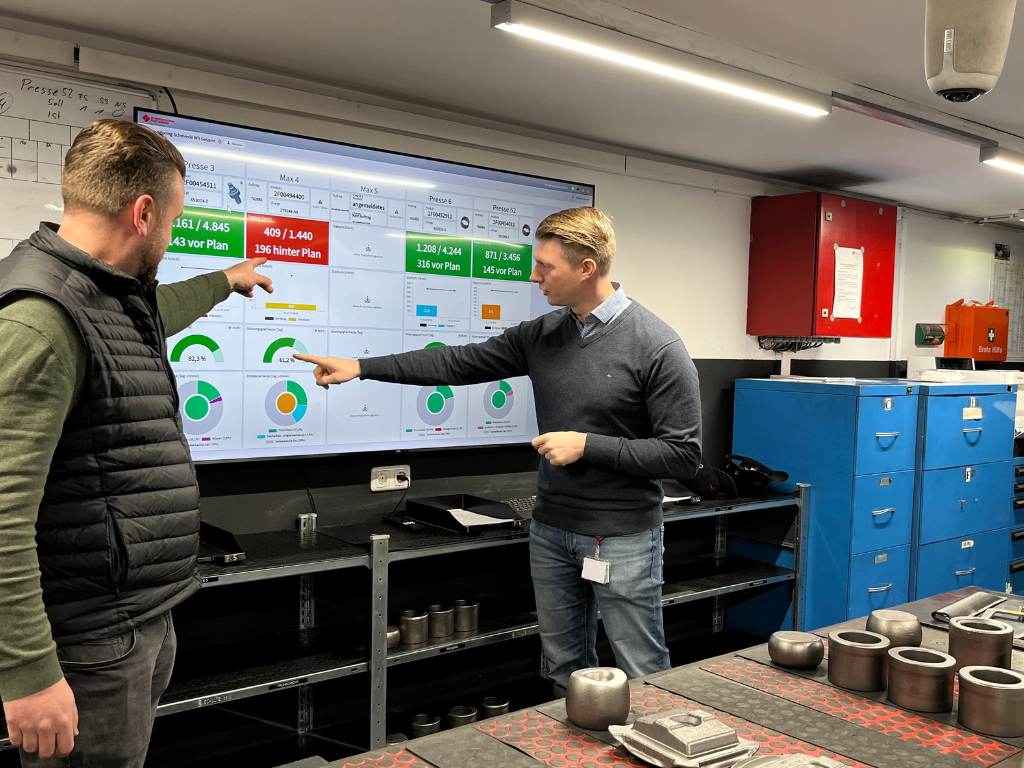
In practice: downtime reasons are captured in real time and categorized using standardized codes — Pareto analyses available at the push of a button. OEE trends show whether TPM measures are actually working. Shift handovers become data-driven instead of verbal.
How SYMESTIC supports TPM: Automated OEE tracking via OPC-UA, MQTT, or digital I/O — live within days. Standardized downtime coding via shopfloor clients. Machine alarm correlation (at Neoperl: SPS alarms mapped to quality defects). Digital shift log replacing handwritten handover notes (Schmiedetechnik Plettenberg). Configurable dashboards for TPM teams — from machine-level Pareto to plant-level availability trends.
The most effective approach follows a pragmatic three-step process:
Step 1 — Measure: OEE is captured through automated data collection. Results are typically well below previous estimates because minor stops and short interruptions become fully visible for the first time. The typical "OEE drop" of 15–20 percentage points is not a problem but the necessary starting point.
Step 2 — Identify: The 3–5 largest loss sources are identified and mapped to TPM pillars. Common findings: changeover processes → planned maintenance. Recurring minor stops → autonomous maintenance + focused improvement. Lack of standardization during shift changes → training.
Step 3 — Act and track: Targeted TPM measures are implemented and their effect tracked through OEE development. At Meleghy Automotive, this approach delivered 10 % reduction in downtimes and 5 % improvement in availability across 6 plants within the first year. At Klocke, standardized changeover procedures yielded 7 additional production hours per week.
First measurable improvements typically appear within 4–8 weeks, provided measures are based on automatically captured loss data.
What is the difference between OEE and TPM?
OEE is a metric that measures availability, performance, and quality of equipment. TPM is a maintenance methodology with eight pillars designed to systematically improve OEE. OEE makes losses visible, TPM eliminates them.
Which TPM pillar has the greatest impact on OEE?
Autonomous maintenance and planned maintenance typically have the largest direct effect. Autonomous maintenance reduces minor stops and gradual deterioration (10–20 % fewer minor stops). Planned maintenance lowers unplanned downtime (5–10 %).
Can TPM be implemented without OEE software?
In principle yes, but effectiveness is severely limited. Without automated data collection, there is no transparency into actual loss causes, and the impact of TPM measures cannot be reliably measured. An MES with automated OEE tracking is the operational foundation for effective TPM.
What are the eight pillars of TPM?
Autonomous maintenance, planned maintenance, focused improvement (Kobetsu Kaizen), quality maintenance, training & skills management, early equipment management, office TPM, and safety & environmental management. The pillar-to-OEE mapping table shows which pillar affects which OEE factor.
How quickly does TPM show results in OEE?
First measurable improvements typically appear within 4–8 weeks, provided measures are based on automatically captured loss data. Without a reliable data foundation, visible results take significantly longer or fail to materialize.
The key takeaway: TPM and OEE are two sides of the same coin. OEE provides the transparency, TPM provides the methodology. Neither works at full potential without the other. The correct sequence is always: measure first (automatic OEE), then improve (targeted TPM pillars based on actual loss data).
→ What is OEE? · → OEE Formula · → Six Big Losses · → Improve OEE · → OEE Benchmarks · → OEE Software