




Contents
What is Quality Assurance (QA)?
Quality Assurance (QA) is the set of planned, systematic activities a manufacturer implements to provide confidence that a product or service will satisfy defined quality requirements. DIN EN ISO 9000:2015 defines it as "part of quality management focused on providing confidence that quality requirements will be fulfilled". QA is process-oriented, preventive and built into the way a plant operates, long before a defect can reach a customer.
In practice, QA shows up in five concrete places on a shop floor: documented procedures and work instructions, process validation and control plans, supplier qualification, internal and external audits, and structured corrective and preventive action (CAPA). It answers the question "is our process capable of producing conforming parts?", not "is this one part good?"
That distinction matters. Quality Control (QC) inspects output. QA engineers the process so bad output becomes unlikely in the first place. In modern manufacturing, both rely on the same data stream: counts, scrap reasons, process values, operator feedback, batch genealogy. A cloud MES is what turns that stream from paper logs into a live QA system.
QA vs. QC vs. Quality Management
The three terms are used loosely in day-to-day conversation, but ISO 9000 gives them precise, distinct meanings. Mixing them up costs audits and, worse, clouds root-cause discussions.
| Concept | Focus | Orientation | Typical activities | Answers the question |
|---|---|---|---|---|
| Quality Management (QM) | Entire organization | Strategic | Quality policy, objectives, management review, resource allocation | "How do we lead the company on quality?" |
| Quality Assurance (QA) | Process | Preventive | Procedures, audits, validation, supplier qualification, CAPA, SPC | "Is our process capable of producing good parts?" |
| Quality Control (QC) | Product | Detective | Incoming, in-process and final inspection, testing, measurement | "Is this specific part conforming?" |
A plant can have strong QC and weak QA. The tell-tale sign is a high PPM sorted out in final inspection, low first-pass yield, and recurring 8D reports pointing to the same causes. The fix is never more inspectors. The fix lives upstream, in QA.
The ISO 9001 framework behind QA
ISO 9001:2015 is the world's reference for QA systems, used by over a million certified organizations. It prescribes no specific inspection method; it prescribes a structure. That structure is built on seven quality management principles and the Plan-Do-Check-Act cycle.
| ISO 9001 clause | QA requirement | What the MES contributes |
|---|---|---|
| 4 – Context | Define interested parties, scope, processes | Process model of all machines, lines, orders |
| 7.5 – Documented information | Control of documents and records | Digital work instructions |
| 8.5 – Production control | Identification, traceability, preservation | Serial number per inspected part, process parameter data |
| 8.7 – Nonconforming output | Identify, segregate, disposition NC parts | Automatic scrap capture, reason codes |
| 9.1 – Monitoring & measurement | Evaluate performance and QMS effectiveness | Real-time KPIs, FPY, scrap rate, OEE |
| 9.2 – Internal audit | Planned audits of the QMS | Objective, timestamped data trail for auditors |
| 10.2 – Nonconformity & CAPA | React, contain, root-cause, prevent recurrence | Scrap and rework by reason, FPY, PPM |
Industry-specific QA standards build on the same spine. IATF 16949 (automotive) adds APQP, PPAP, FMEA, MSA and SPC. ISO 13485 (medical devices) adds design controls and risk management per ISO 14971. AS9100 (aerospace) adds configuration management and counterfeit parts prevention. IFS and BRCGS (food) add HACCP. All of them assume the same plant-floor reality: if you can't prove it with data, it didn't happen.
The core QA toolkit on the shop floor
QA lives or dies on the methods it uses. The toolkit below is what a manufacturing QA organization actually runs, day to day, whether the product is a stamped bracket or a filled blister pack.
| Tool | Purpose | When to use it |
|---|---|---|
| APQP & Control Plan | Translate customer requirements into process controls | New product or process launch |
| FMEA (DFMEA, PFMEA) | Identify and rank failure modes by severity × occurrence × detection | Design phase, process changes, recurring defects |
| SPC (control charts, Cp/Cpk) | Detect special-cause variation in real time | Any measurable critical characteristic in series production |
| MSA (Gage R&R) | Verify measurement system capability (< 10 % is acceptable) | Before trusting any SPC or capability study |
| Poka-Yoke | Engineer errors out of the process (mistake-proofing) | Whenever a human step carries risk of confusion |
| 8D / RCA | Structured problem solving to permanent countermeasure | Customer complaint, recurring internal defect |
| PPAP | Prove process capability before series release (automotive) | New part, new tool, new supplier, major change |
| Layered Process Audits (LPA) | Verify that the documented process is actually run | Daily/weekly, across all management levels |
How an MES makes QA work in practice
Every QA tool above needs data. On paper-driven shop floors, that data is filled in by hand, aggregated on Mondays, and analyzed on Fridays. By then the bad parts are boxed and on a truck. A cloud MES changes the clock from weekly to real time, and it does five specific things for QA:
| QA function | Without MES | With SYMESTIC MES |
|---|---|---|
| Scrap & rework capture | Paper tally, shift-end entry into Excel | Automatic count from PLC, reason code at the terminal, live scrap rate per order |
| SPC on critical characteristics | Offline Minitab analysis, days after the run | Live process data with control limits and Cp/Cpk for a process parameter |
| Traceability | Batch sheet in a binder, linkable in hours | Order, serial number and OK/NOK result per inspected part |
| Nonconformity containment | Verbal handover, risk of shipment | Automatic alarms, email to QA lead |
| Audit preparation | Days of document hunting, gaps likely | Timestamped records pulled live from the database |
Meleghy feeds machine-cycle data back into SAP via IDoc, closing the loop between production and the quality system across four plants. Klocke runs the same platform in a GMP-regulated packaging environment, where every stoppage and count is automatically tied to a production order.
Four common QA failure modes
Recognizing them early is worth more than any new tool.
| Failure mode | Symptom | Fix |
|---|---|---|
| "Inspection-driven QA" | Final inspection headcount grows year over year | Shift investment upstream: SPC, poka-yoke, process capability |
| Scrap reasons ≈ "other" | Scrap logged without a specific cause | Fix the reason catalogue, capture at source, not in Excel |
| CAPA theatre | 8D reports close fast, defects return within months | Track CAPA effectiveness with real KPI data, not opinions |
| Measurement system not validated | SPC charts look great, customer still finds defects | Gage R&R before trusting any capability study |
FAQ
What is the difference between QA and QC?
QA is process-focused and preventive: procedures, audits, process capability, supplier qualification, CAPA. QC is product-focused and detective: incoming, in-process and final inspection. QA makes good parts likely; QC confirms individual parts are good. A mature plant invests heavily in QA so it needs less QC. The opposite ratio is a symptom of a weak quality system.
Is ISO 9001 certification mandatory?
Legally, no. Commercially, in most B2B manufacturing it is effectively required. Automotive tier suppliers need IATF 16949, which sits on top of ISO 9001. Medical device manufacturers need ISO 13485. Aerospace needs AS9100. Food needs IFS or BRCGS. Even where no certificate is contractually required, major OEMs audit against ISO 9001 clauses during supplier approval. Running a QA system per the ISO 9001 structure is the baseline; the certificate is just the evidence.
How does an MES support a regulated QA environment?
A cloud MES supplies the three things auditors always ask for: timestamped records of what was produced, under which parameters, by whom. In a GMP environment like Klocke's packaging operations, SYMESTIC captures counts and downtime per production order and ties them to the batch record in ERP. The MES itself is not a validated GMP system for electronic batch records, but it provides the same kind of objective data backbone under ISA-95 Level 3 that any QA investigation depends on.
Can you do SPC without an MES?
Technically yes, with manual sampling, hand-entered data and offline tools. In practice, SPC only creates value when the operator sees a rule violation while the process is still running. Real-time SPC needs automated process-data capture (via OPC UA or digital signals) and a visualization layer operators actually use. That is what a modern MES delivers. Paper-based SPC usually degenerates into a compliance ritual within 12 months.
Where should a QA team start if everything is on paper today?
Start with one pain point, not a master plan. Pick the defect or scrap category that costs you the most money, capture that reason code automatically at the source, and put the live KPI on a shop-floor monitor. Once the first loop works, widen the scope. Klocke, for example, started with one line and scaled from there. The risk of a boil-the-ocean QA project is the same as for any MES project: it dies in the scoping phase.
Related: Quality Control · SPC · Six Sigma · Root Cause Analysis · PPM · Poka-Yoke · PDCA

Paper defect lists show what went wrong, but never how often or what it costs.
Inspect every part at the workstation, analyze every defect
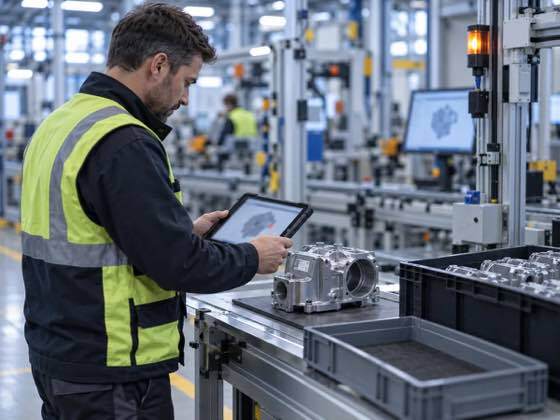
The operator scans the part, picks OK or NOK and marks the defect location. SYMESTIC shows top defects, PPM, first pass yield and scrap costs.