




Contents
What is real-time monitoring in manufacturing?
Real-time monitoring in manufacturing is the continuous, automatic capture of machine, process and production events at a latency short enough to change the next decision on the shop floor. It is the data-layer foundation underneath OEE dashboards, alarm systems, quality control and every flavour of digital shopfloor management. Without it, everything downstream — KPIs, alerts, schedules, reports — is a retrospective based on partial memory. With it, the plant operates on facts that are minutes or seconds old, not shifts or days.
The underlying technology has changed completely several times. The underlying human problem has not changed at all. Every plant believes it already knows what is happening in its production. Almost every plant is wrong, often by a wide margin — not because the people are wrong, but because without continuous measurement, perception is systematically distorted. This article is about why that happens, what "real-time" actually means in manufacturing, and what separates real-time monitoring that works from real-time monitoring that just looks impressive.
"Real-time" is three different things — don't conflate them
The first source of confusion in nearly every RTM conversation is that "real-time" is being used as a single word for three latency classes that have almost nothing in common. They serve different decisions, require different architectures, and fail in different ways. Getting them apart is the prerequisite for every sensible monitoring decision.
A system can be excellent at one class and useless at another, and the choice has direct architectural consequences. Closed-loop control cannot be done in the cloud and should not be attempted. Operational dashboards cannot be done on a nightly ETL and should not be attempted. Managerial reporting does not need sub-second latency and paying for it is wasted money. Any vendor that sells "real-time monitoring" without telling you which class they mean is selling you a word, not a system.
The first-day gap: why real-time monitoring is disruptive before it is useful
When automatic data capture is turned on for the first time, the same pattern repeats again and again. The plant believes, before the system is live, that its availability is comfortably high. On day one of real-time measurement, the system reports a considerably lower number. The operations director insists the number is wrong. It is not wrong. The measurement is correct. The previous number was an estimate stitched together from paper shift logs and memory, and it was systematically optimistic — always. The direction practically never goes the other way.
The same pattern repeats for micro-stops (far more frequent than the plant believed), changeover times (longer), first-pass yield (lower than the previous number) and setup duration (almost always wider in variance than anyone thought). Not because people were lying. Because paper-based and memory-based measurement systems are physically incapable of capturing the sub-five-minute stops, the short deviations, the daily variance that real instrumentation sees by default.
The rule before go-live: when the numbers drop in the first two weeks of real-time monitoring, that is the system working, not the system failing. The plant is not getting worse. The plant is getting measured for the first time. Resist the urge to "calibrate" the new numbers up to the old ones, because that is exactly how honest instrumentation gets turned back into comfortable fiction. The gap between the old number and the new number is the improvement runway.
The 30-year arc — and why "too complex" is no longer a valid reason
Real-time monitoring in manufacturing has gone through several generations, each considerably cheaper and faster to deploy than the previous one. The reason "we haven't done it because it's too complex" is no longer a valid answer in 2026 is that the complexity argument is about 15 years out of date.
- Generation 1 (1990s): Paper shift reports, manual end-of-shift entry into the plant's mainframe. Latency: 8-24 hours. Cost: mostly operator time. Accuracy: rough.
- Generation 2 (2000s): PLC direct-connect into on-premise process-control systems, specialist engineer required per line. Latency: minutes. Cost: six-figure per plant. Time to deploy: 6-18 months.
- Generation 3 (2010s): On-premise OEE software layered on top of MDE/BDE infrastructure, plant-level servers, custom integrations. Latency: seconds. Cost: mid-five- to low-six-figure per plant. Time to deploy: 3-9 months.
- Generation 4 (2020s): Cloud-native event ingestion via OPC UA, MQTT and digital-I/O gateways into a multi-tenant platform. Latency: sub-second. Cost: four-figure per month per plant. Time to deploy: days to weeks.
The deployment profile is the point. In generation 4 we routinely connect 10 machines in under a month and entire plants in under three months, with no PLC intervention and no production interruption. That is a categorical change, not an incremental one. Plants that still carry generation-2 assumptions about what real-time monitoring costs or takes to deploy are holding back investment for reasons that no longer exist in the market they operate in.
Monitoring is now cheap — acting on it is the hard part
Because the sensing, telemetry and dashboard layers have collapsed in cost, the failure pattern in real-time monitoring projects has shifted. It used to be that projects failed because the technology was too expensive or too brittle. In 2026 it is nearly always because the plant bought the monitoring layer and did not build the workflow response. The dashboard goes live, the numbers are visible, the alerts fire — and nothing happens, because nobody has defined who acts on what, by when, with what escalation if no action is taken.
The question that separates real monitoring from theatrical monitoring is uncomfortable and has to be answered before the system is built: when this threshold is crossed, what action is taken, by whom, within what timeframe, and what happens if that action is not taken? If the answer is "someone will see it at the next shift huddle and we'll discuss it then," that is not real-time monitoring; it is end-of-shift review with a more expensive display. Real-time monitoring that actually changes outcomes always has a specific, time-boxed human response attached to each significant event class — and it has an escalation if the first response does not close the event.
Alert fatigue: the category error
The second structural failure is alert inflation. The monitoring system goes live, every possible threshold is configured, and within a month the plant is receiving 300-500 alerts per day. Within two months, nobody on the floor is reading them. Within three months, the whole system is treated as background noise and the plant effectively has no alerting. A monitoring system that generates 400 alerts a day has zero alerts, not 400. That is a category error, not a volume problem.
The fix is boring engineering. Define the five or ten events that actually warrant an immediate human response. Define who responds to each, with what action, in what timeframe. Send only those as alerts. Everything else goes to the dashboard as information, not as an alert, and is reviewed on a scheduled cadence. Signal-to-noise engineering is the single most underinvested discipline in manufacturing digitalisation, and it is the difference between a plant that acts faster because of monitoring and a plant that wastes engineering time drowning in it.
FAQ
What is the difference between real-time monitoring and SCADA?
SCADA is historically focused on operational control of the machine and process — it lives close to the PLC layer, and its primary job is supervisory control, not business-level visibility. Real-time monitoring in the MES sense is a layer above: it takes the same machine signals but contextualises them against orders, shifts, operators and products to produce KPIs like OEE, availability and first-pass yield. A modern MES can consume SCADA data, but the two layers answer different questions for different users.
What counts as "real-time" in a manufacturing context?
There is no single answer — it depends on the decision the data supports. Closed-loop control needs sub-100-millisecond latency. Operator dashboards need 1-60 seconds. Shift-management workflows can tolerate 1-15 minutes. Enterprise KPI reporting works fine at 15-minute to hourly refresh. A vendor that promises "real-time" without specifying which class is selling language, not engineering. Honest systems tell you the latency they deliver and let you pick the class that matches each use case.
Do we need to upgrade our PLCs to get real-time monitoring?
Almost never. I have personally seen plants with 1990s-vintage PLCs connected into real-time monitoring within a working day, using digital-I/O gateways that tap the existing cycle and stop signals without touching the PLC program. The belief that "our machines are too old" is the most common reason plants delay monitoring projects, and in 2026 it is almost always wrong. Modern retrofit connectivity was designed specifically for brownfield environments.
How fast should a real-time monitoring implementation be?
In 2026, go-live on the first line in 1-3 weeks is typical for a cloud-native platform. Scaling across a plant in 1-3 months is typical once the pattern is established. If a vendor quotes 9-18 months for initial go-live, they are quoting a generation-2 or generation-3 architecture, and the architecture is the problem, not the scope. This is one of the clearest differentiators between mature cloud-native MES platforms and older on-premise offerings repackaged as "cloud."
How do we avoid alert fatigue?
Define the five to ten event classes that genuinely require an immediate human response. Define who responds, with what action, in what timeframe, and what escalates if the response does not close the event. Everything else goes to the dashboard as information, not as an alert. Review the alert catalogue quarterly and retire anything that has not triggered action in the last 90 days. Signal-to-noise engineering is boring but decisive — a system with ten well-calibrated alerts beats a system with three hundred.
What should we monitor first?
Start with stop events (status, duration, category) and cycle counts at the bottleneck machines. Those two data classes deliver 80 percent of the improvement runway at 20 percent of the complexity. Add quality data once the availability baseline is honest. Add energy data once the operational KPIs are stable. Add predictive-maintenance data once the reactive-maintenance workflow is functioning. The common error is trying to monitor everything at once — by the time the system is live, the organisation is overwhelmed and acts on nothing.
Cloud or edge for real-time monitoring?
Both, for different jobs. Control-loop latency (sub-100-millisecond) must be handled at the edge; no cloud architecture will beat physics. Operational and tactical monitoring (seconds to minutes) is best served by a cloud platform with edge gateways — this gives you the scale and cross-plant analytics without the on-premise maintenance burden. In 2026 the pragmatic pattern is edge for control, cloud for visibility and analytics, and a clean protocol boundary (OPC UA, MQTT) between the two.
How does SYMESTIC support real-time monitoring?
Automatic event capture via OPC UA, MQTT and digital-I/O gateways (including retrofit on legacy machines); sub-second telemetry into Microsoft Azure; continuous aggregation of availability, performance, quality and alarm KPIs; role-appropriate rendering across operator terminals, shift-manager browsers and enterprise analytical views; bidirectional integration with SAP, Infor, Navision and Dynamics; alert catalogues with built-in signal-to-noise discipline. Go-live in days, not months, on 15,000+ connected machines. See SYMESTIC Production Metrics.
Related: OEE · MES · KPI Dashboard · Machine Data Acquisition · Shopfloor Management · Production Data · Alarm Management · SYMESTIC Production Metrics

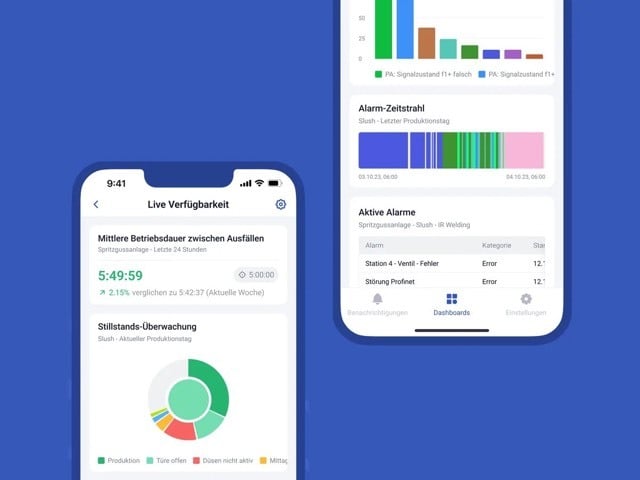
Every machine in view, even the one from 1995
SYMESTIC captures states, cycles and part counts via Plug & Play, older machines over digital signals without touching the controller.