




Contents
What are setup processes in manufacturing?
Setup processes — also called changeover, setup, or Rüstprozess — are all activities required to transition a machine, line, or cell from producing the last good part of one product to the first good part of the next. That includes tool changes, die swaps, fixture adjustments, parameter updates, material replacement, cleaning, test runs, and first-piece quality approval. Measured correctly, setup time runs from the last acceptable part of job A to the first acceptable part of job B — not from "tool down" to "tool up," which systematically understates it by 20–40%.
In OEE terms, scheduled setup is typically excluded from planned production time, while setup overruns count as Availability losses. Long setups are the single biggest reason high-mix plants struggle with flexibility: they push batch sizes up, inventory up, responsiveness down — the opposite of what Lean manufacturing demands.
Planned setup vs. unplanned setup vs. overrun
Three distinct events that plants routinely collapse into one line on the shift report. Each has a different cost profile and corrective action.
How does SMED actually reduce setup time?
SMED — Single-Minute Exchange of Die, developed by Shigeo Shingo at Toyota — is the canonical method, and it still works when applied rigorously. The core insight is trivial and almost always ignored in practice: separate internal setup (only possible while the machine is stopped) from external setup (possible while the machine is still running the previous job). Most plants do both kinds of work with the machine stopped, because "that's how we've always done it."
The classical SMED sequence has four stages. Stage 1: observe and document — video the full changeover, list every task with duration. This alone typically exposes 15–25% waste before any change. Stage 2: separate internal from external — move preparation, staging, and tool pre-heating outside the downtime window. Typical gain: 30–50% reduction. Stage 3: convert internal to external — modify fixtures and procedures so tasks formerly requiring machine stop can be done in parallel. Stage 4: streamline all operations — quick-release clamps, pre-set tools, one-touch adjustments, colour-coded fasteners. The target is under 10 minutes ("single-minute" = single-digit minutes, not 60 seconds).
What's a realistic setup time target?
Benchmarks vary wildly by process, so a blanket "world-class" number is misleading. Useful ranges from the ISO 22400 and Lean Enterprise literature, cross-checked against implementations we see in the field:
- Stamping and forming: SMED targets 5–10 minutes; typical un-optimised 45–90 minutes.
- Injection moulding: SMED targets 10–20 minutes; typical un-optimised 2–4 hours.
- Packaging lines (FMCG/pharma): SMED targets 15–30 minutes; typical un-optimised 60–120 minutes.
- CNC machining: with pallet systems 1–5 minutes; manual 20–60 minutes.
- Assembly (high-mix): 2–10 minutes achievable with good poka-yoke.
The target is not a benchmark — it's your current median minus 50% within twelve months. Plants that reach the industry benchmark typically share the same starting move: automatic measurement of actual changeover duration, not self-reported.
What causes setup overruns in practice?
Five recurring causes, in rough order of frequency. Missing tools or fixtures at kickoff — external setup wasn't done because the previous shift ran over, or the tool kit was incomplete. First-piece quality loops — parameters need adjustment, often because the last setup record wasn't saved. Material not at the line — kitting hadn't finished before the changeover window. Operator experience gaps — the changeover was last performed weeks ago, the standard work wasn't followed, trial-and-error crept back in. Equipment issues discovered during setup — worn fixtures, broken sensors, calibration drift. Four of the five are information and preparation problems, not technical ones. That's why digital capture and standard work beat hardware investment in most cases.
How does MES help reduce setup time?
An MES contributes three things that manual systems can't. First, automatic measurement — the start and end of every setup is captured from machine signals (last cycle of job A, first cycle of job B), not from an operator pressing a button. This removes the self-reporting bias that hides 20–40% of actual setup time. Second, reason-code capture during the setup window — what delayed the first-piece approval, which tool wasn't ready, which parameter needed adjustment. Without this, Pareto analysis is impossible. Third, setup parameter storage and recall — the approved recipe for every part number stored centrally, pushed to the machine at changeover, eliminating the "try until it runs" loop. Plants that combine these three see setup time reductions of 25–50% in the first six months, before any SMED workshop. The workshop builds on clean data, not guesses.
FAQ
Is setup time part of OEE?
Planned setup is typically excluded from planned production time, so it doesn't enter the OEE calculation. Setup overruns — minutes beyond the target — are Availability losses and do affect OEE. This is why plants with long standard setups can still show respectable OEE: they've defined the loss out of the denominator.
What's the difference between setup and changeover?
In common usage, the terms are interchangeable. Some frameworks distinguish changeover (full product transition including cleaning and qualification) from setup (tool/fixture change only). When in doubt, use "changeover" for the full event and "setup" for the tool-change portion.
How is SMED different from Lean?
SMED is one specific methodology within Lean, focused narrowly on setup reduction. Lean is the broader philosophy covering flow, pull, waste elimination, continuous improvement, and standard work. SMED without Lean produces faster setups but doesn't change the system that demanded frequent setups in the first place.
Does short setup time mean small batch sizes are always better?
It enables them, but doesn't mandate them. The formula is classical: Economic Order Quantity balances setup cost against inventory carrying cost. Reducing setup time shifts the economic batch size down, which unlocks flexibility — but the actual batch size should follow demand patterns, not ideology.
How long does it take to implement SMED on a line?
First improvements appear within days of observation and documentation. A full four-stage SMED project on a single line typically runs 6–12 weeks. Rolling SMED across a plant of 20–40 machines takes 6–18 months, with the limiting factor being operator training and standard-work adoption, not technical change.
Can setup processes be tracked without an MES?
Yes, with stopwatches and spreadsheets — the way Toyota did it originally. It works but is expensive in management attention and systematically under-measures. MES-based capture pays back quickly on lines where changeovers are frequent (more than once per shift) or where setup cost is a meaningful fraction of total cost.
How does SYMESTIC support setup process optimisation?
SYMESTIC captures every changeover automatically via machine signals, tagging start, end, and reason-coded sub-steps. Setup parameters per part number are stored and pushed to the line at changeover kickoff. Live dashboards show target vs. actual changeover time, and the Production Control module sequences orders to minimise cumulative setup time across the schedule.
Related: OEE · MES · Machine Downtime · SMED · Lean Manufacturing · Six Sigma · Process Interruptions · Production Control · Production Planning · Production Metrics.

How much of your changeover can be done in advance?
Split your changeover steps into internal and external and see how much downtime disappears. No sign-up needed.
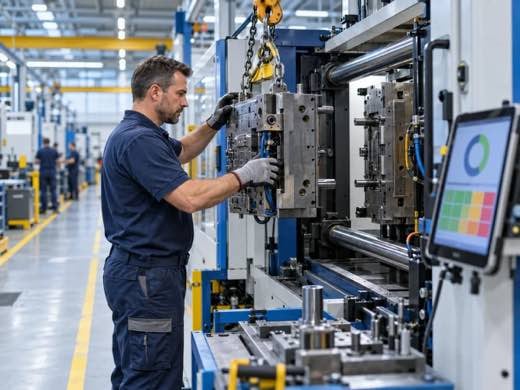
Which changeover costs you the most time?
SYMESTIC measures every changeover automatically. The changeover matrix shows the slowest product changes at a glance.