





MES Software: Vendors, Features & Costs Compared 2026
MES software compared: vendors, functions per VDI 5600, costs (cloud vs. on-premise) and implementation. Honest market overview 2026.
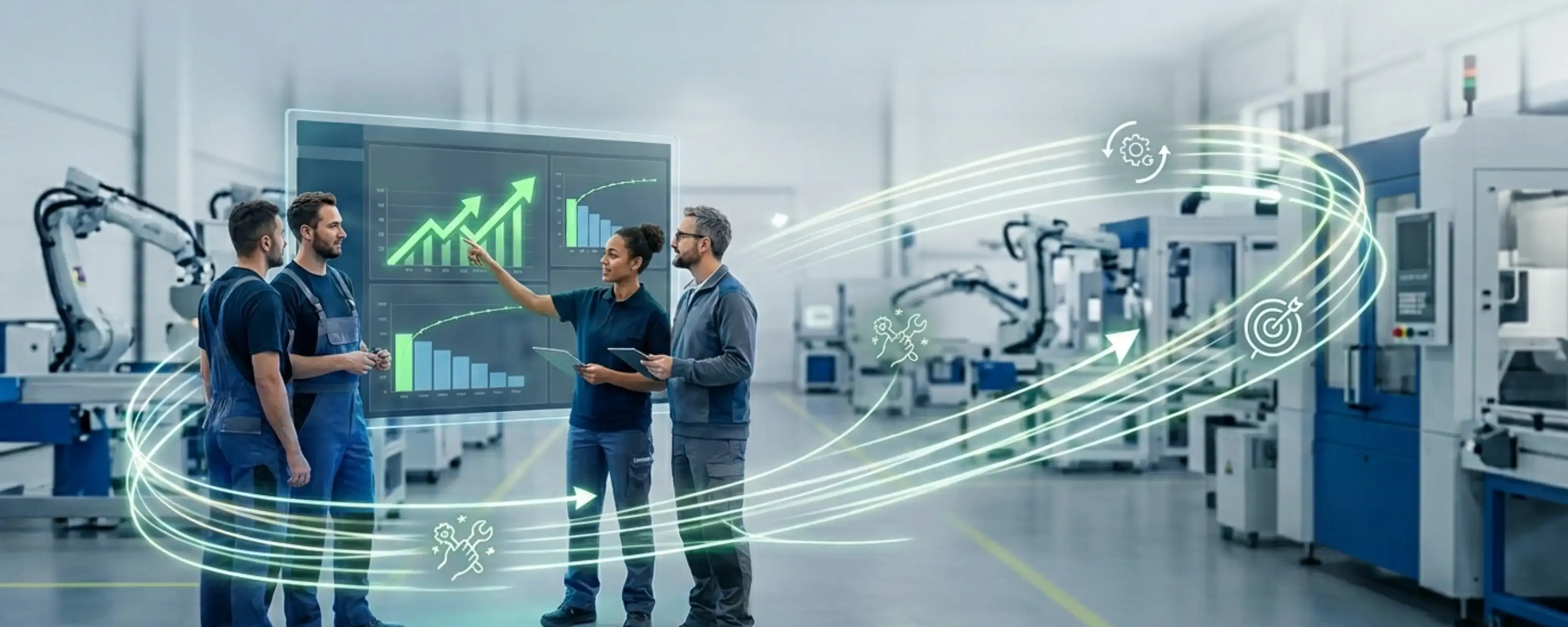
Continuous Improvement Process (CIP) is a systematic approach to making incremental, ongoing improvements across all areas of a manufacturing operation. It is rooted in the Japanese Kaizen philosophy and uses the PDCA cycle (Plan–Do–Check–Act) as its core framework. CIP is not a one-time project — it is an operating system for the shop floor. The key differentiator between companies that talk about CI and those that achieve measurable results: real-time data. Without automatic OEE tracking and loss visibility via an MES, improvement cycles run on opinions instead of facts.
Table of contents
CIP (Continuous Improvement Process) is a management philosophy and operational method for systematically improving products, processes, and services through many small, incremental steps — rather than occasional large-scale projects. The concept originates from the Japanese Kaizen philosophy and was codified in the Toyota Production System (TPS) in the 1950s.
In manufacturing, CIP operates at the intersection of three forces: the people who identify problems daily on the shop floor, the methods that structure problem-solving (PDCA, Six Sigma, 5S), and the data that makes losses visible and improvements measurable.
The German equivalent is KVP (Kontinuierlicher Verbesserungsprozess) — widely used in DACH manufacturing and standardized in frameworks like VDA and IATF 16949 for automotive suppliers.
| CIP principle | What it means in practice | Opposite approach |
|---|---|---|
| Small steps over big leaps | 100 improvements of 0.1 % beat one restructuring of 10 % | Innovation-only mindset ("wait for the big project") |
| Everyone improves | Operators submit ideas, not just engineers | Top-down consulting engagements |
| Data over opinion | Changes validated with measured KPIs before/after | Gut-feeling decisions in production meetings |
| Standards before creativity | Stabilize the process first, then improve it | Firefighting mode — fixing symptoms not causes |
The PDCA cycle (Plan–Do–Check–Act), also known as the Deming Cycle or Shewhart Cycle, is the engine of CIP. Every improvement follows these four phases — and then repeats.
| Phase | What happens | Data requirement | Manufacturing example |
|---|---|---|---|
| Plan | Identify the problem, analyze root cause, define target | Loss analysis from OEE data, Pareto of downtime reasons | Top-5 stoppage codes account for 70 % of availability loss |
| Do | Implement countermeasure on a trial basis | Baseline KPI captured before change | Change material feed sequence on line 3 |
| Check | Measure result, compare to baseline | Real-time OEE comparison: before vs. after | Micro-stoppages on line 3 dropped 40 % |
| Act | Standardize if successful, or adjust and re-plan | Trend monitoring over weeks/months | New feed sequence standardized across all 3 shifts |
The critical insight: the "Check" phase is where most CIP programs fail. Without automatic data capture, teams cannot objectively verify whether an improvement worked. They rely on subjective assessments in the next production meeting — by which time the context is lost. An MES with real-time OEE dashboards closes this gap: the before/after comparison is automatic, immediate, and indisputable.
| Tool | What it does | Best for | Data dependency |
|---|---|---|---|
| PDCA Cycle | Structures every improvement as a hypothesis → test → verify loop | Every improvement — the universal framework | Medium: needs baseline + post-change measurement |
| Kaizen | Daily micro-improvements driven by every employee | Building culture, operator-level engagement | Low: starts with observation + suggestion |
| Six Sigma (DMAIC) | Statistically reduces process variation using data analysis | Quality problems, yield losses, complex root causes | High: requires process data, SPC, Cp/Cpk |
| Value Stream Mapping | Visualizes material & information flow, exposes waste | Lead time reduction, WIP optimization, layout changes | Medium: needs cycle times, wait times, inventories |
| 5S | Sort–Set in order–Shine–Standardize–Sustain at the workplace | Workplace organization, safety, visual management | Low: primarily visual audits |
| Poka-Yoke | Error-proofing — designs processes so mistakes cannot occur | Assembly errors, operator mistakes, sequence violations | Low: driven by observation + design thinking |
These tools are not alternatives — they are layers. 5S creates the foundation (organized workplace). Kaizen drives daily engagement. PDCA structures every change. Value Stream Mapping identifies where to focus. Six Sigma solves the hard problems. Poka-Yoke prevents recurrence.
The number-one reason CIP initiatives stall after 6–12 months is not lack of motivation — it is lack of feedback. Improvement teams implement changes but cannot verify whether they worked. The production meeting three days later discusses anecdotes, not evidence. Without data, the PDCA cycle collapses: "Check" becomes "guess", and "Act" becomes "move on to the next topic".
This is where an MES transforms CIP from a methodology into a management system:
| CIP requirement | Without MES | With MES |
|---|---|---|
| Identify the biggest loss | Opinions in the production meeting | Pareto of downtime reasons from automatic OEE data |
| Verify an improvement | Subjective assessment 3 days later | Before/after OEE comparison in seconds |
| Sustain gains | Hope that the new standard is followed | Automatic alerts when KPI drops below threshold |
| Prioritize next cycle | The loudest voice in the room decides | Data-driven loss ranking updated in real time |
SYMESTIC implementation example: At Neoperl, a building products manufacturer, SYMESTIC was implemented specifically as a CIP tool. SPS-based alarm capture and automatic downtime classification enabled the CI team to correlate PLC alarms with quality defects. Results: 10 % fewer stoppages, 15 % less scrap, 15 % productivity gain — all from targeted countermeasures identified through the data, not through guesswork.
| Phase | Timeline | Focus | Deliverables |
|---|---|---|---|
| 1. Baseline | Weeks 1–4 | Connect machines, start automatic data capture, establish OEE baseline | Honest OEE values, top-10 loss Pareto, identified quick wins |
| 2. Quick wins | Weeks 5–8 | Tackle the top-3 losses with cross-functional PDCA cycles | Measurable OEE improvement, first success stories for communication |
| 3. Structure | Months 3–4 | Embed CIP into shopfloor management: daily dashboards, weekly reviews | Standard meeting cadence, CI board (physical or digital), defined KPIs |
| 4. Scale | Months 5–6 | Expand to additional lines/plants, train CI champions in each team | Cross-plant CI benchmarking, operator-driven improvement suggestions |
| 5. Sustain | Ongoing | Monthly trend reviews, annual CI maturity assessment, continuous tool expansion | OEE trend shows sustained improvement, CI becomes "how we work" |
The most common mistake: trying to build a CI culture before having the data. Culture follows evidence. When operators see their improvement idea reflected in the next day's OEE dashboard, they submit the next idea. When they never see the result, they stop.
A CIP program that depends on a single champion will collapse when that person leaves. Sustainable CI culture requires structural anchoring — not motivational posters.
| Culture element | What it looks like | What kills it |
|---|---|---|
| Visible leadership | Plant manager reviews CI metrics daily on the shop floor, not in an office | Delegation to a "CI department" that nobody listens to |
| Fast feedback loops | Improvement suggestions acknowledged within 24 hours, implemented within days | Suggestion box that gets emptied once a quarter |
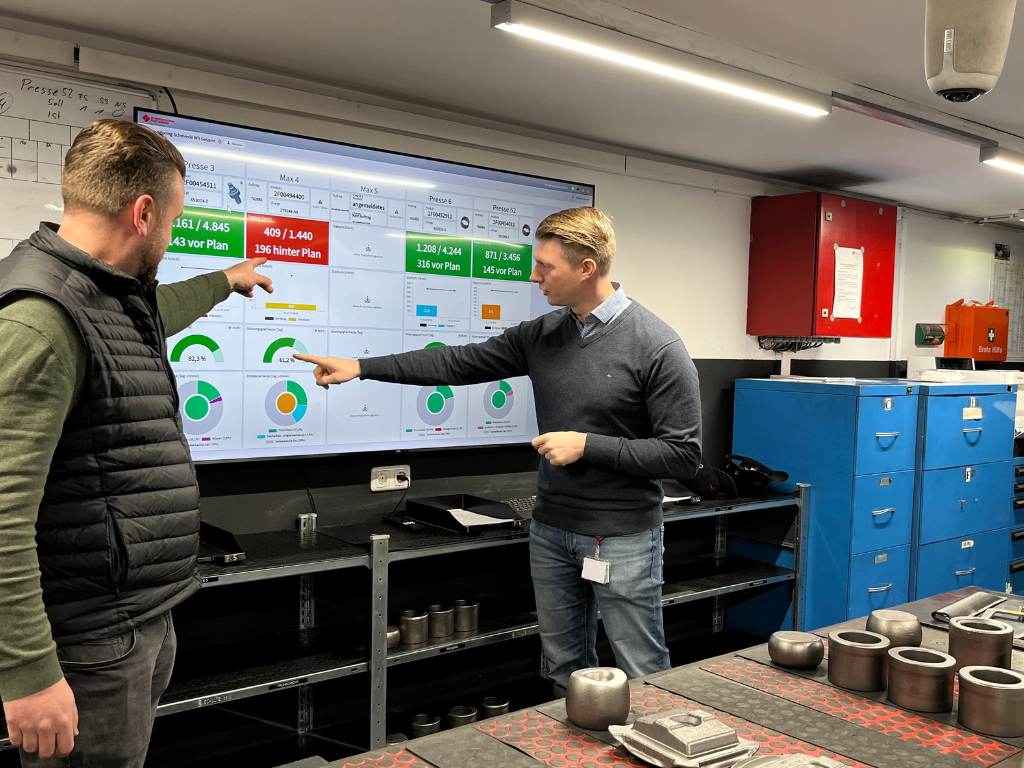
| Transparent data | OEE dashboards visible on the shop floor for every operator | KPIs locked in management reports nobody reads |
| Celebration of small wins | Weekly recognition of improvements — even 0.5 % OEE gain is worth sharing | "That's too small to mention" attitude |
What does CIP stand for?
CIP stands for Continuous Improvement Process. In German-speaking manufacturing, the equivalent is KVP (Kontinuierlicher Verbesserungsprozess). Both refer to the same systematic approach of making incremental improvements through active employee participation and structured problem-solving.
What is the difference between CIP and Kaizen?
Kaizen is the philosophical foundation — the mindset that everything can be improved. CIP is the operationalization of that mindset into a structured process with defined cycles (PDCA), tools, and measurement. In practice, the terms are often used interchangeably.
What is the difference between CIP and Six Sigma?
CIP is the overarching operating system for continuous improvement. Six Sigma (DMAIC) is a specific tool within that system, optimized for statistically reducing process variation. Six Sigma is one layer of CIP — powerful for quality problems, but not the full picture.
How does an MES support CIP?
An MES provides the data foundation for CIP: automatic OEE capture, downtime classification, loss Paretos, and before/after comparisons. Without automatic data, the "Check" phase of PDCA relies on guesswork. With an MES, every improvement cycle is evidence-based.
How long does it take to see results from CIP?
With automatic data capture, the first measurable improvements typically appear within weeks — not because CIP is magic, but because the data reveals losses that were previously invisible. At Neoperl, SYMESTIC's automatic alarm capture led to 10 % fewer stoppages through targeted countermeasures identified in the first PDCA cycles.
The bottom line: CIP is not a methodology to be "implemented" and checked off. It is a way of operating a production facility — and it works only when powered by data that is automatic, real-time, and accessible to everyone on the shop floor. Start by making losses visible. The improvements will follow.
→ OEE Explained · → What is an MES? · → Kaizen · → Six Sigma · → Lean Production · → Shopfloor Management · → Operational Excellence