Calculate machine electricity cost from power in kW, operating hours and your price per kWh. Add standby consumption separately and compare period costs with an annual projection.
Power draw, operating hours per period and electricity price – the basis of energy costs.
Average power during production
kW
Average measured power while producing, e.g. 15 kW
Operating hours /
h
Productive hours per selected reference period
Electricity price
EUR/kWh
Energy rate per kilowatt-hour, e.g. 0.30 €/kWh
Currency
Energy production0kWh
Idle, CO₂ & scenario (optional)
Make standby consumption visible, report CO₂ and run a savings scenario.
Idle power
kW
Standby / idle power draw (optional)
Idle hours /
h
Non-productive time with electricity draw (optional)
Energy idle0kWh
CO₂ factor
g/kWh
Grid- and country-dependent – please enter your own value.
Savings-potential scenario
%
“What if −X % consumption/idle?” – 0 to 100 %
TOTAL0kWh /
Energy costs
/
Annual projection
/ year
Total energy
kWh
Production + idle per period
Energy costs
/ year
Energy × electricity price
Annual cost
/ year
Projection via period factor
CO₂ emissions
–t / year
kWh × factor ÷ 1,000
Production vs. idle
How energy consumption per period splits between productive time and idle.
Production0 kWh
Idle / standby0 kWh
Energy consumed without production is the first lever. SYMESTIC's energy monitoring measures exactly this share live, per machine – instead of estimating.
Values projected to 1 year
Cost saved / year
Energy saved / year
CO₂ saved / year
What does a reduction achieve?
Enter a savings potential in % on the left to see savings in € and CO₂ per year.
Recommendations
Get your results as a PDF
Your inputs, results and rating on one page, plus a print view and a link to your results. Free.
Enter your values and your report will be ready.
Please enter connected load (kW), operating hours and the electricity price per kWh to calculate the energy cost of your machine.
A free tool by SYMESTIC – cloud-based Manufacturing Execution System.
Electricity cost formula: kW, kWh and price
Power in kW describes the rate of electricity use. Energy in kWh includes time: average power multiplied by hours. Use average measured power for the operating state, rather than assuming that nameplate connected load is consumed continuously.
Enter productive hours and idle hours as separate, non-overlapping periods. The calculator adds production energy and idle energy before applying one electricity price. A mixed tariff needs a representative energy rate for the same period.
Measure
Formula
Unit or basis
Production energy
Average production kW × productive hours
kWh
Idle energy
Average idle kW × idle hours
kWh
Electricity cost
(Production kWh + idle kWh) × price per kWh
Currency per period
Worked example: a machine running for one month
Illustrative inputs: choose Month, 15 kW average production power, 160 productive hours, 2 kW idle power, 40 separate idle hours and €0.30/kWh. These are example values rather than an energy tariff recommendation.
Measure
Calculation
Result
Production energy
15 × 160
2,400 kWh
Idle energy
2 × 40
80 kWh
Total energy
2,400 + 80
2,480 kWh
Monthly electricity cost
2,480 × 0.30
€744
Annual projection
744 × 12
€8,928
Annual projection and tariff limits
The annual projection uses the selected period factor: day × 250 working days, week × 52, month × 12 or year × 1. It assumes the entered period repeats. Seasonal production and shutdowns need a separate annual forecast.
Only consumption-based electricity cost is included. Demand charges, fixed fees, taxes and other invoice items are excluded unless already included in your input rate. This is a machine electricity estimate rather than a household bill or data-center pricing model.
CO₂ results use the emission factor you enter. A percentage-reduction scenario changes consumption arithmetically; it is not verified savings.
From three inputs the tool instantly calculates energy consumption, electricity cost and the annual projection. Here's how:
1
Capture power & runtime
Enter the machine's power draw in kW and the operating hours per reference period (day/week/month/year). Choose the period at the top right.
2
Electricity price & options
Enter the energy rate per kWh. Optionally add idle power and hours, the CO₂ factor and a savings scenario in percent.
3
Read result & potential
Energy costs, annual projection, production vs. idle share and – if enabled – CO₂ and savings appear instantly. The biggest lever is highlighted.
The formulas at a glance
Energy productionPower × operating hoursEnergy consumption of productive time in kWh.
Energy idleIdle power × idle hoursConsumption without production (standby/idle) in kWh – 0 if not entered.
Total energyProduction + idleTotal consumption per reference period in kWh.
Energy costsEnergy × electricity priceElectricity cost per reference period in the selected currency.
Annual costEnergy costs × period factorProjection: day ×250, week ×52, month ×12, year ×1.
CO₂kWh × factor ÷ 1,000CO₂ in kg; the emission factor (g/kWh) must be entered yourself.
SavingsEnergy × reduction %Saved kWh, € and CO₂ per selected scenario.
Energy costs = power × runtime × electricity price (the physical base formula). The CO₂ factor is grid-, year- and country-dependent and is deliberately not preset.
WORKED EXAMPLE
How to read the idle share
In the worked example above, 80 kWh of idle energy come on top of 2,400 kWh of production, 3.2% of the total. The calculator rates the idle share in three bands and shows the annual idle cost once the share reaches 10%.
Idle share bands in the calculator
The bands are built into the calculator and serve as orientation for your own machines. Idle energy is the easiest share to cut because it produces nothing. Machines that stay heated overnight or between orders deserve a look first.
Idle share of total energy
Calculator band
What it suggests
Under 10%
Low idle share
Look at electricity price and utilization
10% to under 20%
Moderate idle share
Check standby and setup times; annual idle cost is shown
20% and more
High idle share
Idle is the fastest savings lever
Common mistakes
Projecting idle with the Day period when the machine also idles on weekends. Day × 250 counts working days only. If heaters stay on over weekends and holidays, choose Year and enter annual idle hours.
FREQUENTLY ASKED QUESTIONS
Energy costs, idle & CO₂ – frequently asked questions
Terms, formulas and practical tips on the electricity cost of your machines.
Energy cost = power draw (kW) × operating hours (h) × electricity price (€/kWh). Power × runtime gives consumption in kWh, and that × electricity price gives the cost per reference period. The period factor projects it to the year.
Idle consumption is the energy a machine draws outside of production – in standby, while warming up or between orders. It is recorded separately as idle power × idle hours and is often the first and fastest lever for cutting costs.
Depending on the reference period: day ×250 working days, week ×52, month ×12, year ×1. This scales daily, weekly or monthly values into comparable annual costs. The number of working days per year can vary by operation.
CO₂ in kg = consumption (kWh) × emission factor (g CO₂/kWh) ÷ 1,000. Multiplied by the period factor, you get the annual emissions. The CO₂ block appears as soon as you enter a factor.
There is no one-size-fits-all value. The emission factor depends on the electricity mix of your country, your utility and the year considered. Use your energy supplier's factor or the official national value – the suggestion in the tool is only an editable placeholder, not a fixed value.
The savings-potential scenario shows how much a reduction of X % of consumption or idle yields in € and CO₂ per year. Reduced standby time is often the fastest lever. It only becomes reliable with live-measured consumption instead of estimates.
Energy costs are operation-specific and depend on power, utilization, idle times and electricity price. Generic comparison values would be misleading. What is meaningful is the production vs. idle share and the concrete savings potential of your equipment.
At least three values: the power draw in kW, the operating hours per period and the electricity price per kWh. Idle power, idle hours, the CO₂ factor and a savings scenario are optional, but sharpen the result considerably.
The print view is available after the free unlock at:https://www.symestic.com/en-us/tools/energy-cost-calculator
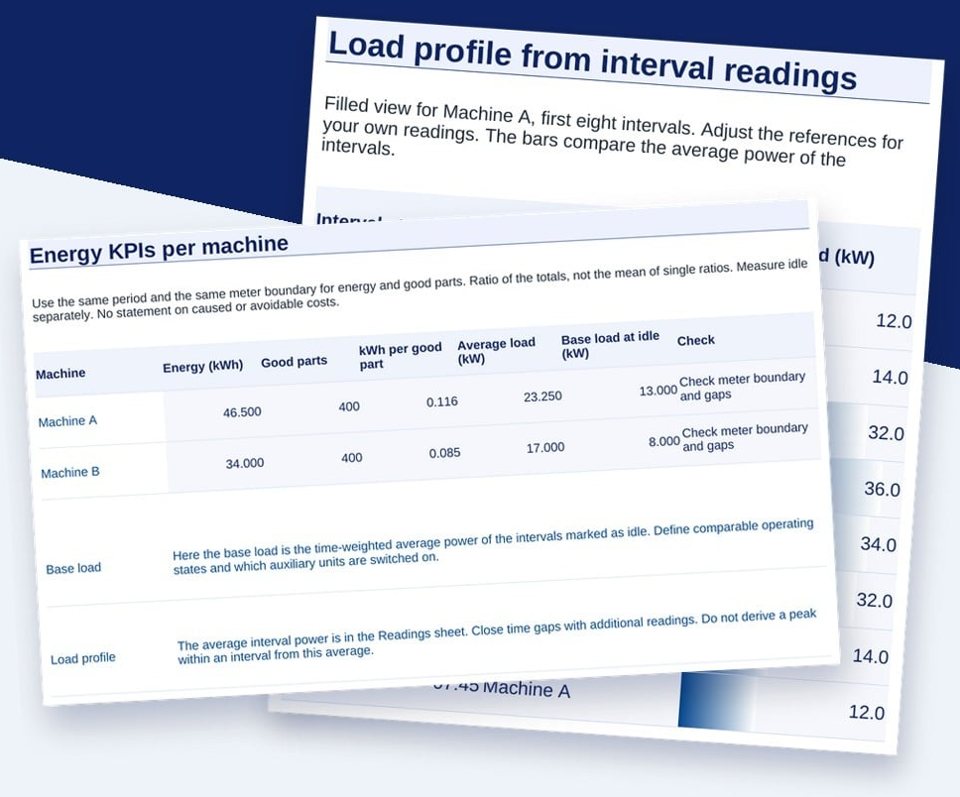
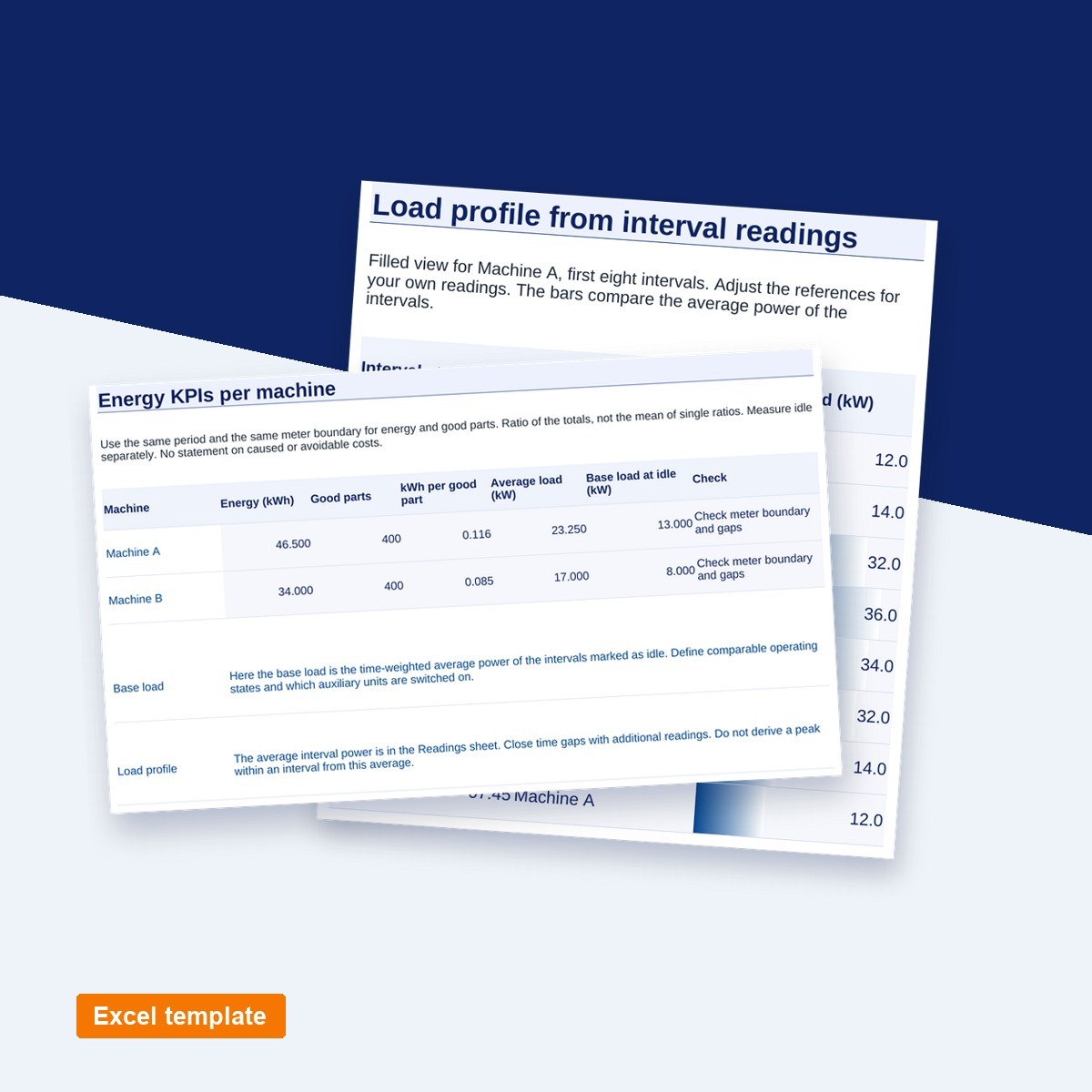
Download · Excel
Energy KPIs per Machine
Calculate kWh per good part and idle load for each machine from your own meter readings.
What is inside
Meter log with readings, time intervals and good quantity
kWh per good part and time-weighted idle base load per machine