




TEMPLATE
8D report: Word template
Use this template to work through a customer complaint or an internal deviation from D0 to D8, with short instructions in every discipline.
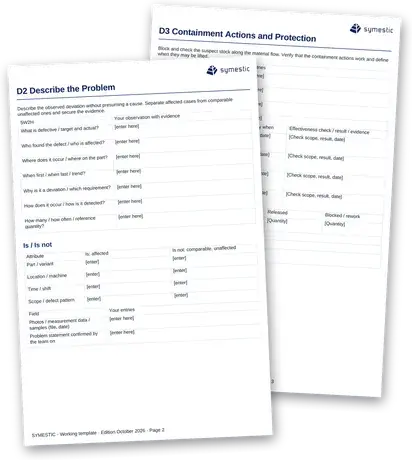
Download the template
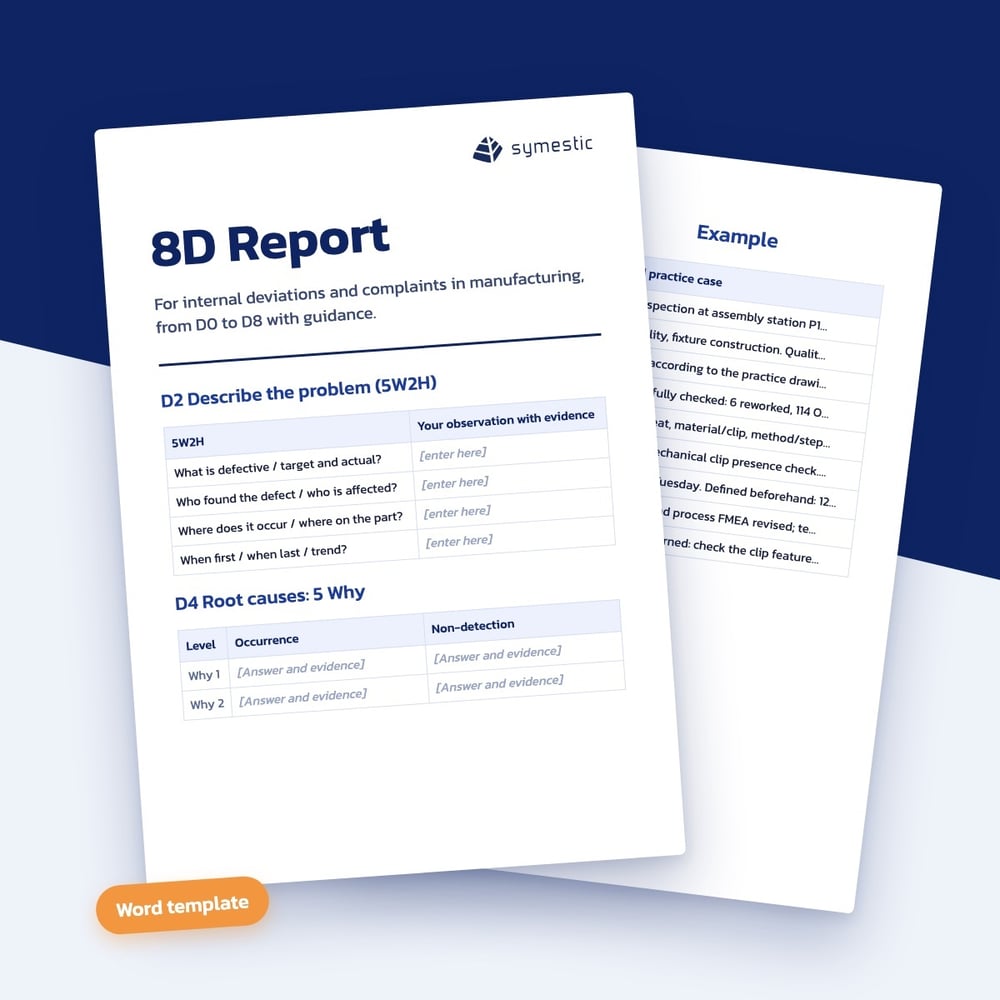
What is in the template
You define the problem, contain the affected stock, prove the root cause with 5 Why and close the report only once the corrective action has been shown to work.
- D0 to D8 with fill-in fields and short instructions for each discipline
- Problem description by 5W2H with is and is not
- Containment actions with a quantity balance and an effectiveness check
- Root causes by 6M and 5 Why, split into occurrence and non-detection
- Permanent corrective actions with success criteria, transfer to similar processes and a closure checklist
- Filled-in example from a fictional plant, Word file to edit
Who it is for
Who the 8D report template is for
The template is for quality managers and complaint handlers who need to deliver a complete 8D report to a customer. It also works for internal deviations where you want to keep containment, root cause and corrective action clearly apart.
How to work with the 8D report template
- 1
Set up the team and the problem (D1, D2)
Name the team and describe the problem by 5W2H, with what is affected and what is not.
- 2
Contain and prove the cause (D3, D4)
Block the stock with a quantity balance and trace the cause by 6M and 5 Why to occurrence and non-detection.
- 3
Correct and close (D5 to D8)
Define corrective actions with a success criterion, transfer them to similar processes and close the report with the checklist.
What makes a good 8D report
Containment and corrective action are two things
Containment in D3 protects the customer while the cause is open, for example by blocking and sorting. The corrective action in D5 and D6 removes the cause, after which containment ends.
The quantity balance makes D3 verifiable
A customer wants to know where every affected part went. The balance of stock at the customer, in the warehouse and in production answers that in one line.
D7 prevents the same defect elsewhere
In D7 you check which similar processes, products or plants share the same weakness. Only then is the problem solved for the company and not just for one complaint.
How to
How to fill in an 8D report from D0 to D8
An 8D report documents how a team solves a quality problem in eight disciplines, D1 to D8. It records the team, the problem, containment, the verified root cause, the corrective action, proof that it works, the transfer to similar processes and the closure. It is the usual answer to a customer complaint in the automotive supply chain.
D0: decide whether the problem needs a full 8D and start emergency measures. D1: name a team with process knowledge and a champion who can release resources. D2: describe the problem by 5W2H and by what is and is not affected. D3: contain, for example by blocking and sorting stock. D4: find and verify the root cause of occurrence and of non-detection. D5: choose corrective actions and prove that they work. D6: implement them and end containment. D7: prevent recurrence in similar products and processes. D8: close the report and recognize the team.
Two points decide whether a customer accepts the report. In D4, a cause counts as verified when you can switch the defect on and off with it. In D6, you need data from production after the change, for example several weeks of output without the defect. Customer supplier manuals set their own deadlines for the first response and for the complete report, so check them before you start.
Example
Example: D3 quantity balance for a burr complaint
A customer found burrs on stamped brackets from one production lot of 2,400 parts. All figures are example values.
| Location | Parts | Inspected | Rejected | Status |
|---|---|---|---|---|
| At customer | 800 | 800 | 12 | Sorted on site |
| In transit | 400 | 400 | 3 | Recalled and sorted |
| Finished goods | 900 | 900 | 9 | Blocked and sorted |
| Work in process | 300 | 300 | 2 | Sorted at the press |
| Total | 2,400 | 2,400 | 26 | Balance closed |
Every part of the lot has a location and an inspection result, so the customer sees that no affected part is unaccounted for. The 26 rejected parts also give D2 a defect rate of about 1.1 percent for this lot.
Questions and answers
Common questions about the 8D report template
What is the difference between 8D and CAPA?
CAPA, corrective and preventive action, is the process in a quality management system that handles nonconformities in general. 8D is a structured method for solving one specific problem within it. A completed 8D report can serve as the CAPA record for that problem, as long as your system links the two.
What is the escape point in D4?
The escape point is the earliest step in the process where the defect should have been detected and was not. Finding it answers why the defect reached the next process or the customer. The corrective action for the escape point improves detection, while the action for the occurrence cause removes the defect itself.
When do you need a full 8D report?
Use it for customer complaints, safety or regulatory issues, and internal defects that keep coming back. For a simple problem with an obvious cause, a 5 Whys analysis or an A3 report is faster. Some customers require an 8D for every complaint, regardless of size, so check the agreement first.
Who signs off an 8D report?
The champion named in D1 approves the closure in D8 once D6 shows that the corrective action works. For a customer complaint, the customer's quality contact accepts or rejects the report. Keep the evidence for D4 and D6 attached, because an auditor or the customer may ask for it later.
Further reading
Download the 8D report template
Fill in the short form and you receive the download right after.