



TEMPLATE
Business case template for an MES investment
Prepare an MES decision with your own loss data, costs and written criteria for the next step.
Download the templates
What is in the template
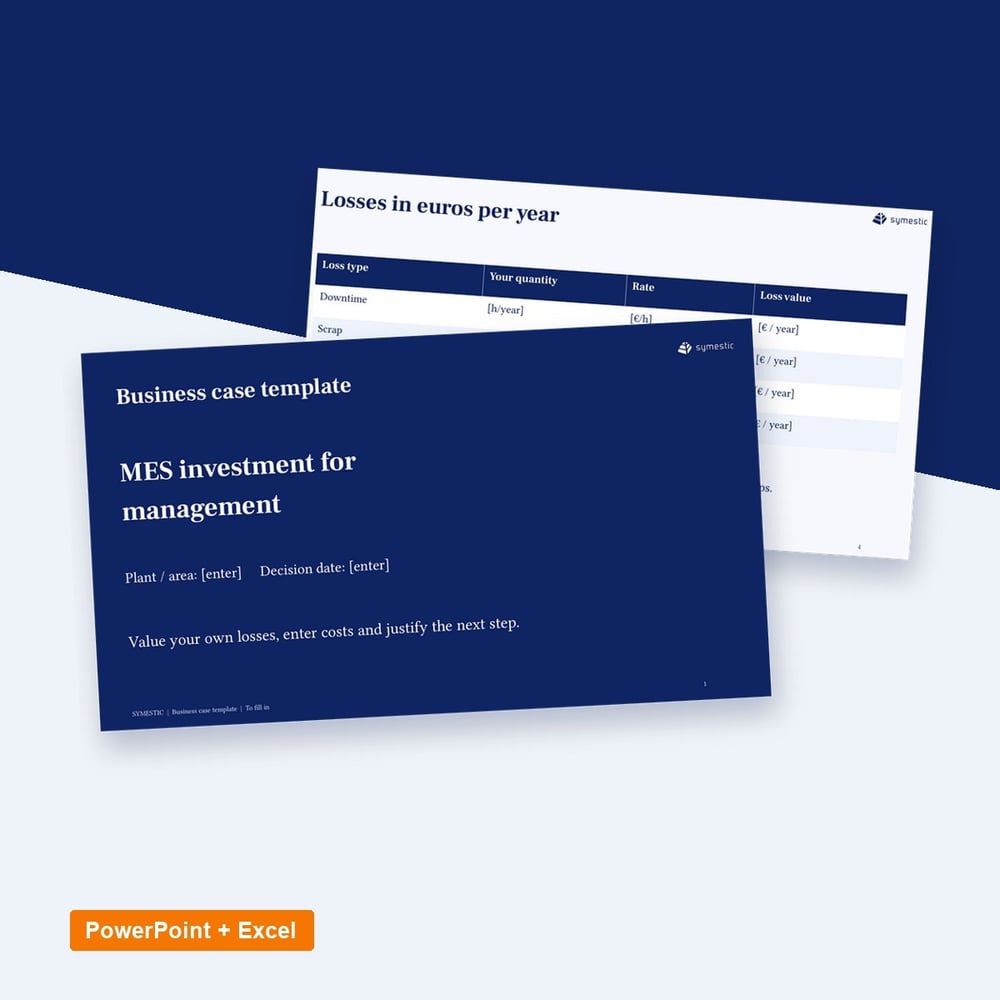
You fill in the calculation with your own data and justify your assumptions. The presentation leads from the starting point through IT review and pilot to the rollout decision. The email contains both the PowerPoint and the Excel calculator.
- Editable PowerPoint with starting point, losses in euros and decision proposal
- Excel calculator for your own assumptions and one-off and running costs
- Step-by-step rollout, comparison of alternatives and risk review
Who it is for
Who the business case template is for
The template is for production managers, plant managers and project leads who have to present an MES investment to management. It helps when losses have only been estimated so far and management expects a calculation with your own figures, the costs and a clear proposal for the next step.
How to work with the business case template
- 1
Value the losses
Enter quantities and rates for downtime, scrap, rework and manual data entry, with a source for each row.
- 2
Add the costs
Record one time and annual costs from the quote and from internal planning, including IT and training.
- 3
Prepare the decision
Transfer the results to the PowerPoint and phrase the proposed step with conditions and a date.
What makes a business case hold up
Every loss counts once
An hour of downtime valued both as cost and as additional output doubles the benefit on paper. The calculator keeps the two values apart.
Controlling confirms the rates
A rate per hour or per part that controlling stands behind convinces more in the meeting than a high value without a source.
The proposal is a pilot
Management does not have to decide on the whole plant. An approved pilot with written criteria limits budget and risk and delivers the figures for the rollout.
How to
How to build a business case for an MES
An MES business case compares the annual value of reduced losses with the one time and running costs of the system. Typical levers are unplanned downtime, scrap and rework, manual data entry and paper based reporting. Each lever is valued with your own quantities and cost rates, and the result is shown as payback period and return on investment.
Three formulas carry the calculation. Annual benefit = sum over all levers of quantity today × expected reduction × cost rate. Payback period in months = one time costs ÷ (annual benefit minus annual running costs) × 12. ROI over five years = (benefit over five years minus total cost over five years) ÷ total cost over five years.
Management reads a business case from the risk side. Show which assumptions drive most of the result and what happens when they are only half right. A case that still pays back within the agreed period at half the expected reduction is easier to approve than one that works only when every assumption reaches its best value.
Example
Example: payback for a plant with 20 machines
All rates and reductions are assumptions for illustration, not a price quote or a measured result:
| Lever | Basis today | Assumed reduction | Value per year |
|---|---|---|---|
| Unplanned downtime | 2,400 h × $90 | 15% | $32,400 |
| Scrap | $400,000 | 10% | $40,000 |
| Manual data entry | 1,500 h × $45 | 60% | $40,500 |
| Total benefit | $112,900 |
With assumed one time costs of $60,000 and running costs of $40,000 a year, the payback period is 60,000 ÷ (112,900 minus 40,000) × 12 = 9.9 months. At half the assumed reductions, the benefit falls to $56,450 and the payback period grows to 43.8 months, which is the figure management will ask about.
Questions and answers
Common questions about an MES business case
How do you calculate the ROI of an MES?
ROI = (benefit minus cost) ÷ cost over a defined period. For an MES, use three to five years, because the one time costs fall in the first year while the benefit builds up over several. Always state the period next to the figure, because an ROI over one year and one over five years describe very different things.
Which costs belong in an MES business case?
One time costs are licenses or setup fees, machine connectivity and hardware, implementation services and internal project time. Running costs are subscription or maintenance fees, hosting or IT operation, support and the internal time to maintain master data. Training belongs in both, because new staff need it every year.
How do you value savings that do not show up in productivity figures, such as less rework?
Value rework with the hours spent on it and the hourly cost of the people and machines involved. Take the hours from rework orders, time records or a short manual count over two weeks. If rework capacity is freed but nobody leaves, the value is the extra output that capacity can produce, and that is how it enters the case.
Should the business case include intangible benefits?
List them, but keep them out of the calculation. Better transparency, faster decisions or easier audits convince some decision makers, but they cannot be checked against a budget. A case that pays back on measurable levers alone is stronger, and the intangible benefits then work as a reserve.
Further reading
Download the business case template
Fill in the short form and you receive the download right after.