



MANUFACTURING KPI CATALOGUE
Manufacturing KPI catalogue: 40 KPIs with formula and worked example
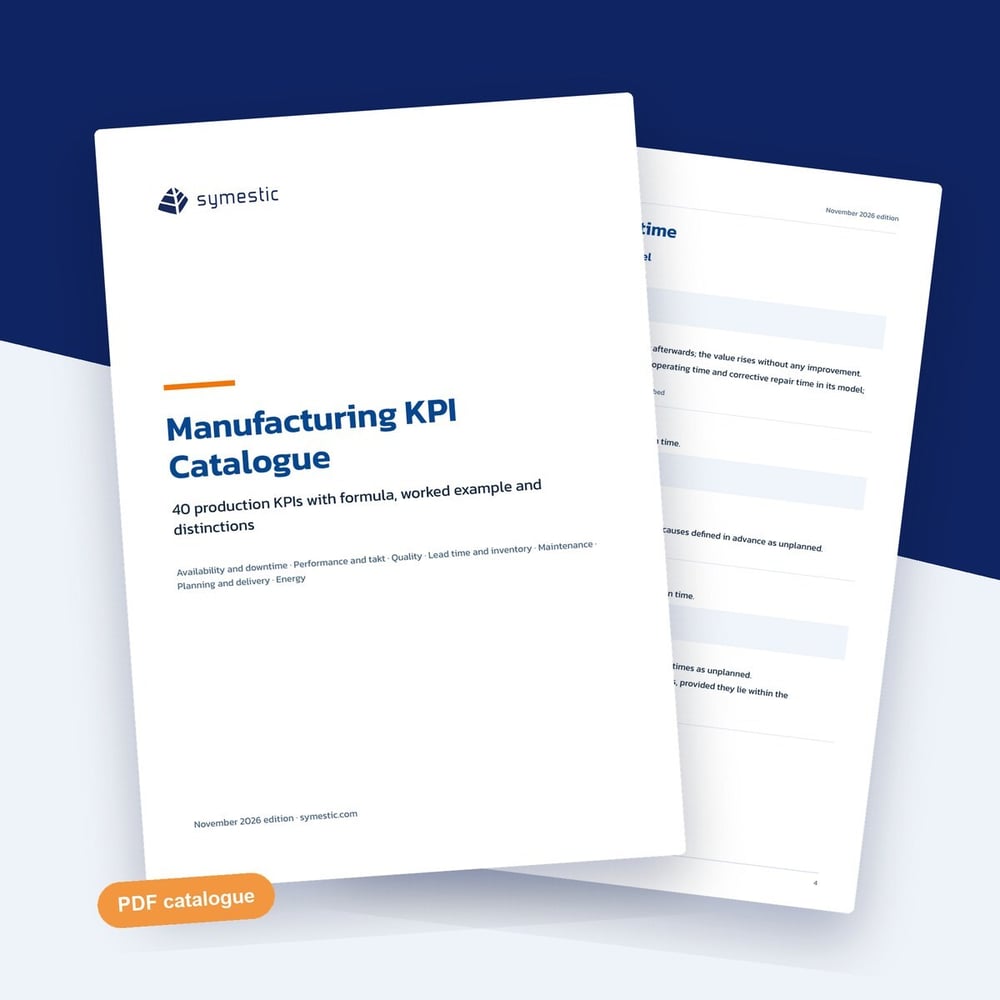
For each KPI, the catalogue gives the definition, formula, unit, a worked example, a common pitfall and how it differs from similar KPIs.
Download the catalogue
What is inside
The 40 KPIs cover availability and downtime, performance and takt, quality, lead time and inventory, maintenance, planning and delivery, and energy. Every formula names its technical source, for example NIST, ASQ or the Lean Enterprise Institute.
- 40 KPIs, including OEE, TEEP, MTBF, MTTR, FPY, Cpk, OTIF and energy per part
- A worked example, a pitfall and a distinction for every KPI
- How to choose five KPIs at your bottleneck, with a worksheet
The figures behind these KPIs come from the machine. SYMESTIC, the cloud-native MES, records quantities, scrap and downtime per machine. You see OEE, TEEP, MTBF and MTTR in dashboards and over time. In a free 30-minute live demo, you see SYMESTIC applied to your own use case.
Who it is for
Who the KPI catalogue is for
The catalogue is for production managers, OpEx teams, controllers and plant managers who want to agree on how a KPI is calculated before they compare plants, shifts or suppliers. It also helps when a new KPI is about to be introduced and its definition should hold up in the first review.
How to work with the KPI catalogue
- 1
Look up the KPI
Find the KPI you want to use and read its formula, unit and the pitfall listed with it.
- 2
Choose five KPIs
Use the worksheet to pick five KPIs that describe the situation at your bottleneck.
- 3
Write down the boundaries
Record for every KPI which machines, periods and quantities it includes, so every shift calculates it the same way.
What makes a KPI comparable
The definition matters more than the formula
Two plants can use the same OEE formula and still get different values when one counts planned maintenance as downtime and the other does not. A written boundary makes the figures comparable.
Five KPIs at the bottleneck beat forty everywhere
The bottleneck sets the output of the plant. A few KPIs there show where improvement pays off, while a long list spreads attention.
Similar KPIs answer different questions
OEE describes the planned production time, TEEP the full calendar time. Choosing the wrong one leads to the wrong decision about extra shifts or new machines.
How to
The main manufacturing KPIs and their formulas
Most manufacturing KPIs fall into five groups: equipment (OEE, availability, MTBF, MTTR), quality (first pass yield, scrap rate, PPM), delivery (on time in full, schedule adherence), flow (lead time, inventory turns) and cost (cost per unit, energy per unit). A useful set takes one or two KPIs from each group that the team can influence.
Formulas for six common KPIs: OEE = availability × performance × quality. MTBF = operating time ÷ number of failures. MTTR = total repair time ÷ number of repairs. First pass yield = parts good without rework ÷ parts started. OTIF = orders delivered on time and in full ÷ all orders delivered. Schedule adherence = orders completed in the planned period ÷ orders planned for that period.
Assign each KPI to the level that acts on it. The shift needs figures it can change within hours, such as output against plan, downtime minutes and scrap. The plant manager needs trends and the link to cost, such as OEE per week, OTIF and cost per unit. A KPI that nobody at a level can influence belongs in another level's review.
Example
Example: one month on a bottleneck machine
Sample values for five KPIs on one machine over one month:
| KPI | Calculation | Result |
|---|---|---|
| OEE | Availability × Performance × Quality | 71% |
| MTBF | 570 h ÷ 15 failures | 38 h |
| MTTR | 780 min ÷ 15 repairs | 52 min |
| First pass yield | 9,620 ÷ 10,000 parts | 96.2% |
| Schedule adherence | 44 ÷ 50 orders | 88% |
The 15 repairs cost 13 hours of the month. Halving the number of failures or halving the repair time would each save about 6.5 hours, so maintenance chooses the route that is cheaper to achieve on this machine.
Questions and answers
Common questions about manufacturing KPIs
What are the most common KPIs in manufacturing?
OEE, first pass yield, scrap rate, on time delivery, cycle time, MTBF, MTTR and cost per unit appear in most manufacturing KPI sets. Which matter most depends on what limits the plant: a capacity bottleneck calls for OEE and downtime, a quality problem for first pass yield and PPM, a delivery problem for schedule adherence and lead time.
What is the difference between a KPI and a metric?
Every KPI is a metric, but only some metrics are KPIs. A metric measures something, such as the number of changeovers. A KPI is a metric tied to a target and a decision, such as changeover time on the bottleneck against a target of 20 minutes. A figure without a target that nobody acts on stays a metric.
What is the difference between leading and lagging KPIs?
Lagging KPIs show results after the fact, such as OEE, scrap rate or OTIF. Leading KPIs show early signs that predict those results, such as completed preventive maintenance orders, open quality actions or material shortages for the next day. A balanced set has both, so the team can act before the monthly result is fixed.
What is OTIF?
On time in full is the share of orders delivered on the agreed date and in the full quantity: OTIF = orders on time and complete ÷ all orders delivered × 100. An order that arrives on time but short counts as missed. Agree with the customer whether on time refers to the day of shipment or the day of arrival.
Is there a standard for manufacturing KPIs?
Yes. ISO 22400 defines key performance indicators for manufacturing operations management, including OEE, availability, quality ratios and maintenance figures, with their formulas and time elements. Industry associations publish further guides. These definitions are a good starting point when two plants or a plant and a supplier need to agree on how a KPI is calculated.
Download the KPI catalogue
Fill in the short form and you receive the download right after.