



MES REQUIREMENTS SPECIFICATION
MES requirements specification: template with vendor evaluation matrix
Write down what your plant needs from an MES, send the same document to every vendor and compare the answers on one scale.
Download the template
What is inside
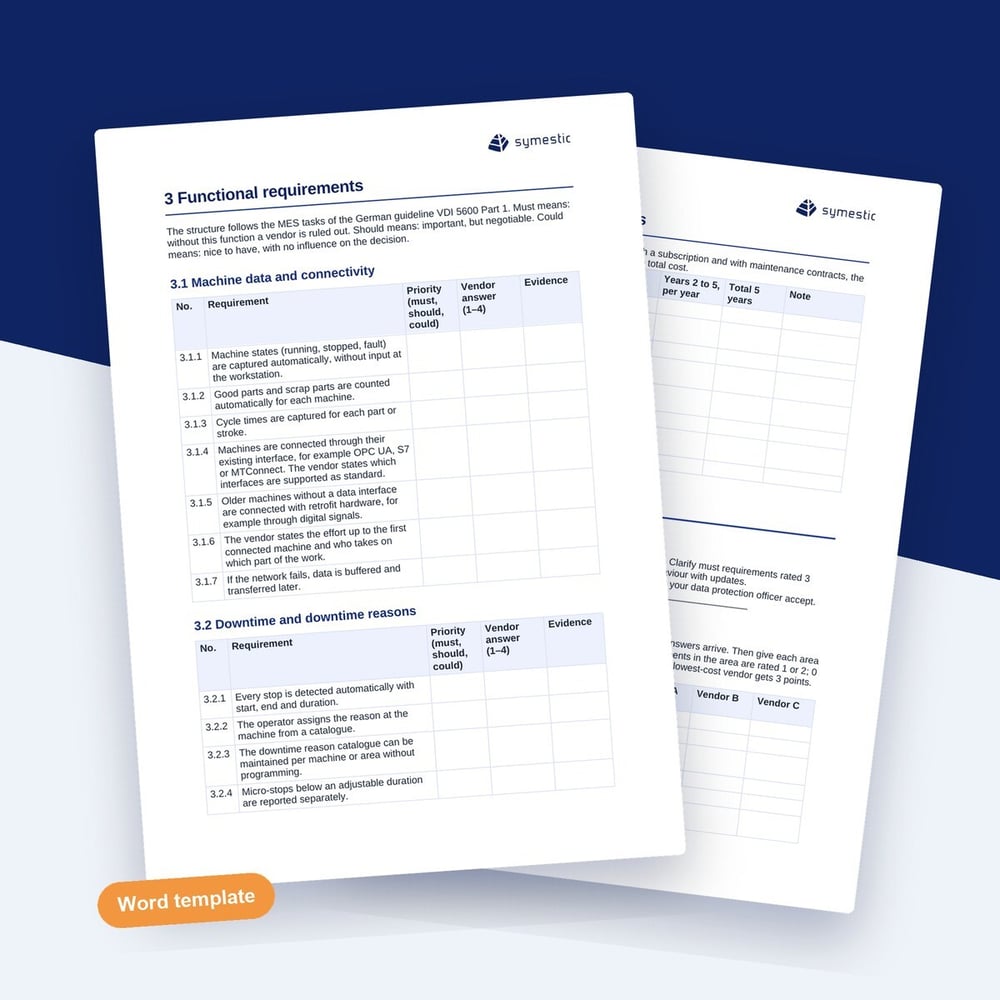
The Word template takes you through current situation and goals, scope, functional requirements in ten areas based on VDI 5600, operation and security, costs over five years and the vendor evaluation.
- Requirement tables with must, should and could, ready to send to vendors
- Ten functional areas, from machine data and downtime to quality, personnel and energy
- A five-year cost table, exclusion criteria and a weighted evaluation matrix for three vendors
You can check your must requirements on a running system. In a free 30-minute live demo, you see SYMESTIC, the cloud-native MES, applied to your own use case. The pricing page shows the plans you need for section 5 of the template.
Who it is for
Who the requirements specification template is for
The template is for production managers, IT managers and project leads who are selecting an MES and want every vendor to answer the same questions. It helps when the requirements are spread across emails and meeting notes and a fair comparison between vendors is not yet possible.
How to work with the requirements specification template
- 1
Describe the starting point
Fill in the current situation, the goals and the scope, including the machines and plants involved.
- 2
Rate the requirements
Go through the ten functional areas and mark each requirement as must, should or could.
- 3
Compare the vendors
Send the same document to three to five vendors and rate their answers in the weighted matrix, including costs over five years.
What makes a requirements specification useful
Few musts lead to a clear choice
When everything is a must, every vendor fails somewhere and the matrix decides nothing. Reserve must for requirements without which the project fails.
Requirements describe the need
A requirement like daily OEE per machine leaves room for good solutions. A prescribed screen or table layout excludes vendors who solve the task in another way.
Costs need the full term
License, hardware, rollout and internal effort over five years make offers comparable. A first year price alone favors offers with high follow up costs.
How to
How to write an MES requirements specification
An MES requirements specification describes what the system must do in your plant, from the users' point of view and independent of any vendor. It covers starting point and goals, scope, functional requirements by area, non functional requirements such as IT security and availability, interfaces, and the criteria for comparing offers.
Write each requirement as one testable statement with an ID, a priority and the reason behind it. "The status of every connected machine is visible within 60 seconds" can be checked in a demo, while "real time machine status" cannot. Group the requirements by area, for example machine data, downtime, quality, orders, personnel, energy and interfaces, so that every vendor answers in the same structure.
Use the specification in three stages. A short request for information to five to eight vendors shows who fits at all. The full specification goes out as a request for proposal to three to five vendors with a fixed answer format. A demo with your own data, or a pilot, follows for the two vendors at the top of the matrix. Each stage narrows the field, so your team spends evaluation time where it pays off.
Example
Example: four requirements with priority and test
Sample entries from the functional requirements of a plant with 40 machines:
| ID | Requirement | Priority | How it is checked |
|---|---|---|---|
| MD-01 | Status of every connected machine visible within 60 s | must | Live demo on a test machine |
| DT-04 | Operator enters a downtime reason at the machine in two taps | should | Demo with an operator |
| IF-02 | Completed quantities reported to the ERP per order | must | Interface description, reference |
| EN-03 | Energy use per order | could | Demo with sample data |
Each row can be confirmed or refuted in a demo or a document. The two must criteria decide which vendors stay in the race, and the should and could criteria separate the remaining offers in the weighted matrix.
Questions and answers
Common questions about MES requirements specifications
What is the difference between a requirements specification and a functional specification?
The requirements specification describes what the plant needs and is written by the customer. The functional specification describes how the chosen vendor meets those requirements and is written by the vendor after selection. In German practice, these are the Lastenheft and the Pflichtenheft, as described in the guideline VDI 2519.
What is a URS for an MES?
URS stands for user requirements specification. In regulated industries such as pharma, the URS is also the basis for validation: each requirement is later traced to a test during qualification. Outside regulated industries, the term is used for the same document as a requirements specification.
What is VDI 5600?
VDI 5600 is the guideline of the Association of German Engineers on manufacturing execution systems. Part 1 describes the tasks of an MES, among them order management, detailed scheduling, resource and material management, personnel management, data acquisition, performance analysis, quality, information and energy management. Many requirements specifications use these tasks as their structure.
How detailed should the requirements be?
Detailed enough that each requirement could change the choice of vendor. Requirements every vendor meets anyway, such as user login, fit into one summary line. Requirements for later project phases go into a separate list, so they do not dominate the evaluation of what you need in the first rollout.
Who should write the requirements specification?
A small core team from production, IT and quality, led by one project owner. Production describes the processes, IT the interfaces and security requirements, quality the inspection and traceability needs. Involve shift supervisors and operators for the requirements they will use every day, because they spot workflows that will not work on the floor.
Further reading
Download the requirements specification template
Fill in the short form and you receive the download right after.