




TEMPLATE
PPAP checklist for Excel
Track the evidence for every part in one place and keep open points visible until the customer decides.
Download the template
What is in the template
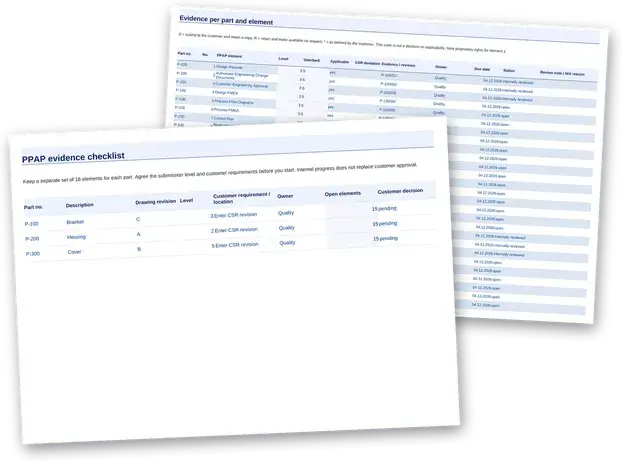
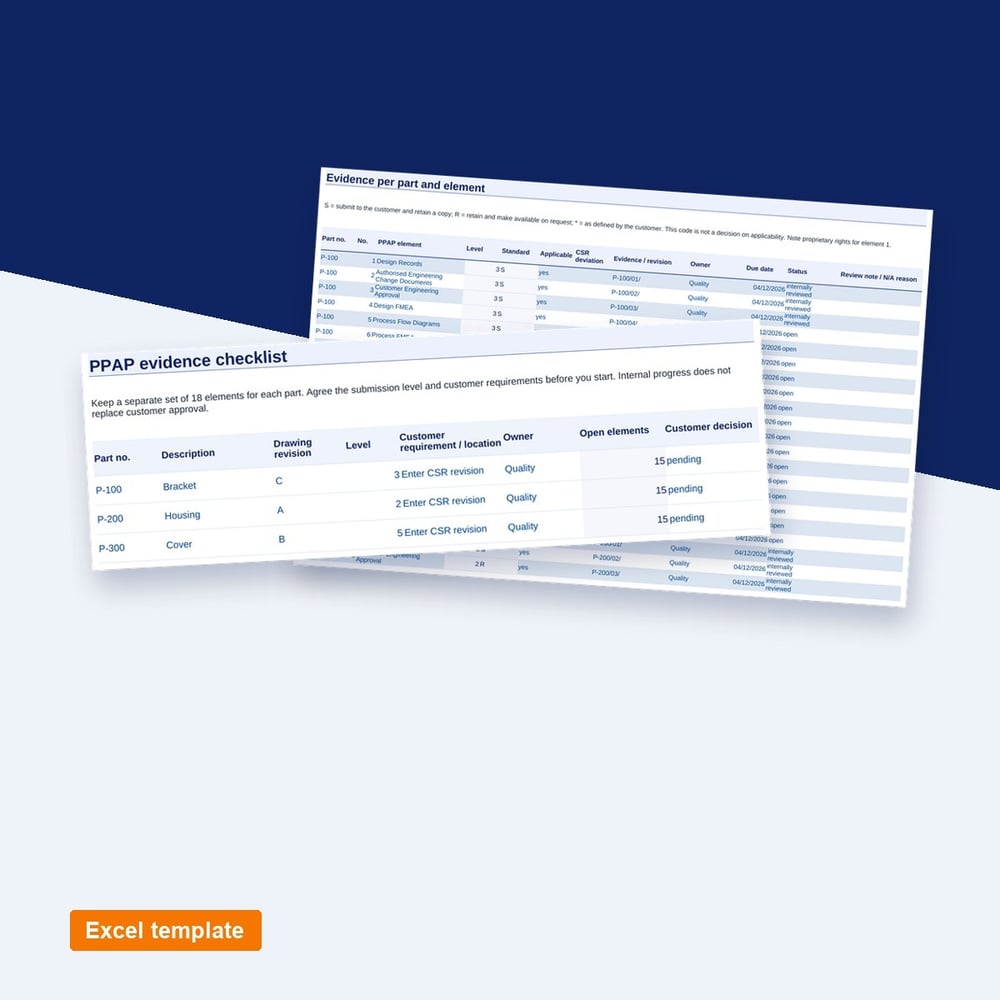
You enter part number, drawing revision and submission level. Each part has 18 rows for evidence. The checklist separates internally checked documents from customer approval.
- 18 PPAP elements with applicability, filing location and status per part
- Submission levels 1 to 5 with notes on submission and retention
- Part overview with open elements and a separate customer decision
Who it is for
Who the PPAP checklist is for
The checklist is for supplier quality engineers and quality managers at automotive suppliers who prepare PPAP submissions for several parts at once. It helps to track the status of every element up to the customer decision when documents come from design, production, lab and metrology.
How to work with the PPAP checklist
- 1
Set up the parts
Enter part number, drawing revision and submission level. Each part gets 18 element rows.
- 2
Check what applies
Decide for each element whether it applies and give a reason for every not applicable in the review note.
- 3
Track the evidence
Record location, owner, due date and status, and enter the customer decision separately.
What to watch with a PPAP submission
The warrant belongs to every level
The Part Submission Warrant, element 18, is submitted at every level. With it, the supplier confirms that the parts come from the series process and meet the requirements.
Reviewed internally is not yet approved
An element your quality team has reviewed is not yet a customer approval. The checklist keeps both apart so no part counts as approved by mistake.
PPAP builds on APQP
Process FMEA, control plan and measurement system analysis come out of product development. Keeping them current there means you only have to collect them for the submission.
How to
The 18 PPAP elements and how to prepare them
A PPAP checklist lists the 18 elements of the Production Part Approval Process from the AIAG PPAP manual, 4th edition. For each part, it records whether an element applies, where the evidence is filed, who owns it and its status. Level 3 is the default submission level and covers the warrant, product samples and complete supporting data.
The 18 elements are design records, authorized engineering change documents, customer engineering approval, design FMEA, process flow diagram, process FMEA, control plan, measurement system analysis, dimensional results, material and performance test results, initial process studies, qualified laboratory documentation, appearance approval report, sample production parts, master sample, checking aids, customer specific requirements and the Part Submission Warrant.
Prepare the evidence from a significant production run, not from prototypes. The AIAG manual describes this run as one to eight hours of production with at least 300 consecutive parts, unless the customer specifies otherwise. Dimensional results, test results and initial process studies come from parts of this run, made with production tooling, gauges, material and operators at the production site.
Example
Example: status of one part before a level 3 submission
A supplier without design responsibility prepares the submission for a machined steel bracket. Sample status two weeks before the due date:
| Element | Applies | Status |
|---|---|---|
| 1 Design records | yes | checked |
| 4 Design FMEA | no, not design responsible | reason recorded |
| 8 Measurement system analysis | yes | open, gauge study running |
| 11 Initial process studies | yes | checked, Ppk 1.82 |
| 13 Appearance approval report | no, no appearance item | reason recorded |
| 18 Part Submission Warrant | yes | open, waits for element 8 |
Two elements do not apply, and the recorded reason answers the question before the customer asks it. The warrant waits for the measurement system analysis, which makes element 8 the critical path of this submission.
Questions and answers
Common questions about PPAP
What is PPAP level 3?
At level 3, the supplier submits the Part Submission Warrant with product samples and complete supporting data. It is the default when the customer names no level. Level 1 is the warrant only, level 2 adds samples and limited data, level 4 is the warrant plus requirements the customer defines, and at level 5 everything is reviewed at the supplier site.
When is a PPAP submission required?
For a new part, after an engineering change to a part, and after changes to the process, such as new or moved tooling, a new production site, a new subsupplier or material, or tooling that was inactive for twelve months or more. Some changes only need a notification. The customer specific requirements decide which.
What Ppk value does PPAP require?
The AIAG manual accepts initial process studies with a Ppk greater than 1.67 for a stable process. Values from 1.33 to 1.67 may be acceptable after agreement with the customer. Below 1.33, the customer has to be contacted and a corrective action plan is needed. Customer specific requirements can set other limits.
Can PPAP be managed in Excel?
Yes, for a manageable number of parts. A spreadsheet with one row per part and element keeps status, owner and due date visible. It gets hard to keep current when many parts change at once or several plants submit, because each copy of the file develops its own status. The documents themselves stay in your document management system.
What decisions can the customer make on a PPAP?
Full approval, interim approval or rejection. Only full approval releases the part for series shipment without restrictions. Interim approval allows limited shipment for a set time or quantity while open points are closed. Record the decision with its date, because an interim approval expires and needs a new submission.
Download the PPAP checklist
Fill in the short form and you receive the download right after.