



TEMPLATE
Machine hourly rate calculation in Excel
Calculate the cost per machine hour from your annual costs and productive running time.
Download the template
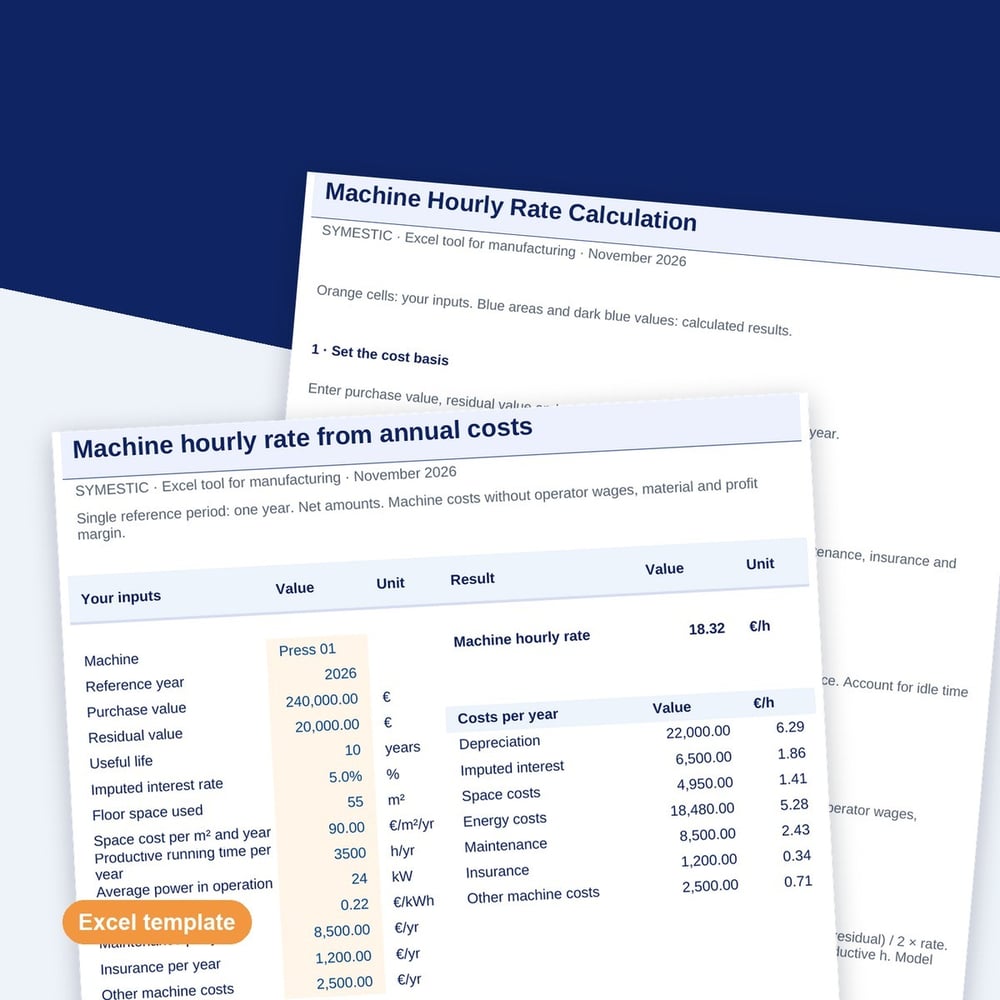
What is in the template
The calculation covers machine costs. Add operator wages, material and profit margins in your quotation costing.
- Depreciation, imputed interest and floor space costs
- Energy, maintenance and other machine costs
- Cost shares per hour with the calculation shown
Who it is for
Who the machine hourly rate template is for
The template is for controllers, cost estimators and production managers who need a traceable cost rate per machine hour for quotes, make or buy decisions or investment comparisons. It suits a single machine and the comparison of an old machine with its successor.
How to work with the machine hourly rate template
- 1
Set the cost basis
Enter acquisition value, residual value and useful life and record the reference year.
- 2
Add the annual costs
Add interest rate, floor space, maintenance, insurance and other machine costs per year.
- 3
Enter runtime and energy
Enter productive hours, average power in operation and electricity price, and read the rate per hour.
What drives the machine hourly rate
Runtime weighs more than cost
All annual costs are divided by the productive hours. When a machine runs fewer hours than planned, the rate rises although no cost was added.
Planned and measured hours differ
Many calculations use shift time minus a flat allowance. Measured runtimes show how many hours the machine actually produced.
Imputed depreciation follows its own rules
It spreads acquisition value minus residual value evenly over the useful life. It can differ from tax depreciation and still belongs in the rate.
How to
How to calculate the machine hour rate
The machine hour rate is the cost of running a machine for one productive hour. Machine hour rate = annual machine costs ÷ productive hours per year. Annual machine costs include depreciation, imputed interest, floor space, energy, maintenance and other costs that the machine itself causes.
The fixed costs are calculated per year. Depreciation = (acquisition value minus residual value) ÷ useful life in years. Imputed interest = (acquisition value + residual value) ÷ 2 × interest rate, because on average half of the capital is tied up. Floor space = square feet × cost per square foot and year. Energy is variable: average power in kW × productive hours × price per kWh.
Split the rate into a fixed and a variable part. The fixed part per hour falls when the machine runs more hours, while the variable part for energy and wear stays the same per hour. The split matters for decisions about extra shifts: once the fixed costs are covered, an additional shift only has to earn its variable costs to add margin.
Example
Example: machine hour rate for a machining center
Sample values for a machining center bought for $400,000, with $40,000 residual value after 10 years and 3,000 productive hours a year:
| Cost item | Calculation | Per year |
|---|---|---|
| Depreciation | (400,000 minus 40,000) ÷ 10 | $36,000 |
| Imputed interest | (400,000 + 40,000) ÷ 2 × 6% | $13,200 |
| Floor space | 400 sq ft × $15 | $6,000 |
| Energy | 15 kW × 3,000 h × $0.12 | $5,400 |
| Maintenance and other | estimate | $9,000 |
| Total | sum | $69,600 |
The machine hour rate is 69,600 ÷ 3,000 h = $23.20, of which $1.80 is energy and $21.40 fixed costs. Depreciation and interest alone make up more than two thirds of the rate.
Questions and answers
Common questions about the machine hour rate
What is the difference between the machine hour rate and the shop rate?
The machine hour rate covers only the costs of the machine. A shop rate, or burden rate, usually adds the operator's wage and a share of overhead such as supervision, building and administration. Quotes often use the shop rate, while make or buy and investment decisions need the machine hour rate on its own.
How do you calculate the cost of equipment per hour?
Divide all annual costs of owning and running the equipment by the hours it is used per year. Owning costs are depreciation, interest, insurance and floor space. Running costs are energy, maintenance, tooling and consumables. For rented equipment, the rent replaces depreciation and interest.
Should depreciation be based on acquisition cost or replacement cost?
For pricing, many cost accountants use replacement cost, because the rate should finance the next machine. For comparison with the financial statements, acquisition cost is easier to reconcile. State which basis you use, because when machine prices rise, the replacement value can be noticeably higher.
Which interest rate should be used for imputed interest?
Use the rate your controlling sets for capital tied up in assets, often the company's weighted average cost of capital or a fixed internal rate. Apply the same rate to all machines, so that the rates stay comparable across the plant.
How often should the machine hour rate be updated?
Once a year with the budget, and whenever a major input changes, such as the electricity price, the shift model or a large repair. A rate that is several years old often rests on a utilization and an energy price the machine no longer has.
Further reading
Download the machine hourly rate template
Fill in the short form and you receive the download right after.