



TEMPLATE
SMED analysis: Excel template
Use this template to break a changeover down into steps and see which ones actually stop the machine.
Download the template
What is in the template
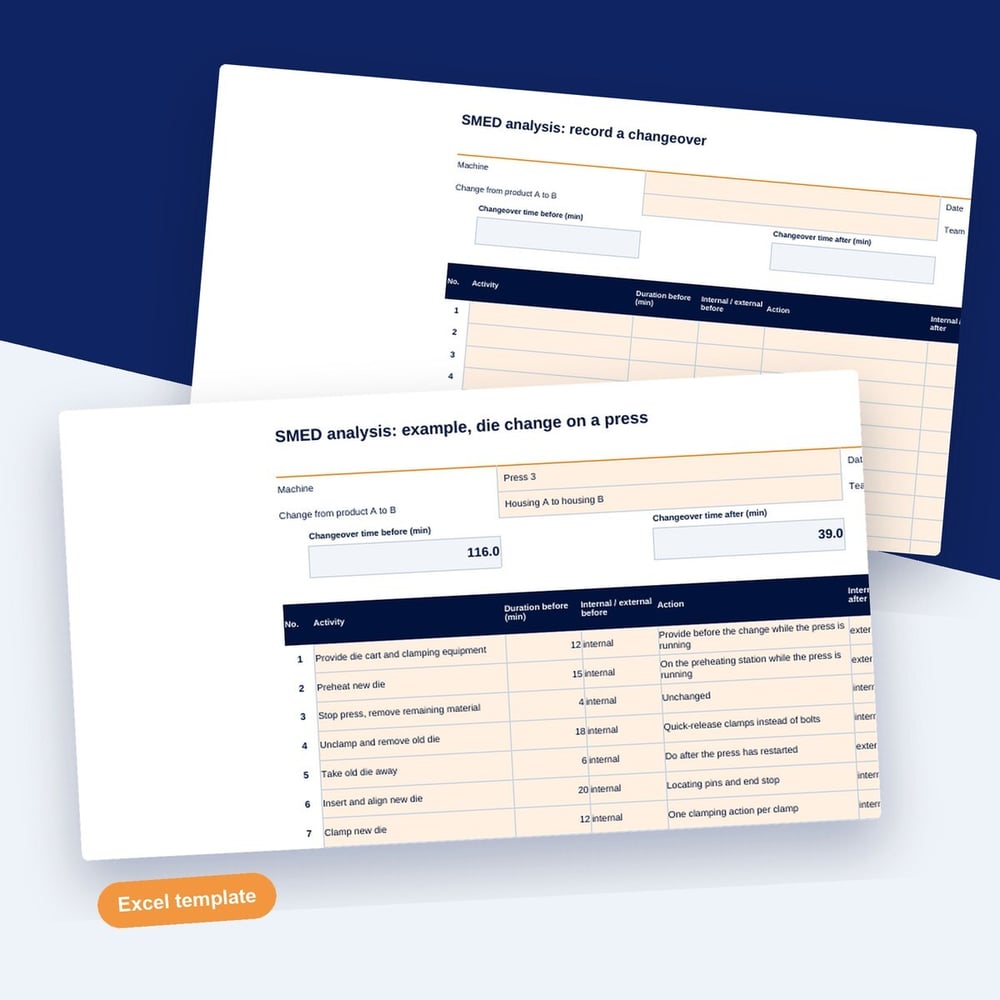
Excel adds up the internal steps to the changeover time, compares before and after, and projects the saving over a year. The example shows a die change on a press.
- Recording of every changeover step with duration and owner
- Classification as internal or external, plus the action for each step
- Time before and after, with the saving per changeover and per year by formula
- Filled-in example of a die change on a press
SYMESTIC, the cloud-native MES, measures how long each changeover takes in daily production: when the product changes, it can create the changeover stop automatically, and the changeover matrix shows which product change takes longest. In a free 30-minute live demo, we show you SYMESTIC on your own use case.
Who it is for
Who the SMED analysis template is for
The template is for production engineers, setters and lean teams who want to shorten changeovers on a machine and show the effect in hours per year. It suits a first SMED workshop on the machine with the most frequent or the longest changeovers.
How to work with the SMED analysis template
- 1
Record the changeover
Observe or film a real changeover and enter each step with its duration and owner.
- 2
Separate the steps
Classify each step as internal, with the machine stopped, or external, with the machine running, and note the action.
- 3
Project the saving
Enter changeovers per week and working weeks and read the saving per changeover and per year.
What matters in a SMED analysis
A video shows what an observer misses
Searching for tools, walking and waiting for the crane are easy to overlook. A recording lets the team go through every step together afterwards.
External steps come first
Moving preparation, tool supply and preheating out of the stop is often possible without investment. Only then does it pay to shorten the internal steps themselves.
The changeover ends with the first good part
Adjusting and test parts belong to the changeover. Measuring only until the machine restarts makes the changeover look shorter than it is.
How to
How to run a SMED analysis step by step
A SMED analysis shortens a changeover in four steps: record every step of a real changeover with its duration, classify each step as internal or external, move internal steps outside the machine stop, then shorten the steps that remain. The method goes back to Shigeo Shingo. SMED stands for Single-Minute Exchange of Die, a changeover in under ten minutes.
For the steps that have to stay internal, look at fasteners, adjustment and people. Quick clamps or quarter turn fasteners replace bolts that need many turns. Locating pins and standard heights replace trial and error when the new die is set. Two people working in parallel on both sides of the machine cut walking time, provided the sequence is written down and each person knows their part.
Value the result with one formula: saving per year = (changeover time before minus changeover time after) × changeovers per week × working weeks. Then write the new sequence down as a standard, with a checklist of what must be ready before the stop and a target time. Measure the next changeovers against that target. Without a written standard, the time creeps back as soon as a different setter does the job.
Example
Example: die change on a press
A press changes dies eight times a week. The sample values below come from one recorded changeover before and one after the workshop.
| Step | Before (min) | Action | After (min) |
|---|---|---|---|
| Fetch next die from storage | 8 | Stage die before the stop | 0 |
| Remove old die | 10 | Quick clamps | 6 |
| Search for clamps and tools | 6 | Prepared tool cart | 0 |
| Set and clamp new die | 14 | Locating pins, standard height | 9 |
| Adjust until first good part | 18 | Settings sheet per die | 12 |
| Internal time in total | 56 | Saving 29 min | 27 |
The saving is 29 minutes per changeover. With 8 changeovers a week and 46 working weeks, that is 368 changeovers and about 178 machine hours a year (sample values). Two of the five steps disappear from the stop entirely.
Questions and answers
Common questions about SMED
What is the difference between SMED and quick changeover?
Quick changeover is the general term for reducing changeover time. SMED is the structured method behind it, with the separation of internal and external steps at its core. Many plants use both terms for the same workshop, and the template works for either.
Which machine should you start with?
Start with the bottleneck or with the machine that changes over most often. On the bottleneck, every saved minute adds output to the whole plant. On a machine that is not a bottleneck, the saved time only pays off when you use it for smaller batches.
What do you do with the time saved?
You have two options. Use it for more output when the machine is short of capacity, or run more changeovers with smaller batches. Smaller batches reduce stock and let you react faster to orders. Decide this before the workshop, because it changes how you value the result.
How does SMED affect OEE?
Changeovers count as availability losses in OEE. Shorter changeovers raise availability when the number of changeovers stays the same. When you use the time for more changeovers, availability may stay flat while stock and lead time go down, so track both figures.
Who should take part in a SMED workshop?
The setters who do the changeover every day, a production engineer, someone from maintenance and, for die or mold changes, the toolroom. The setters know where the time goes, and the others can approve technical changes such as new clamps. Keep the group small enough to stand around the machine.
Further reading
Download the SMED analysis template
Fill in the short form and you receive the download right after.