List your setup activities, classify each one as internal or external, and instantly see how much downtime you can eliminate with SMED — a fast setup time calculator built on the SMED method.
80 min of internal downtime, broken down by measure.
Annual projection
h
production hours gained
capacity recovered
Recommended levers
Related calculators: OEE calculator (availability loss) · Downtime cost calculator
Get your results as a PDF
Your inputs, results and rating on one page, plus a print view and a link to your results. Free.
Enter your values and your report will be ready.
In 5 steps
1
List the setup steps
Enter every activity of a typical changeover along with its duration — from preparation to the first good part.
2
Internal or external?
Decide for each step: does the machine have to be stopped (internal), or can it be done while production keeps running (external)?
3
Mark convertible steps
Flag internal steps that, with a little preparation, can be shifted to external — they then drop out of the downtime.
4
Streamline the remaining internal time
For each remaining internal step, estimate how much you can save through standardization, quick-clamp tooling or fixed presets.
5
Project it across the year
Add your changeovers per year and the value per production hour to see the recovered capacity in hours and euros.
The SMED method
SMED brings every changeover down to a single-digit number of minutes. Shigeo Shingo structured the approach into three stages:
Stage 1
Separate
Cleanly distinguish internal and external setup.
Stage 2
Convert
Shift internal activities to external wherever possible.
Stage 3
Streamline
Standardize and speed up every remaining activity.
Before all of this comes Stage 0: observe the current changeover closely and document every step.
WORKED EXAMPLE
Setup time reduction example: an injection mold change
A molding shop changes molds on one press about 300 times a year. The team timed one changeover from last good part to first good part and listed six steps. One production hour on this press is valued at €180, entered in the calculator's euro field.
Inputs
Bring next mold, hoses and clamps; preheat mold
25 min, internal, marked convertible
Disconnect water lines, unclamp and remove old mold
15 min, internal, streamline 40%
Hang, align and clamp new mold
20 min, internal, streamline 50%
Connect water lines, load process settings
10 min, internal, streamline 30%
Adjust and shoot until the first good part
25 min, internal, streamline 20%
Clean old mold and return it to storage
15 min, external
Changeovers per year
300
Value per production hour
€180
Current downtime25 + 15 + 20 + 10 + 25 min (external 15 min not counted)95 min
ConvertStaging and preheating move outside the stop−25 min
Annual projection49 min × 300 ÷ 60; 245 h × €180245 h, €44,100
Result: Downtime per changeover drops from 95 to 46 minutes, a 51.6% reduction. Over 300 changeovers that frees 245 production hours, worth about €44,100 at €180 per hour.
Reading the result
46 minutes is still far from the single-digit SMED target, and the calculator flags that. The largest remaining block is the 20 minutes of adjusting and test shots. Repeatable mold locating and stored process settings address that block directly. The €44,100 turns into money only if the freed hours carry orders or replace overtime.
Common mistakes
Leaving test shots out of internal time. Setup runs until the first good part, and adjusting needs the machine, so it counts as internal.
Working from remembered durations. Time or film a real changeover before you enter values, or the baseline is guesswork.
Frequently asked questions about setup time & SMED
The key terms and methods around setup time reduction — briefly explained.
SMED stands for “Single-Minute Exchange of Die” and was developed by the Japanese engineer Shigeo Shingo at Toyota. The goal is to bring every changeover down to a single-digit number of minutes (under 10 minutes). “Single minute” therefore does not mean one minute, but a single-digit setup time.
Internal activities can only be performed while the machine is stopped — for example removing and installing a tool. External activities can be done while the machine is still producing — for example staging material and tooling. Only internal activities create machine downtime.
The downtime per changeover is the sum of all internal activities — external ones do not count, because the machine keeps running. Mark internal steps as “convertible” and they are shifted to external setup; use the slider to streamline the remaining internal time. This gives you the optimized setup time.
It depends on your starting point. Cleanly separating internal and external setup and pulling preparatory activities forward alone often delivers a 30–50% reduction with no investment. With consistent converting and streamlining, many plants achieve reductions of up to 90%.
Shorter setup times reduce downtime losses and increase availability — and therefore OEE. Above all, they enable smaller lot sizes: fast changeovers let you switch more often, hold less inventory and respond more flexibly to demand.
Classically in three stages per Shingo: (1) separate internal and external setup, (2) convert internal setup into external, (3) streamline and standardize all setup activities. This is preceded by carefully observing and documenting the current state.
No. SMED originated with tool changes on presses, but it can be applied to any changeover or format change — from injection-molding and packaging machines through CNC machining to filling and assembly lines.
Setup time is an availability loss and feeds directly into the availability factor of OEE. Every setup minute saved increases productive time and therefore OEE — especially with frequent product changeovers.
The print view is available after the free unlock at:https://www.symestic.com/en-us/tools/setup-time-calculator
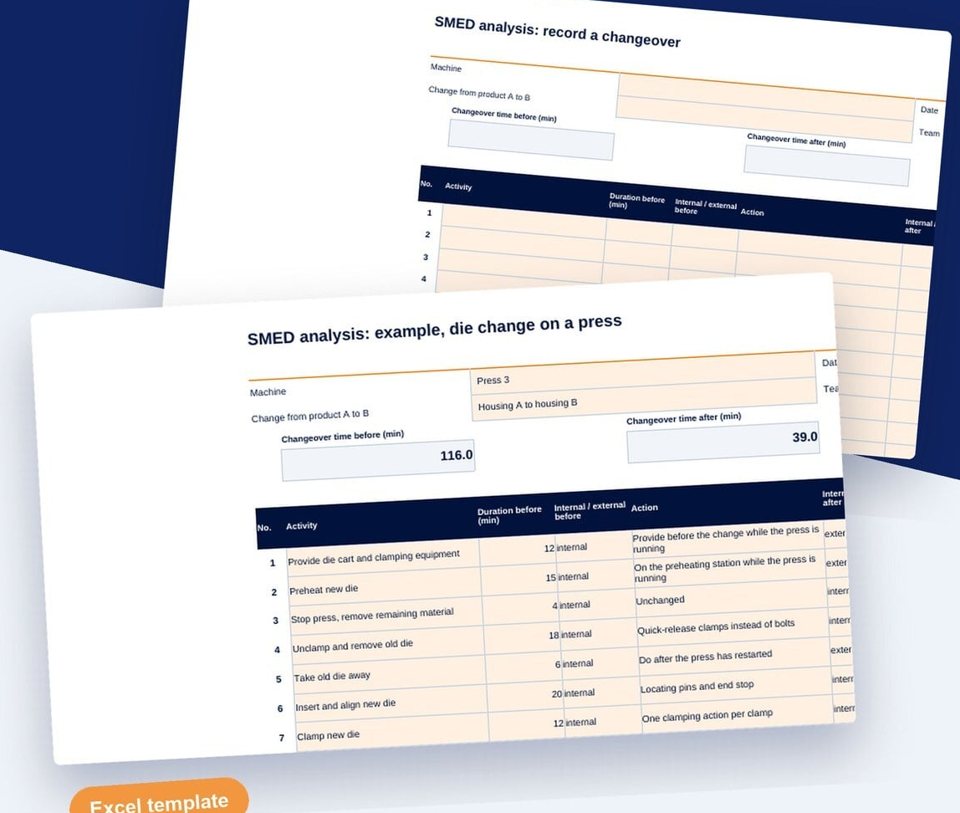
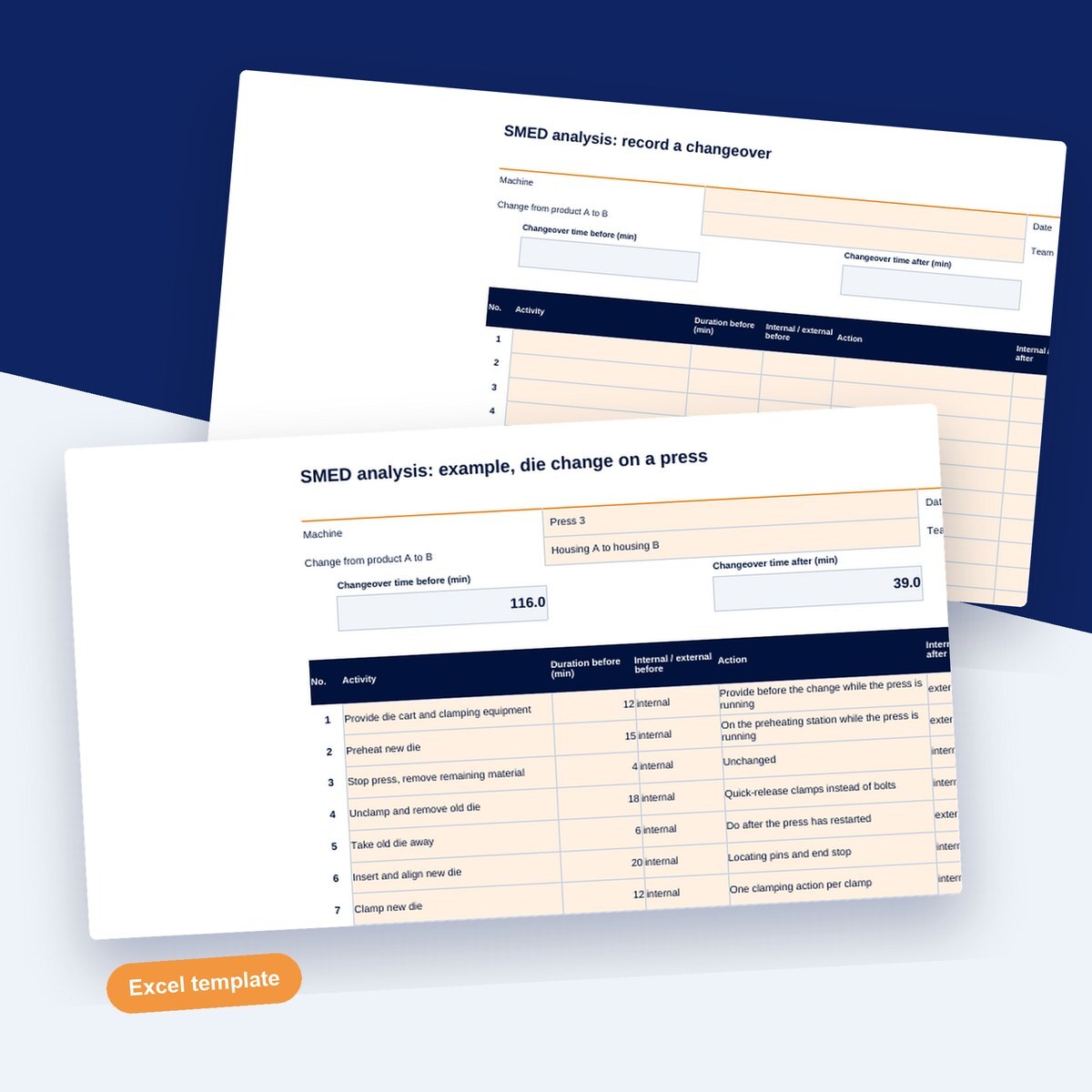
Download · Excel
SMED Analysis Template
Use this template to break a changeover down into steps and see which ones actually stop the machine.
What is inside
Recording of every changeover step with duration and owner
Classification as internal or external, plus the action for each step
Time before and after, with the saving per changeover and per year by formula