




Contents
What is pull control?
Pull control is a production principle in which every process step only starts work when a downstream step signals real consumption. Nothing is produced "just in case" based on a forecast. Nothing moves forward until the next station is ready to take it. The customer order at the end of the value stream is the only legitimate trigger for activity upstream, propagated station by station through physical signals, Kanban cards or digital equivalents.
The principle sounds simple and is brutal in its implications. A pull system exposes every weakness in the process: unreliable equipment, variable cycle times, poor quality, long changeovers. That is not a bug, it is the point. Toyota built the Toyota Production System on pull precisely because push systems hide those problems behind inventory buffers.
In the Lean literature, pull is one of the five Lean principles defined by Womack and Jones (Value, Value Stream, Flow, Pull, Perfection). In ISO 22400, the related KPIs are on-time delivery, inventory turns and work-in-process. On a factory floor, it is a Kanban card, a coloured bin, or a digital signal that says "produce one more, now".
Push vs. pull: the defining difference
The clearest way to understand pull is to compare it side-by-side with the push logic that still dominates most ERP-driven plants. The two operating models produce very different plant behaviour even when the equipment is identical.
| Dimension | Push system | Pull system |
|---|---|---|
| Trigger | Forecast, MRP run, schedule | Downstream consumption signal |
| Inventory strategy | Safety stock to cover forecast error | Capped supermarket at each step |
| Response to a problem | Keep producing, inventory hides it | System stops, problem becomes visible |
| Typical lead time | Long, driven by queue time | Short, driven by cycle time |
| Behavioural effect | Keep machines busy | Produce only what is needed |
| Tolerance for disruption | High, absorbed by WIP | Low, forces root-cause fixes |
The practical consequence is that pull works best in environments where demand is reasonably stable, product variants are controllable and quality is reliable. In genuinely chaotic demand or low-reliability processes, a naive pull rollout will either starve the line or collapse into a push system wearing a Kanban costume.
The building blocks of a real pull system
"We do pull" often means very different things in different plants. A rigorous pull system contains a specific set of mechanisms, each doing a distinct job. Missing any of them turns pull from a discipline into a slogan.
| Element | What it does | Typical tool |
|---|---|---|
| Takt | Converts demand rate into the beat of the line | Takt-time calculation, visual Andon |
| Supermarket | Capped buffer between processes that absorbs short-term variation | Defined racks, min/max levels, SAP/MES inventory |
| Kanban signal | Authorises the upstream step to produce or move material | Physical card, e-Kanban, MES pull signal |
| Pacemaker process | Single scheduling point that sets the rhythm of the entire value stream | Usually last process before shipping |
| Heijunka | Levels the product mix so pull signals arrive in a predictable pattern | Heijunka box, sequencer |
| FIFO lane | Sequenced buffer where supermarkets don't fit (low-volume variants) | Marked lane with a capacity limit |
| Quick changeover | Makes small-lot production economical | SMED |
Pull, JIT and Kanban: how the terms relate
The three terms are often used as synonyms. They are not.
| Term | What it is | Scope |
|---|---|---|
| Pull control | Principle: produce only on downstream demand | The why |
| Just-in-Time (JIT) | Delivery strategy: right part, right quantity, right moment | The what |
| Kanban | Mechanism: cards or signals that carry the pull instruction | The how |
You can have JIT without strict pull (scheduled sequencing can also deliver parts on time), and you can use Kanban boards for non-pull applications (software teams do it routinely). But if you want a true Toyota-style pull system, you need all three, reinforcing each other.
When pull works — and when it doesn't
Pull is not a universal operating model. The pattern is clear: pull delivers spectacular results in the conditions it was designed for, and fails quietly in others.
| Condition | Pull works well | Pull struggles |
|---|---|---|
| Demand pattern | Repeating, levellable, medium-to-high volume | One-off, highly seasonal, extreme variance |
| Product variety | Finite variant family (tens to hundreds) | Pure project business, thousands of rare SKUs |
| Process reliability | Stable quality, predictable cycle time | Frequent unplanned stoppages, high scrap |
| Changeover time | Short enough to run small lots | Multi-hour setups that force big lots |
| Supply chain | Reliable, short lead times from suppliers | Volatile sourcing, allocation markets |
In practice, most mid-sized manufacturers are a mixed case: some value streams are perfect pull candidates, others belong on a classical MRP/push schedule. Recognising the difference is the job; applying pull as a blanket policy almost always backfires.
How an MES makes pull actually run
Paper Kanban was the original Toyota innovation, and for stable, collocated plants it still works. But as soon as you have multi-site production, digital ERP integration, or even moderate product complexity, paper cards become the bottleneck. A pull loop also holds only as long as the process behind it is reliable and its cycle times, stop reasons and changeover times are known. An MES supplies that data layer.
| What a pull loop depends on | What SYMESTIC provides |
|---|---|
| Known, current cycle times | Cycle time per machine, last and average, from the connected machine. |
| Few unexplained stops upstream | Stops recognised automatically, even where the machine sends no stop signal; reasons recorded and analysed by machine, order and shift. |
| Changeovers short enough for small lots | Changeover as its own stop reason on the downtime timeline, analysable by machine, order and shift. |
| Order status at the pacemaker | Live order status and current operation; orders imported from the ERP or created directly in SYMESTIC. |
| A fast reaction when a loop is starved | Alarms by push or e-mail when a freely defined condition is met, for example a machine stop. |
| A link to ERP orders and master data | Documented REST API and webhooks; SAP, InforCOM, Microsoft Dynamics NAV and Microsoft Business Central are connected. |
The Kanban signal itself (card, bin, board or e-Kanban) is not part of this list. It stays in the ERP, in a dedicated Kanban tool or on the shop floor; the MES shows whether the process feeding the loop can deliver. To see these data for your own machines, book a live demo on your own use case.
FAQ
Is pull the same as Just-in-Time?
No. JIT describes the delivery outcome — right part, right quantity, right moment. Pull is the mechanism most commonly used to achieve JIT, where downstream consumption authorises upstream production. You can deliver JIT through tight sequencing without a formal pull loop, and you can run a pull loop that is not strictly JIT (for example, supermarket-based pull with safety stock). In Toyota's original design, the two are deliberately combined, which is why they are often confused.
Does pull control require Kanban cards?
No. Kanban is the best-known mechanism but not the only one. Other valid pull signals include CONWIP (constant work-in-process) limits, polca (paired-cell overlapping loops of cards with authorisation), reorder-point replenishment, two-bin systems and digital e-Kanban. The cards themselves are irrelevant; what matters is that no upstream work starts without an explicit downstream signal, and that work-in-process is capped.
Can we run pull if our demand is unpredictable?
Only with heavy adaptation. Classical pull assumes that demand can be levelled (Heijunka) into a repeating pattern. If 80 % of your demand is repeating and 20 % is one-off, run pull on the 80 % and keep the 20 % on a classical schedule. If the ratio is inverted, pull will force you to either carry large safety stocks (defeating the purpose) or starve the line. In that case, invest first in SMED and flexibility, not in Kanban boards.
How does pull control interact with ERP?
ERP still owns master data, demand planning, customer orders, BOM and costing. Pull operates at the shop-floor execution layer, below the ERP scheduling horizon. The clean architecture, per ISA-95, is: ERP sets the forecast and master schedule, the MES converts real consumption into pull signals, and the ERP receives backflush data from the MES. Where companies fail is when they try to run pull through ERP MRP runs directly — MRP is a push planning engine by design, and bolting pull onto it creates nervous signals and instability.
What is the first sign that a pull system is failing?
Rising WIP inside the capped loops. In a healthy pull system, WIP stays at or below the designed limits, with visible empty spaces in the supermarkets. When WIP silently climbs — extra cards appear "temporarily", bins overflow, informal buffers emerge near the pacemaker — pull has collapsed into push with extra paperwork. The second warning sign is cards being overridden by supervisors under shipment pressure. Both are symptoms of an underlying reliability or changeover problem, not of a broken pull concept.
Related: Kanban · Just-in-Time · Takt Time · Heijunka · Lean Production · SMED · Cycle Time
ExcelFree download
Kanban Cards and Kamishibai Board
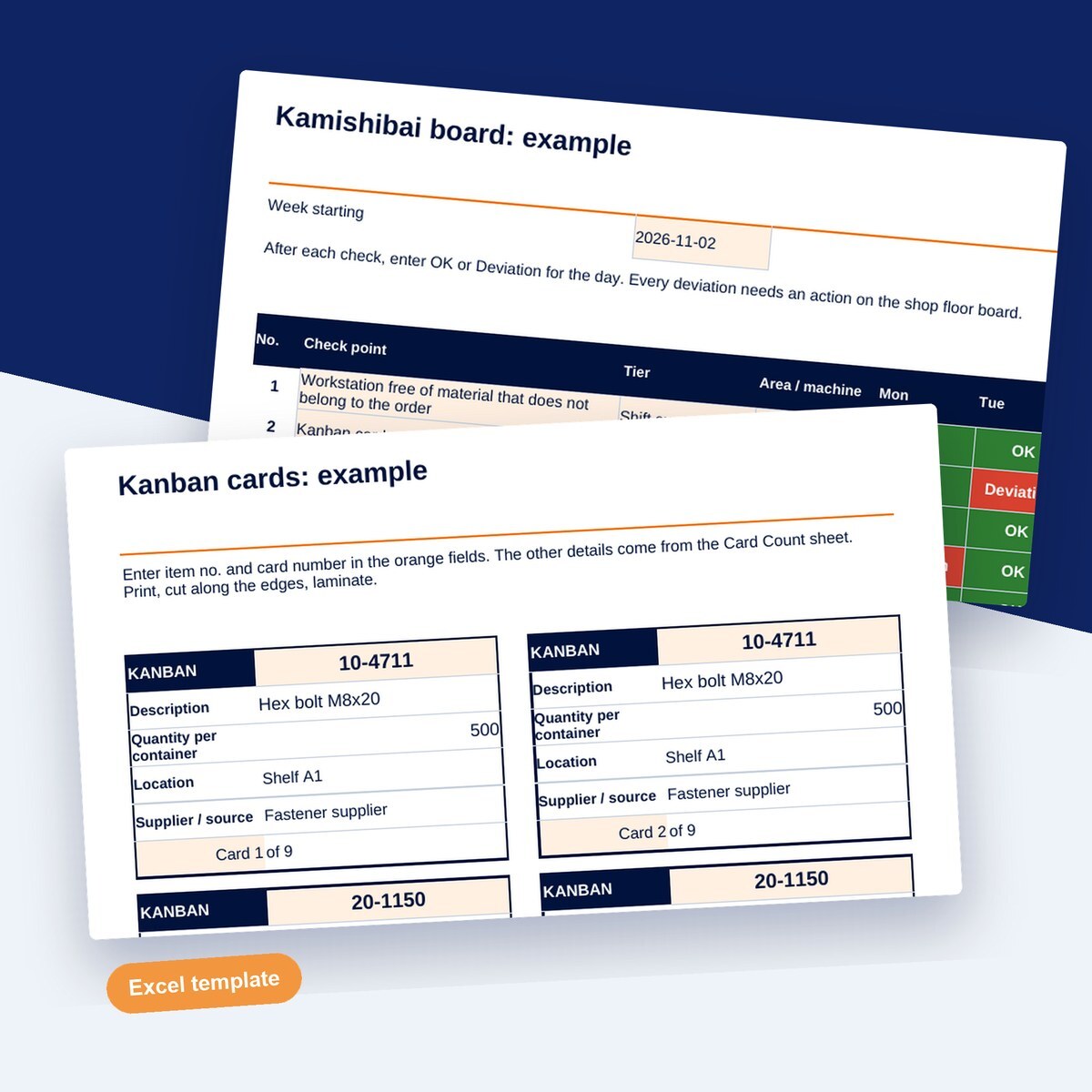
Use this template to calculate the number of kanban cards per item and print the cards and a kamishibai board.
- Number of cards per item from demand, replenishment lead time, safety factor and container quantity
- Kanban cards to print, eight per A4 page, filled from the item list
- Kamishibai board with check points, tiers and a weekly view
Excel
Kanban Cards and Kamishibai Board
- Number of cards per item from demand, replenishment lead time, safety factor and container quantity
- Kanban cards to print, eight per A4 page, filled from the item list
- Kamishibai board with check points, tiers and a weekly view

Six Sigma Black Belt with more than 25 years in manufacturing, previously at Johnson Controls, Visteon, iTAC and Dürr.
Book: „OEE: Eine Zahl, viele Lügen“ (2025)
- Manufacturing Execution Systems (MES)
- OEE
- Shopfloor Digitalization
- Six Sigma (Black Belt)
Updated
All articles by Christian Fieg